

Dealer’s Choice Poker
Dealer’s Choice is a popular format for home poker games. Although money is involved, dealer’s choice games are often played mainly for entertainment rather than for profit. The essence of the game is that on each deal a different poker variant, chosen by the dealer, is played. Please refer to the page giving general rules of poker for poker basics. This page covers only the specifics of the Dealer’s Choice game.
Players and Cards
Dealer’s Choice works best with 5 to 7 players, the ideal number being six. With more players, the range of playable variants is restricted; with fewer many of the variants become uninteresting.A standard 52-card pack without jokers is used. As in any poker game, it is best to have two packs with different coloured backs, so that one can be shuffled ready for the next hand while the other is being dealt. This reduces the amount of down time between deals.The ante and betting limits should be agreed among the players, and all players should buy at least an agreed minimum amount of chips – say 50 times the minimum bet – or if using cash for betting (less convenient) should bring at least this amount to the table.
The Deal
The first dealer is chosen by some random process, such as dealing cards clockwise face up until a jack appears. With one exception, mentioned later, players take turns to deal, in clockwise order around the table.Before beginning to deal, the dealer chooses and announces what poker variant will be played. The main requirement is that the dealer should be able to explain the game clearly and concisely, remembering to deal with any options or special rules that may be needed. Most groups that meet regularly establish a range of variants that they like to play. These known games, and slight modifications of them, can be chosen without fuss. But since the variety of games played provides part of the entertainment, most groups will be willing to try unfamiliar variants occasionally, and dealers sometimes introduce their own inventions, hopefully having carefully thought them through in advance to be sure that they will work.To help the game run smoothly, players should try to decide in advance what variant they are going to call when it is next their turn to deal. Then they can specify the game without hesitation and the game can continue without delay.If any problems occur, such as ambiguities in the rules, or mistakes in the deal or sequence of play, it is the dealer’s reponsibility to fix them in a way that is fair to all players. The principle that once significant action has occurred the game must continue applies here as in other poker games. Once two or more players have had a turn to bet, throwing in the cards and starting again is not an option – the problem must be solved in a way that allows the deal to be played out.
Multi Deal Variants
There are some variants that inherently last for more than one deal. For example they may be designed to continue until the pot is emptied, which may take several deals. In many cases, it would be unfair for the player who called the game to keep dealing, because the dealer often has a positional advantage. So the turn to deal should pass to the left until the variant is completed. It then returns to the player to the left of the one who called the multi-deal variant, who calls and deals the next variant.
The Games
There is an ulmost unlimited range of variants to choose from. A selection of them will be found listed on the poker variants page. Stud poker games with various enhancements seem to be among the most successful, but there are also draw and shared card games that work well. In addition, it is quite common to allow games that are not strictly forms of poker – not only games like Badugi, which uses different hand types, and Guts, which uses a different form of betting, but also games like 7-27, Bourré and Acey Deucey which have nothing much to do with poker, apart from being gambling games suitable for a similar number of players.
Example
Here is a link to a comprehensive set of rules for a particular version of Dealer’s Choice Poker, contributed by Arthur Buderick.
H.O.R.S.E.
- Introduction
- H.O.R.S.E
- C.H.O.R.S.E and C.H.O.R.S.E.L
- R.O.E., H.O.E, H.O.S.E, S.H.O.E.
- Eight Game Mix
Introduction
The games described on this page are mixed poker games in which several different poker variants are played in a fixed sequence. They could be thought of as equivalent to the pentathlon in athletics: success requires skill and experience in all the variants included. To ensure fairness, a complete round of each game is played, every player having one chance to deal (or to have the dealer button) before the table moves on to the next game in the sequence. The names of the games are acronyms indicating which variants are played and in what order.
These formats are commonly used for tournaments, both face to face and on line. Unlike the home game of dealer’s choice, once the game has begun the players have no choice about which variants to play and in what order.
H.O.R.S.E
The most famous of these mixed games is H.O.R.S.E in which the five games are:
Normally these are all played as limit games. The two shared card games Hold’em and Omaha are played with blinds and the three stud games with antes and a compulsory bring-in bet as usual.
If there are more than seven players at the table, the last player(s) in order (the dealer and if necessary the player to dealer’s right) sit out for the seven-card stud games, to avoid the possibility that the deck will run out. Since a complete round of each variant is played, everyone at the table will sit out the same number of hands during these rounds.
An alternative format is sometimes used in casinos, in which the game is changed every 30 minutes when a new house dealer comes to the table.
C.H.O.R.S.E and C.H.O.R.S.E.L
These games are similar to H.O.R.S.E. but with the addition of one or two extra variants. The C stands for Crazy Pineapple and the L for Lowball, which in this case is California or Ace-to-Five Lowball.
R.O.E., H.O.E, H.O.S.E, S.H.O.E.
These are shorter (or more quickly cycling) games similar to H.O.R.S.E but involving only three or four of the variants.
Eight Game Mix
This version was introduced in 2008 and was offered as event 2 in the 2010 World Series of Poker, and is also available online at Pokerstars. It is sometimes known as T.H.O.R.S.E.H.A. and consists of eight variants played in the following sequence:
- Limit 2-7 Triple Draw
- Limit Texas Hold ’em
- Limit Omaha High-Low 8 or better
- Limit Razz
- Limit Seven-card Stud
- Limit Seven card Stud Hi-Lo Eight or better
- No limit Texas Hold’em
- Pot limit Omaha High (PLO)
Chicago, Follow the Queen, The Bitch and Black Mariah
In most of these seven card stud poker variants, a special role is played by the spades, the queens or the queen of spades.
Chicago
This poker variant, also known as High Chicago, is a seven card stud game in which the pot is split between the highest hand and the highest spade in the hole. Face up spades do not count, so for example if the ace of spades is dealt face up, the king of spades in the hole is sure to win half the pot.
The cards are dealt as in seven card stud: two cards face down, four cards face up and the last card face down. There are five betting rounds: one after each round of face up cards and one after the final card. Each betting round is begun by the player with the highest hand showing.
After the final betting round the active players declare whether they are going for highest (face down) spade, highest hand or both. A player declaring both wins only if holding both the highest spade and the highest hand. Declaration can be either in sequence, starting to the left of the dealer, or simultaneous, using chips.
You must have a spade face down to be eligible to win the spade half of the pot. Without this, you cannot declare spade and win, even if all the other players are going for high.
Variants
In Low Chicago the pot is split between the lowest spade (ace counting high) and the highest hand (it is not a low poker game). Similar games can of course be played using any suit: for example in High or Low San Francisco the high hand splits the pot with the highest or lowest heart.
Follow the Queen
This is seven card stud in which when a queen is dealt face up, the next card dealt face up and the other three cards of the same rank become wild for all players. For example a player gets the Q face up and the next player is dealt the 7 face up: all sevens are now wild. If another queen is dealt face up, the previous wild card is cancelled, and the face up card following the new queen becomes wild instead. If the last face up card dealt is a queen, there are no wild cards. In the showdown the highest hand wins.
Variants
Some play that all queens in the hole are wild. In this version there can be as many as seven wild cards in play: three concealed queens and four wild cards created by an exposed queen.
Some play that if no queens are dealt face up, no one wins and there is a new deal, played for the same pot, involving only the players who did not fold on the deal without a face up queen.
Some play that if the last card dealt face up is a queen., the dealer deals one further card face up. This card belongs to no one, but the other three cards of the same rank are wild.
In Arthur Buderick’s version all queens are wild. Also a player who is dealt is dealt a wild card on the board (i.e. face up) or has a card on the board that is made wild must pay an extra ante to the pot, or two antes if dealt a queen.
Dirty Schultz
This is similar to Follow the Queen, except that the event that causes the next card to become wild is the appearance of a natural pair among any player’s face up cards.
So whenever a card is dealt face up that is the same rank as another face up card held by that player, the next card that is dealt becomes wild (as do all cards that are equal to it), and the previous wild card (if any) ceases to be wild. If the very last face up card that is dealt creates a pair, then there nothing at all is wild.
Two details need to be clarified before playing this variant:
- What happens if a player who has a wild card face up is dealt a second (equal) wild card face up? My suggestion: these cards are equal so they count as a pair, and the next card dealt will change the wild card.
- What happens if a player who already has a natural pair is dealt a third equal card face up? My suggestion: this is not a new pair, so the wild card does not change. However, if a player has 5, 8 face up and 5’s are currently wild, and the player is then dealt a second 8 face up, this pair of 8’s is a new natural pair, and the next card dealt changes the wild card.
Variants
Some play that after a pair is dealt, the next card is immediately dealt face up to the centre of the table. This centre card belongs to no one, but all cards of the same rank as it are wild. Whenever a new pair appears, another card is dealt to the centre on top of the previous one, and this will normally change the wild card. In this version, a wild card is dealt to the centre even if the very last card dealt face up to a player is wild – so there will always be a wild card if any player has a pair showing.
Some play that each player’s seventh card is dealt face up, unless the player pays a fixed price to the pot to have the seventh card dealt face down. By buying a face down card at the end you avoid the risk of changing the wild card if it pairs one of your face up cards, and also gain the advantage of having three rather than two cards concealed from the other players.
The Bitch
The Bitch in this seven card stud variant is the queen of spades. If the queen of spades is dealt face up, the deal and betting immediately stop, all the cards are thrown in and shuffled, and there is a new deal involving only those players who had not folded when the queen of spades appeared.
In the showdown the player with the highest hand splits the pot with the player who has the queen of spades in the hole (if any). If the queen of spades was not dealt at all the high hand wins the whole pot.
Variants
Some play that the queen of spades in the hole is wild. In this case the pot is not split.
Black Mariah
This name is used for at least four different variants.
- Often, Black Mariah is used as an alternative name for The Bitch.
- Some play Black Mariah as a variant of Follow the Queen in which if the Q is dealt face up, the play immediately ends, as in The Bitch.
- Some play Black Mariah as a seven card stud variant in which you must have the best hand and the highest spade to win the pot. The high spade can be any of your seven cards, not necessarily face down. If the best hand and the highest spade in the showdown are held by different players, or if no one has any spades, no one wins and the pot remains for the new deal, in which only the players who were in the showdown take part.
- Sometimes Black Mariah is used as an alternative name for High Chicago.
Guts
- Introduction
- Two-card Guts – Players, Cards and Limits – Deal and Declaration – Showdown – Payments
- Variations – Simultaneous Declare – Single Loser, Ante on All Deals – Kitty or Ghost – Three-card Guts
- Games with a second deal: Two Plus One – Four-Two-Two – Four-Two-Three
- Three stage games: Three Five Seven – Napalm
Introduction
Guts is often played as an option in dealer’s choice poker games, although it is not strictly speaking a poker game. It is normally played with hands of fewer than five cards, and it has a different betting mechanism from normal poker – match pot betting. If the players are somewhat reckless the size of the pot can escalate very rapidly, and the name presumably refers to the bravery required to contest one of these large pots and risk losing an equally large amount.
Two-card Guts
Players, Cards and Limits
This is the basic game. A standard 52-card pack without jokers is used. In theory as many as 26 people could play, but the game probably works best for around 5 to 10 players.
The players need to agree in advance on the ante that all will pay at the beginning to start the pot, and it is wise also to agree on a maximum amount that can be won from or lost to the pot in a single deal. This might for example be set at 100 times the ante.
Deal and Declaration
If the pot is empty all players pay the agreed ante to the pot. The cards are shuffled and cut and the dealer deals the cards one at a time face down until every player has two cards. The players look at their cards.
Starting with the player to dealer’s left and continuing clockwise around the table, ending with the dealer, each player in turn says either “in” or “out”.
Players who say “out” cannot win the pot, but do not lose any extra money.
Showdown
If more than one player says “in”, all those who are “in” show their cards, and the player with the best cards wins the pot. When comparing hands, aces are high and
- any pair of equal cards beats any two unequal cards,
- a higher pair beats a lower pair,
- between two non-pair hands, the hand with the highest card wins,
- if two hands have equal highest cards, the hand whose other card is higher wins.
Therefore the highest hand is A-A, then K-K, Q-Q, etc. down to 2-2, then A-K, A-Q, A-J, … , A-2, K-Q, K-J, … ,K-2, Q-J, … down to the lowest hand 3-2.
Payments
Players who said “in” but do not have the highest hand must each pay an amount equal to the whole pot, and these payments form the pot for the next deal.
If two or more players tie for best hand, they share the pot equally.
If just one player says “in” and all the others say “out”, the player who is “in” simply takes the whole pot and does not need to show any cards. The pot will also be emptied if there is a tie between all the players who stay in. This may end the game, if it is being played as an option in dealer’s choice. If the game is to continue, the players will need to place a new ante.
Note that if all the players other than the dealer say “out”, the dealer will automatically say “in” and collect the pot, irrespective of how good or bad his or her cards may be.
If after the losers have paid, the amount in the pot exceeds the agreed limit, the excess chips are set aside in a reserve. The pot to be played for in subsequent deals will be equal to the limit, and if it is won, chips are brought out of the reserve to form a new pot. Example: there is 80 in the pot and the limit is 100. Four people stay in. The winner takes the 80, the three losers each pay 80, and there is now 100 in the pot and 140 in reserve. If this pot is won without a contest there will be 100 in the pot and 40 in reserve. If this too is won without a contest there will be 40 in the pot and no reserve.
Variations
Simultaneous Declare
Some play a version in which all players declare simultaneously whether they are in or out. This is sometimes done by the players holding their cards face down over the table, and the dealer calling “1 – 2 – 3 – DROP”. On the word “DROP” all those who want to be out must drop their cards, and the others are in.
The dropping method has the disadvantage that some players might be tempted to try to delay for a split second to see what the others will do. Therefore it is probably better to declare using chips. Each player holds out a closed fist, when all are ready, everyone opens their fist, and those holding a chip are in while those with empty hands are out.
If everyone is out, the pot stays for the next hand and some play that all players must contribute another ante to it. Some play the wimp rule that in this case the cards are shown and the player with the best hand must ante on behalf of all players.
The game with simultaneous declare has less tactical scope than the game declared in sequence. There is no point in bluffing – players simply stay in if their cards are good and drop otherwise.
In the game with simultaneous declare, some play that after the deal, before the declaratrions, each player may discard one or both cards and is dealt replacements.
Compulsory First Round
Some play that on the first deal of a session or when the pot was emptied on the previous deal, all players must stay in. That almost guarantees that there will be some losers and helps build the pot for subsequent deals.
Single Loser, Ante on all Deals
Some play that if more than one person stays in, only the player with the worst hand must match the pot. If two or more players tie for worst they must both or all match it. In this version, players ante on every deal, adding their ante to the pot. Only a player who had to match the pot is excused from placing an ante on the following deal.
No Split Pots
Some play that in case of a tie between two or more players for best hand, the tied players neither receive not pay anything. The pot remains for the next deal, augmented by the payments of any losing players.
Kitty or Ghost
Some players find it unsatisfactory that when only one player stays in, that player simply takes the pot without a contest. They play a version in which an extra hand known as the kitty or ghost is dealt. This hand belongs to no one, but is exposed in the final showdown. To win the pot you have to beat the ghost as well as the other players. If the ghost wins, everyone who stayed in must match the pot. In this version, sometimes everyone drops out, in which case all must add an ante to the pot for the next deal.
There is another version in which the ghost only plays when just one person stays in. If two or more players stay in, they play only against each other.
The presence of a ghost hand that always plays makes it unprofitable to bluff, so players will stay in only with a better than average hand, which makes the game tactically less interesting than the version with no ghost.
Three-Card Guts
Each player is dealt three cards rather than two. The betting procedure is the same as in two-card guts, but with three cards most people play that 3-card straights and 3-card flushes count. The ranking of hands from high to low is usually:
- three of a kind; straight flush; straight; flush; pair; nothing
but some groups rank a straight flush above three of a kind or a flush above a straight so this should be checked and agreed before playing.
Some play that after the deal and before the declaration, all players pass one card face down to the left. Players must decide what card to pass before seeing what they have received.
Any of the variants listed above for two-card guts can also apply to the three-card game. For example players may be allowed to discard one, two or all three cards and have them replaced before declaring.
Games with a second deal after the declare
Two plus One
Each player is dealt two cards, players declare in or out, and those who are in receive a third card. Hands rank as in Three-card Guts.
Some require those who stay in for a third card to pay an extra ante and take part in a second round of declaring in or out when they have three cards. So players who stay in for a third card but drop out when they have seen it lose this extra ante but do not risk having to match the pot.
Four-Two-Two
Brian Johnson describes a variant in which players are initially dealt 4 cards face-down. Twos are wild. Players declare simultaneously by holding a coin in their closed fist if they are playing. Players who are in receive 2 more cards face up, so that each player has 6 cards, and whoever can make the best 5-card poker hand wins. All players who stay in and lose match the pot. Usually a maximum loss per deal is agreed, say $5.00, and if the pot contains more than this, losers only pay the maximum.
The game ends when one person stays in by themselves, winning the whole pot.
Four-Two-Three
In this variant of 4-2-2,also contributed by Brian Johnson, after the declaration, instead of dealing two cards face up to each player, the dealer deals three common cards face up, and players form their best 5-cvard poker hand from the 7 available cards – the 4 that were dealt to them and the 3 on the table.
Variants of 4-2-2 or 4-2-3
- Players who dropped out must pay a new ante while losers who stayed in match the pot.
- If no one “plays” (no coin in hand), the holder of the best hand of all non-players matches the pot, as do all non-players who held a 2 (twos being wild).
- If one person stays by themselves, their 4 cards play against the deck’s top 4 cards. If the player wins, the game is over: if the deck wins, the player matches the pot,
Three-Stage Games
In these games the deal is in three stages. At each stage players declare in or out, but players who declare out keep their cards and may still compete in subsequent stages.
Three Five Seven
This game is played in three stages, with three-card, five-card and seven-card hands. At each stage, if more than one player stays in the highest of them wins from the others, but if only one player stays in, the player scores a point (sometimes known as a leg, and represented by a token of some sort) towards winning the pot. The game continues until someone collects three legs and wins the pot.
Stage One. All players ante and three cards are dealt face down to each player. Players then declare whether they are in or out. Declarations can be in sequence or simultaneous, as agreed in advance by the players – or in dealer’s choice as specified in advance by the dealer.
- If no one stays in, nothing happens and the game proceeds to stage two.
- If just one player stays in that player scores a point (takes a token) and play proceeds to the stage two.
- If two or more players stay in, those players look at each other’s cards – passing them to each other face down without showing them to the players who are out – and determine who has the best hand. Triplets beat pairs, which beat unmatched cards; there are no straights or flushes; threes are wild. Players who stayed in but did not have the best hand must pay an amount equal to what is in the pot to the winner. If several hands tie for best, then losers must pay this amount to all winners. No chips are added to or paid out of the pot.
Stage Two. Now all players, including those who didn’t stay in in the first stage, are dealt two more cards face down. Everyone declares again. As before if no one stayed in nothing happens, and if one player stayed in that player gets a token. If two or more stayed in, the best five-card poker hand wins, using normal poker ranking and with fives wild instead of threes. Players who stayed in look privately at each others hand and the loser(s) pay the winner(s) as before.
Stage Three. All the players are dealt two more cards face down, and there is a third round of declarations. If no one stays in all cards are thrown and there is a new ante and deal. If just one player stays in that player gets a token before the cards are thrown in. If two or more stay in, they show their hands and the winner is the holder of the best five-card poker hand (using any five cards of the seven), with sevens as the only wild cards. The winner is paid by the losers who stayed in as before.
If no one has three tokens yet, everyone keeps the tokens they have, all cards are thrown in, everyone adds another ante to the pot, and the cards are shuffled and dealt by the next dealer, beginning with three cards as before.
As soon as any player collects a third token, whether on a three-card, a five-card or a seven-card hand, that player collects the whole pot and the game is over.
Napalm
A similar game, know as Napalm or Whipsaw, in which the stages are two cards played for high, five cards played for low, and seven cards played for high, is described on a separate page.
Stud Poker Variants: Baseball, No Peek and others
- Baseball – variants
- No Peek – variants – Mexican Sweat
- Night Baseball – variants
- The Good, the Bad and the Ugly
- Sequence
- Second Hand High
- Jack the Shifter
Baseball
Baseball is a popular home poker variant based on seven card stud. All threes and nines are wild and fours give the player an extra card. The numbers are chosen because of their significance in the American sport – three strikes, three outs, nine innings, four balls for a walk. Because of the extra cards dealt after fours, this game cannot be played by more than six people without the risk of running out of cards.
The deal is as in seven card stud: two cards face down, four face up and the last face down. There are five betting rounds, one after each round of face up cards and one after the final card is dealt. Each betting round is begun by the player with the highest hand showing at the time. If the cards run out in a seven-player game, it will be necessary to deal the last card as a face up community card instead of dealing a down-card to each player.
In the showdown the highest five-card poker hand wins. All threes and nines are wild and can be used as any card not already present in the player’s hand, or as a fifth card of any rank to make five of a kind, which is the highest hand type – see also poker ranking with wild cards.
If a player is dealt a four face up, the player is immediately dealt an extra face up card before the next player receives a card. Such players will have eight, nine or more cards at the showdown.
Variants
Some play that a player who is dealt a three face up must immediately either match the pot or fold. Some only require a fixed payment to the pot as an alternative to folding.
Some play that face down fours also entitle the player to an extra card. Practice varies as to when the player should reveal the four and claim the extra card, and whether the extra card is dealt face up or face down. Possible rules for claiming extra cards for face down fours are:
- the four must be revealed as soon as it is dealt, and the extra card is dealt immediately;
- any concealed fours are revealed in clockwise order and extra cards given immediately before the next betting round;
- concealed fours may be revealed whenever the holder wishes, and an extra card is given as soon as the four is revealed.
Some play that the extra card given when a four appears must be paid for. The price may be a fixed amount paid to the pot or may vary according to whether the extra card is face up or face down, and how late in the game it is dealt.
The wild cards and the card which entitles the player to an extra card can of course be varied. Examples include:FootballThrees and Sixes are wild and you get an extra card for a two.WoolworthFives and Tens are wild and some play that you get an extra card for a two. Arthur Buderick describes a version in which players must pay $1 to the pot for each 10 or 5 they recieve face up, but with no extra cards dealt.
No Peek
The dealer deals seven cards face down to each player. Players must not look at their cards.
The player to dealer’s left flips his or her first card face up, and starts the first betting round.
The next active player in clockwise order then flips up cards until showing a hand that beats the first player’s card, and then begins a second betting round. For example if the first player flipped a 9 and the second player a jack, the second betting round starts immediately. If the first player flips a 9 and the second player a 5, the second player must flip another card. Suppose it is a seven. 7-5 still does not beat the 9 so a third card must be flipped. If this is another 5, the second player now has a pair, which beats the 9, so the second betting round starts.
This continues clockwise around the table. At your turn, if you have not folded, you must flip cards until you have the best poker hand showing, and then begin a new betting round. If you flip all seven of your cards and still do not have the highest hand showing you must drop out: there is no betting round and the turn passes to the next active player.
This continues until all cards are face up or there is only one player left in. The highest hand wins the pot.
When comparing hands, any kicker beats a missing card, so for example 7-3 beats a 7 by itself. Flushes and straights must have five cards to count. See poker ranking – incomplete hands for details.
Variants
Some begin by turning up a card from a second deck. The player to dealer’s left must start by flipping cards until able to beat this card, before beginning the first round of betting.
Some play with back betting. When a player flips all seven cards without beating the best hand, and is thereby knocked out, there is a round of betting begun by the best hand showing before the next player begins flipping cards.
Mexican Sweat
In this variant of No Peek, seven cards are dealt to each player and one face up in the middle of the table. The first player must beat this face up card before the first betting round begins.
If any player flips one of the three cards of the same rank as the face up card in the middle, that player must immediately fold. By prior agreement there may or may not be a betting round before the next player starts flipping cards.
Night Baseball
This game, also known as Midnight Baseball or No Peek Baseball, is a combination of Baseball and No Peek.
The deal and the procedure for flipping cards are the same as in No Peek, but as in Baseball, all threes and nines are wild.
Any player who flips a four is immediately dealt an extra card face down from the deck.
Variants
All Baseball and No Peek variants can be used here too. For example players may have to pay or fold when flipping a three. They may have to pay for the extra card dealt when a four appears. The first player may have to beat a card truned up from another deck before the first betting round. “Back betting” may or may not be included.
The Good, The Bad, and The Ugly
The deal and betting are the same as in seven-card stud, with the following modifications.
After the initial deal of two down cards and one up card to each player, three cards are dealt face down to the table.
After the fourth card is dealt to each player, the dealer turns one of the table cards face up. This is The Good: all players’ cards which are the same rank as this card are wild.
After the fifth card is dealt, the second table card is turned face up. This is The Bad: all cards of the same rank as this card must be discarded.
After the sixth card is dealt, the final table card is turned face up. This is The Ugly: anyone who has an up card of the same rank as The Ugly must immediately fold.
After the seventh card is dealt, the final betting round and showdown take place as usual. Note that the three face up cards on the table are not shared (community) cards – they cannot be used by players to complete their hands.
Sequence
The deal and betting are same as in seven-card stud.
- If a two is dealt as a face-up card, all twos become wild.
- If a three is dealt face up when twos are wild, twos cease to be wild and threes become wild instead.
- If a four is dealt face up while threes are wild, threes cease to be wild and fours become wild instead.
- And so on…
Note that for the wild card to be created and changed, the upcards must appear in increasing order, starting with the two. If a three is dealt face up before a two appears, there is no wild card yet. If a two appears subsequently, twos are wild, not threes, despite the presence of the previously dealt three. The wild cards do not have to be consecutive: if the upcards are 6, 2, Q, 5, 3, 9, 4, A in that order, 4’s are wild.
At the showdown, the high hand wins the pot.
Alternatively, the game can be played high/low with declaration.
Second Hand High
The deal and betting are the same as in seven-card stud, but if there is a showdown, the second highest hand wins.
If all but one player fold, the surviving player wins as usual.
The Game Report site, which described this variant, did not specify how to deal with ties. I suggest that if there is a tie for first place, none of those equal hands wins but the next highest hand takes the pot. If there is a tie for second place, the equal hands should split the pot.
Jack the Shifter
For this game to work, the group must have an agreed list of seven-card stud games that they normally play. The game begins as ordinary seven-card stud played for high, but whenever a jack is dealt as an upcard, the player who receives the jack can change the game to any seven-card stud game on the agreed list.
An explicit or implicit agreement on the list of allowable games is needed to prevent a player who receives a jack inventing a new game on the fly to favour the particular hole cards he has been dealt.
In addition, a player who is dealt a face-down jack may reveal it at any time before the final round of betting and name a game. Immediately before the final betting round, the dealer offers each player in turn a final chance to reveal a jack, after which no fiurther changes are possible.
The high hand wins the pot, unless the winning condition has been changed by a player with a jack.
Draw Poker
- Introduction
- Five Card Draw
- Variations
- Jacks or Better
- Trips to Win
- Five Card Draw with a Bug
- Deuces Wild – Wild Widow
- Diablo
- Jacks Back
- All for One and One for All
- 32-Card Poker
- Seven Card Draw Poker
Introduction
Five Card Draw is one of the oldest forms of poker and was by far the best known internationally until the sudden rise in popularity of Texas Hold’em at the end of the 20th century. The basic game will be described first, followed by some variations with extra opening conditions, winning conditions or wild cards. These can be combined in various ways – for example jacks or better and trips to win are often played with a bug or wild card. This page assumes some familiarity with the general rules and terminology of poker. See the poker rules page for an introduction to these, and the poker betting and poker hand ranking pages for further details.
Five Card Draw Poker
This basic game, with no restrictions on the cards needed to open or win, is sometimes known as California Draw or Guts, though Guts is also the name of another poker-like game. Because of this freedom it offers considerable scope for bluffing, especially if played for high stakes.
Players and Cards
Five Card Draw is played with a standard 52-card pack, and there can be from two to six players – six probably make the best game. It is possible for seven or or even eight people to play, but then there is the disadvantage that the cards may run out during the draw.
Ante, Deal and First Betting Round
Before the deal each player puts an agreed ante into the pot. Usually the ante is the same amount as the minimum bet.
After the shuffle and cut, the dealer deals the cards face down clockwise one at a time until each player has five cards. Players may look at their cards, and there is a betting round begun by the player to dealer’s left. If everyone passes (checks) in this first betting round, the cards are thrown in, the turn to deal passes to the left, the pot remains and everyone adds another ante to it.
In fixed or spread limit games, the number of raises after the initial opening bet is usually limited to four.
The Draw
If more than one player remains in the game after the first betting round, active players have one opportunity to improve their hands by discarding some cards and obtaining replacements. Beginning with the nearest active player to dealer’s left, each active player announces the number of cards to be replaced, discards that number of cards face down, and is dealt an equal number of cards face down by the dealer.
A player can discard from zero to three cards. The dealer should wait until the player has discarded the number of cards stated before starting to deal replacements. Discarding no cards at all and thus keeping one’s original hand is known as standing pat. Naturally, it is in the players’ interest to wait for their turns and not give away information in advance about how many cards they intend to draw.
In a game with more than six players it is possible that the deck will run out of cards (since each player can consume up to 8 cards – a hand of 5 plus 3 more drawn). If the dealer finds that not enough cards remain then the discards of the players who have already discarded are shuffled and cut to form a new deck from which replacement cards can be dealt to the remaining player(s). Reusing cards rejected by other players is not very satisfactory, and this is why six players is normally set as the maximum number for this game.
Until the second round of betting begins, any player is entitled to ask how many cards any other player drew, and be given an honest answer.
Second Betting Round
After all active players have had a chance to draw there is a second round of betting, begun by the player who opened the betting on the first round.
The minimum and maximum bets allowed in the second betting round are normally set higher than in the first betting round – typically double.
In a fixed limit or spread limit game, the second betting round, like the first, is normally limited to a bet and four raises.
Showdown
After the second betting round, if the pot has not already been won, players show their cards in clockwise order, beginning with the last player who took aggressive action (bet or raised) in the second betting round. If everyone checked in the second betting round, the player who opened the betting in the first betting round shows first.
Variations
Drawing more than three cards
Some allow a player to discard and draw four cards if the fifth card is an ace. Some allow a player to discard four or all five cards unconditionally. With these rules the likelihood of running out of cards during the draw process is increased. In practice, however, the difference is small since it is rarely if ever worthwhile to draw more than three cards.
Two Draws
Some play with two draws. The first time up to three cards can be discarded and drawn, after which there is a round of betting. Then each remaining player can discard and draw one or two cards, after which there is a third and final round of betting and a showdown.
Blinds
Some prefer to begin the pot with a blind bet instead of or in addition to the ante. In the first betting round, the player to dealer’s left is forced to bet an agreed amount, irrespective of his cards. The next player to the left may be permitted to straddle by placing a blind bet of twice this amount, the next player to re-straddle and so on. Then the betting round begins with the player to the left of the player who placed the largest blind bet. Players may fold, call or raise. If all others call or fold, the player who placed the largest blind bet may check or raise. See the poker betting page for further details.
Five Card Draw – Jacks or Better
This game, also known as Jack Pots, a hand at least as good as a pair of jacks is required to open the betting. It is probably the most popular version of Five Card Draw Poker. There should be at least four players and preferably more, otherwise most of the hands will be thrown in without play. Opinions on the merits of this game have varied widely over the years. For example:
“The addition of jack pots has probably done more to injure Poker than the trump signal has injured Whist … the whole system has become a nuisance, and has destroyed one of the finest points in the game of Poker – the liberty of personal judgement as to every counter put into the pool, except the blind.” (R.F.Foster: Handbook to the Card Games, 1897).
“It is essential for the stability of the game that a player have jacks or better when opening. If this rule is not enforced and a player opens the pot any time he feels like it, one of the greatest factors of skill in the game is automatically eliminated – which depends on knowing that the opener holds at least a pair of jacks.” (J.Scarne: Scarne on Cards, 1949).
The ante and deal are as in Five Card Draw, but in the first betting round, if no one has yet bet, a player who does not have a pair of jacks or better is obliged to pass. Once a player has opened the betting, others are free to call or raise irrespective of what they hold.
Note that the opener does not actually have to hold jacks, or cards higher than jacks. Any hand that beats a pair of tens is sufficient – for example you could open with 5-5-3-3-6 (two pairs) but not with 10-10-A-K-Q.
The draw is the same as in Five Card Draw, except that if the player who opened the betting discards cards that formed part of the qualification to open, this must be announced and the discarded cards kept separate from the cards discarded by other players. This is known as splitting openers. For example a player might discard the  Q from Q-
 Q-10-7-6 in the hope of getting a flush, especially if some of the other players seemed to have good hands.
The second round of betting and the showdown are as in Five Card Draw. When the pot is awarded, the player who split openers must show the discarded card(s) to prove that the opening requirement was satisfied.
If no one has a good enough hand to open (or if those that do choose not to open), then the cards are thrown in and it is the next player’s turn to deal.
If the opener wins the pot, enough of the opener’s hand must be shown to prove that the opener really has jacks or better. This applies even if all the other players fold on the opener’s bet. If the opener cannot show a qualifying hand, the opener’s hand is dead. The opener cannot win the pot. If there was a showdown, the best of the other hands wins the pot. If everyone else has folded the pool remains for the next deal.
Some play progressive jackpots: if no one opens the minimum requirement for the next deal is increased to a pair of queens, and if this hand too is thrown in then kings and then aces, then back to kings, queens, jacks and so on.
Five Card Draw – Jacks or Better, Trips to Win
The rules are the same as Five Card Draw – Jacks or Better except that a player needs a hand at least as good as three of a kind to win the pot. If the pot is won without a showdown, the winner must expose enough cards to prove that the hand is at least as good as three of a kind. This of course further reduces the scope for bluffing.
If no one has a hand as good as three of a kind after the draw, the pot remains, but the players who folded before the draw are out of the game. The players who did not fold ante again and there is a new deal involving just these players.
Five Card Draw with a Bug
To increase the proportion of good hands, some players add a joker, to make a deck of 53 cards. The joker is not a true wild card but a bug: the holder can use it to represent an ace, or to complete a straight or flush. So for example 9-9-7-7-joker is not a full house but two pairs with an ace kicker.
In this game the highest hand is five aces: A-A-A-A-joker. This beats a straight flush.
When used in a flush the joker represents the highest card not already present, so for example  A-K-J-4-2 beats
 A-10-9-8-joker because the bug represents the K not a second ace.
The bug can be added to any of the above versions: California (Guts) Draw, Jacks or Better or Trips to Win.
Five Card Draw with Deuces Wild
In this variation of Jacks or Better, the four deuces (twos) are wild cards. A deuce can be used as any card the holder needs to complete a hand. The highest hand type is Five of a Kind, which is better than a Straight Flush.
Except when making Five of a Kind, a wild card cannot be used to represent a card that is already present in a player’s hand. The only case where this matters is when making a Flush, in which case if you have (for example) a natural ace, you cannot use a wild card as a second ace.
This variant is found mostly in home poker games and is usually played with the rule that players must declare their own hands (the cards do not “speak for themselves” – see poker betting and showdown for details).
It is equally possible to play with any other set of cards wild as agreed by the players, or as specified by the dealer in a dealer’s choice game. For example you one can play with fives wild, or with one-eyed jacks wild.
Wild Widow
This five-card draw variation is similar to deuces wild except that the wild card is determined during the deal rather than specified in advance. This is done by dealing a card dealt face up to the table, usually after the fourth card has been dealt to each player. The other three cards of the same rank as the face up card are wild.
Diablo
This is a five-card draw in which deuces are wild and players are not allowed to draw more than two cards. There is an extra rule that the player who opens (makes the first bet) must either win the pot or match it. In other words, if the pot is won by a player other than the opener, the opener must pay to create a new pot equal to the pot was just won. The deal then passes to the left (with no new antes) and the game is played for this new pot. This continues until a hand is played in which the opener wins the pot.
If this variant is played in a dealer’s choice game, it continues until the opener wins the pot, after which the deal passes to the player to the left of the player who called Diablo, who can then select another game. To avoid the pot becoming too large, some groups may prefer to put a fixed limit on the size of the new pot that the opener must create after failing to win.
Jacks Back
This variation of Jacks or Better works well for smaller groups, say 3 to 5 players, in which case there will be many deals on which no one can open.
The game begins like Five Card Draw. Five cards are dealt to each player and there is a betting round, in which Jacks or Better are required to open. If someone opens the betting the game proceeds exactly like normal Five Card Draw, and in a showdown the highest hand wins the pot.
If no one opens in the first betting round the cards are not thrown in. Instead the players keep their cards and the game changes to Ace-to-five Lowball, and there is a new betting round begun by the player to dealer’s left. Provided that the betting is opened in this new betting round, the players then have the chance to draw with the aim of making a low hand. After the draw there is another betting round, begun by the first active player to dealer’s left. If more than one player stays in there is a showdown in which the lowest poker hand wins. Aces are low and straights and flushes do not count, so the best hand is A-2-3-4-5 (a “bicycle”). A-A-2-3-4 is a pair, so it is worse than any hand without a pair, but better than any other pair since aces are low.
It may happen that no one opens in the first betting round, and then after the game changes to Lowball everyone checks again. In this case the cards are thrown in and the turn to deal passes to the left.
To avoid the possibility that a hand is thrown in, some clubs have a rule that when the game changes to Lowball the player to dealer’s left must place a “blind” bet, and the betting round begins with the next player to the left. The player who placed the blind may raise after everyone else has acted even if no one did more than call. The betting round after the draw is begun by the first active player to dealer’s left as usual.
Some play that check-raising is not allowed in the Lowball part of this game, and also apply the betting sevens rule as for California Lowball.
Jacks Back is often played with a joker, which acts as a bug for high hands. When the game is played for low, the joker is known as a fitter, and it represents the lowest card not already present in the player’s hand. Other forms of Lowball Draw Poker are described on the Lowball page.
All for One and One for All
In this game the drawing and betting can continue until the deck is all but exhausted.
Antes are placed and five cards are dealt face down to each player. There is a betting round.
Now there is a drawing round. Each active player, beginning to dealer’s left, can either:
- stand pat, or
- discard one card face down and receive a replacement, or
- discard all five cards face down and receive a new five-card hand.
The drawing round is followed by another betting round.
This process is repeated: there is a series of drawing rounds, each begun by the player to the left of the one who began the previous drawing round. Each drawing round is followed by a betting round.
There are restrictions to ensure that the cards do not run out:
- A player is not allowed to exchange all five cards if this would not leave enough cards for all remaining active players in the current drawing round to exchange one.
- If after a betting round there are fewer cards remaining in the deck than there are active players, there is no more drawing, but a showdown in which the highest hand wins the pot.
32-Card Poker
Sometimes known as Stripped Deck Poker, this version of Five Card Draw is popular in Southern Europe. The 32-card deck consists of cards from Ace (high) to Seven (low) in each suit. The main differences from normal Five Card Draw are as follows:
- Because a flush is harder to make than with a 52-card pack, it ranks above a full house and below four of a kind.
- When used as a low card, Ace is adjacent to Seven, so A-7-8-9-10 is a low straight (or straight flush).
- There is a ranking of suits, usually hearts (highest), diamonds, clubs, spades (lowest). When hands are otherwise equal, the suit of the highest card in the combination is compared. For example when two players have equal pairs with equal kickers, the pair containing the heart will win (the suits of the kickers don’t count).
- The maximum number of players is five: usually there are four players or fewer.
Variants
The four-player versions of Italian Poker and Turkish Poker are forms of 32-card poker with some special rules.
The following variant is found in Bosnia and Herzegovina, and perhaps other places. A player who asks to exchange four cards discards four and is first dealt three cards face down to look at. Then the dealer deals one card face up and one face down, and the player must choose which of these to take as the fourth card. If the face up card is chosen the face down card is discarded unseen.
Seven Card Draw Poker
This variant is not widespread but it is played to a minor extent in the Netherlands. It is seen as a novelty game with a greater element of risk than 5 card draw, in that players have a better chance to make a high ranking combination. Because of the larger number of cards dealt, this game does not work well with more than four players.
Before the deal, the player to dealer’s left places a small blind, and the next player to the left a big blind. The size of the blinds is agreed in advance – the small blind should be half the value of the big blind. The dealer then deals seven cards to each player and there is a first round of betting beginning to the left of the big blind.
After the betting round each surviving player in turn, beginning to the left of the player who placed the big blind, has one opportunity to discard from zero to four cards and obtain replacements from the dealer. If the deck runs out during this process, the cards already discarded are shuffled to a make new deck from which replacement cards can be dealt to the remaining player(s).
After everyone has had a chance to exchange there is a second betting round beginning with the player to dealer’s left. As usual, it is possible just to check, but if anyone wishes to bet, the minimum is twice the amount of the final bet in the first betting round (twice the big blind if no one raised in the first round).
In the showdown, each surviving player discards two cards and keeps five. The best five-card poker hand wins the pot.
Variant: this game is often played with an ante placed by all players, in addition to the small and large blinds.
Rules of Seven Card Draw Poker in Dutch are available on the Pokeren Online site.
Buy Your Card Poker
- Introduction
- Buy Your Card / Substitution – Substitution
- Abyssinia
- The Price is Right
- Auction
- Grocery Store Dots
- Wall Street
Introduction
This is a collection of stud poker variants in which a player can buy cards to improve his or her hand by paying extra chips to the pot. The chips paid for a card are not bets in the ordinary sense: they do not have to be matched or called by the other players. They are fixed prices, paid by a player to the pot, over and above the normal betting process.
Buy Your Card / Substitution
In this variant players can pay to exchange cards for better ones. The maximum number of players is six.
The players ante and the dealer deals five cards to each player: two face down and three face up. Players look at their face-down cards. The dealer deals a row of three more cards face up and places the undealt deck face down at the end of the row. The face-up card furthest from the deck costs 1 unit, the middle face-up card 2 units, the card next to the deck 3 units and the unknown top card of the deck 4 units, where 1 unit is equal to the ante and the minimum bet.
This is a high-low game with declaration. There are three rounds of buying, each followed by a round of betting.
A buying round begins with the first active player to the left of the dealer and goes once around the table clockwise. At your turn you have three options:
- Buy a card. You discard one card from your hand and buy one of the four cards on offer to replace it, paying the appropriate amount to the pot. If you buy the top card of the face down deck, you look at it but keep it face down, even if you are replacing a face-up card. If you buy a face-up card you keep it face up if it replaces a face-up card from your hand, but turn it face down if it replaces one of your hole cards (even though the other players in fact know what it is). Players should always have at least two cards face-down and may have more.
- Stand pat. You buy no card and keep your hand as it is.
- Fold. You throw away your cards face down and take no more part in the hand. There is not really any point in doing this, since you could equally well fold in the following betting round.
When a face-up card is bought, the dealer replaces it with a new face-up card which will be offered at the same price. If the last player in a buying round buys a face-up card, it is not replaced until after the ensuing betting round.
The betting round that follows each buying round is begun by the player who at that time has the best hand showing.
After the third and last betting round the surviving players declare high, low or both before the showdown.
Substitution
In this variant, playable by up to 10 players, cards are not offered for sale but simply dealt to the players. As in Buy Your Card / Substitution each player is dealt two hole cards and three up cards, and there are three rounds of substitution, each followed by a betting round.
In a substitution round, each player in turn either stands pat or discards a card and is dealt a replacement card. If a hole card is discarded the replacement is dealt face down; if a face-up card is discarded, it is replaced by a new card dealt face up. Each betting round is begun by the player with the highest hand showing.
Surviving players declare high, low or both before the showdown.
Abyssinia
In this five card stud high-low variant players start with no cards and buy known or unknown cards to form their hand.
The players place their ante and the dealer turns up two cards and places them one each side of the face down deck. Starting with the player to dealer’s left, each player in turn may choose to buy either one of the face up cards or the unknown top card of the face down deck. The price depends on the ran of the card – for example 2-5: 2 units, 6-K: 1 unit, ace: 4 units. If a card is bought from the deck it is dealt face up so that its price can be paid. After a face up card is bought, the top card of the deck is turned face up to replace it.
After everyone has bought their first card there is a round of betting, begun by the player to dealer’s left. The process is repeated four more times, so that each player who has not folded has five cards. The highest and lowest hands split the pot.
This game could be played with all players’ hands face up throughout, since in theory everyone knows what cards everyone has. Alternatively the players can pick up the cards as they buy them and hold them as a concealed hand. In this case the fifth round of buying cards could be followed by a final betting round and declaration of high, low or both, though if the players have perfect memories they will already know who has won.
The Price is Right
This is a seven-card stud high-low game for three to seven players in which everyone starts with two down-cards and buys the remainder.
After players have placed their ante, the dealer deals two cards face down to each player: players may look at their cards. The dealer places two cards face up on the table side by side with the face-down deck next to them. The upcard further from the deck costs 1 unit, the upcard nearer the deck costs 2 units and the unknown top card of the deck costs three units.
Each player in turn, beginning with the player to the dealer’s left, must either fold or purchase one of the three cards on offer. Face-up cards remain face up; if the top card of the deck is bought, the buyer looks at it and keeps it face down, unknown to the other players. If the cheaper face-up card is bought, the dearer card slides over to replace it and a new card is turned up for the 2-unit position. If the dearer face-up card is bought it is replaced by turning up the top card of the deck. After everyone has had the chance to buy, there is a round of betting begun by the player with the best hand showing.
This is repeated until the final round of betting when everyone has seven cards. The players then declare high low or both and there is a showdown.
Variation: this game can be played with three upcards costing 1, 2 and 3 units and the face down card costing 4.
Auction
This is another seven-card high-low game. After antes are placed the dealer deals two cards face down to each player, which they may look at.
The dealer now deals face up to the table as many cards as there are players. Everyone simultaneously chooses how much to bid and holds that value of chips in a closed fist. Everyone must bid at least the amount of the minimum bet, and a maximum bid may also be agreed. On a signal from the delaer all players open their hands and reveal their bids. The player who bid highest chooses one of the face up cards and adds it to his or her hand face up; then the next highest bidder does the same and so on, the lowest bidder getting the last card. In case of a tie, the player with the higher poker hand showing goes first; if the hands are also equal, the player nearer to dealer’s left has priority. All the bids are added to the pot.
This procedure is repeated four more times. When everyone has seven cards, there is a betting round. The surviving players then declare high, low or both and there is a showdown.
Grocery Store Dots
This is a seven-card stud game. “Dots” are the pips in the centre column of each card: aces, fives, sevens and nines have one dot; twos, eights and tens have 2 dots, threes have three dots and fours, sixes and picture cards have no dots. The pot is split between the highest five-card hand and the player whose seven cards have most dots.
After everyone has placed their ante, the dealer deals two hole cards and one upcard to each player as in seven-card stud, and the first betting round takes place.
The dealer then sets out the “grocery store” consisting of a row of three face up cards on the table, and marks the leftmost card by placing a chip or other marker on it. This card costs 1 unit, the card next to it 2 units and the third card 3 units. From now on, a player who is about to be dealt a card from the deck has the option to buy a card from the grocery store instead, placing the appropriate price in chips in the pot. A player who chooses not to buy is dealt a card from the deck as normal.
If a card is bought, the store is restocked from the deck immediately before the next purchase decision. That means that if the dealer buys a card, the store is not restocked until after the betting round that follows.
When everyone has four upcards the remaining store stock is discarded, After the betting round, a final card is dealt to each player face down, and there is a final betting round foolowed by a showdown in which the high hand and the player with most dots split the pot.
Wall Street
This seven card stud game is similar to The Price is Right, with the difference that there are four face up cards on sale, and a player who does not wish to buy any of them is dealt a free card face up from the deck.
The dealer deals two cards face down and one face up to each player, and a row of four cards face up to the table. These cards are called Wall Street, and the card at one end of the row is marked with a chip. There is a round of betting, begun by the player with the highest card showing.
Now each player in turn starting to dealer’s left acquires another upcard. The card can be bought from Wall Street: the card marked with a chip costs 1 unit and the others cost 2, 3 and 4 units respectively. The price is paid to the pot. A player does not want to buy from Wall Street is dealt a card face up from the deck. Immediately before each purchase decision, any empty position in Wall Street is filled by dealing a new card from the deck. After everyone has their new card there is a betting round, begun by the player with the highest hand showing. Note that if the last player bought from Wall Street, there will only be three cards showing during the betting round, since Wall Street is not replenished until the beginning of the next buying round.
The process is repeated two more times, so that everyone has four up cards. The unsold Wall Street stock is then discarded. After the ensuing betting round a card is dealt face down to each player. There is a then final betting round after which players declare high, low or both and the high and low winners split the pot.
Five Card Stud Poker
- Introduction
- Players and Cards
- Play
- Variations
- Lowball
- Five Card Stud High-Low
- Five Card Stud High-Low with a Buy
- Sökö
Introduction
Stud poker first appeared as early as the 1860’s in America. Formerly all poker games had been “closed” – the cards were known only to the player to whom they were dealt. Stud poker is an “open” game in which most of a player’s cards are displayed on the table. Therefore players can form an idea of the strength of other players’ hands and bet accordingly, although each player has at least one “hole” card which remains concealed until the showdown. Since poker is a five card game it is natural that the earliest form of stud poker was five card stud. In this game each player’s first card is dealt face down and known only to the owner, but the other four are dealt face up with a betting round after each.
Although Five Card Stud was overtaken in popularity in the late 20th century by Seven Card Stud and community card games such as Texas Hold’em and Omaha, it is still played in some places.
This page assumes some familiarity with the general rules and terminology of poker. See the poker rules page for an introduction to these, and the poker betting and poker hand ranking pages for further details.
Players and Cards
A standard 52-card pack is used, and since only five cards per player are dealt, it is possible for up to 10 people to play.
The Play
The sequence of events is as follows (as usual the cards are dealt clockwise one at a time):
- All players place an ante in the pot.
- Each player is dealt one card face down and one face up, and there is a betting round.
- Each player is dealt a third card face up. There is a second betting round.
- Each player is dealt a fourth card face up. There is a third betting round.
- Each player is dealt a fifth and card face up. There is a fourth betting round.
- Surviving players show their cards and the best five-card hand wins the pot.
The concealed card – the first dealt to each player – is sometimes known as the “hole” card.
Order of Betting
Traditionally, each betting round is begun by the player with the best hand showing. For this purpose pairs, triplets, two pairs and quads count in their normal poker order – so for example with three cards showing 3-3-3 is higher than 7-7-8, which is higher than A-K-Q. Incomplete straights and flushes do not count. If there is a tie it is resolved by comparing the suits of the highest cards in the tied hands using the ranking order clubs (low), diamonds, hearts, spades (high).
Some play that in the first betting round, the first player must place a compulsory bet, called the bring-in. In this case there may be no ante, though an ante is usually paid as well.
Some play that the first betting round starts with a compulsory (bring-in) bet by the player showing the lowest card. This is now the normal rule in formal games hosted by American casinos. The subsequent betting rounds are begun by the highest hand showing as usual.
Size of Bets
This is of course for the players to agree. Five Card Stud is often played as a fixed limit game with the following arrangements.
- A small bet and a big bet size are determined – say for example $5 and $10.
- When there is a compulsory bring-in bet, the ante amount is generally much smaller than the small bet – say $0.50 in the example.
- The compulsory bring-in bet is normally less than the small bet but more than the ante – say $2 in the example.
- The player who opens the betting has the option to place a full small bet ($5) instead of just the compulsory minimum $2.
- If the opener just places the minimum bring-in, subsequent players have the option to complete the bet to a small bet ($5), to call the bring-in ($2) or to fold. Only if someone completes the bet are later players allowed to raise. If the opener chooses to begin with a full bet ($5), subsequent players can raise.
- In the first betting round no big bets are allowed.
- If there is no compulsory bet in the first betting round, then a larger ante should be used, and only full small bets are allowed in the first betting round.
- Only one bet and a maximum of three raises are allowed in any betting round, if there were more than two active players at the start of the betting round. A bring-in of less than a small bet does not count as a bet for this purpose – after it is completed there can be three raises.
- In the second betting round, when players have two face up cards, big bets ($10) are allowed if any player has a pair (or better) showing. In this case anyone can place a big bet or raise, even if they do not themselves have a pair.
- Note that if the rule is played that each raise must be at least as large as the last bet or raise, then after a player places a big bet, only big raises are allowed in that round. However, many home poker games do not have this rule, in which case a player may respond to a big bet with a small raise, thereby “using up” one of the three raises and limiting the potential size of the pot.
- Some play that in the last two betting rounds, after players are dealt their fourth and fifth cards, only big bets are allowed. This is the normal rule in casino hosted games, but not in home poker games.
Variations
Sometimes Five Card Stud is played with the fifth card dealt face down, so that in the last betting round each player still has only three cards showing. In this case the final betting round will be begun by the same player who began the previous round.
Lowball
Five Card Stud can be played low (lowest hand wins). This game is sometimes called Lowball, though this name is also used for Draw Poker played for low. Any of the low poker ranking systems can be used. In American casinos ace-to-five ranking would be most usual. Many home poker players prefer ace-to-six ranking. Deuce-to-seven ranking would also be possible.
In the formal casino version, the player with the highest card showing (Ace counting as low) starts the first round of betting with a compulsory bring-in bet. Subsequent betting rounds are begun by the player with the lowest hand showing. Since a pair is not a good hand in this game, a player with a pair showing is not entitled to place a big bet. The remaining rules are the same as in ordinary Five Card Stud, as described above, except that in the showdown the lowest hand wins.
Five Card Stud High-Low
The deal and betting are mostly the same as in ordinary five card stud. Some play that in high-low games, a pair showing does not give players the option of a big bet or raise.
In the formal version of this game, at the showdown, the pot is split equally between the highest and lowest hands, the odd chip going to the high hand if the amount cannot be divided exactly by two. Any of the possible low hand ranking methods can be used – see low hand ranking on the poker hand ranking page.
In home games, Five Card Stud High-Low is often played with declaration. After the final betting round each player has to declare either “high”, “low”. This can be done either in sequence around the table or simultaneously – see the section on declaration methods on the poker betting page. Usually players are not allowed to dealer “both” in Five Card Stud High-Low. Even if it were allowed it would be unusual, unless perhaps you were playing ace-to-five ranking (uncommon in home games) and a player had (or pretended to have) an A-2-3-4-5 straight which is good for both high and low.
In the showdown, the highest hand among the players who have declared “high” shares the pot with the lowest of the players who have declared “low”. See the section on the showdown in split pot games on the poker betting page for further details and variations.
Five Card Stud High-Low with a Buy
This home poker variant is exactly like Five Card Stud High-Low except that after the fifth card is dealt, each player in turn has the opportunity to “buy” a card. The player discards one card and the dealer deals a replacement card, face up if the discarded card was face up but face down if the discarded card was face down. A player who buys a card must pay an agreed amount to the pot – for example one large bet. After everyone has had a chance to buy, the final betting round, the declaration and the showdown follow.
This game can be played with two rounds of buying, the second round being more expensive than the first.
Sökö
In Finland, one of the most popular poker games is Sökö. Elsewhere it is sometimes known as California Stud. It is the same as 5-card stud except for the hand ranking: there are two additional hands, ranking below a pair.
A 4-straight consists of four cards of consecutive rank and an odd card. When comparing 4-straights, compare the straights first: if they are equal the rank of the odd card decides.
A 4-flush consists of four cards of one suit and one card of a different suit. First compare the four flush cards in descending order and if the these are all equal compare the odd card.
The rank of hands from lowest to highest is:
- high card
- pair
- 4-straight
- 4-flush
- two pair
- three of a kind
- straight
- flush
- full house
- four of a kind
- straight flush
Iron Cross, Tic Tac Toe, Pyramid, etc.
Introduction
This page gives rules for a number of shared card poker games in which the shared (or community) cards are dealt in a particular configuration, and only certain sets of cards are available to be used together as part of the player’s final hand. The number of variants of this type that could be invented is almost endless, and several more examples, some quite complex, will be found among the pagat.com collection of invented shared card poker variants.
These variants are normally played in private poker games, in which the players place an ante before the deal and each betting round begins with the first active player to dealer’s left.
Iron Cross
 In this game, also known as Church or Criss Cross, five cards are dealt face down to each player, and five cards face down to the table in the shape of a cross – see diagram.
There is a betting round, and then the cards are turned face up in the order indicated, with another betting round after each card is exposed.
In the showdown, each player can use two or more of their five cards together with cards from the cross to form their hand, but the shared cards used must all come either from the horizontal line of three cards (4-5-2) or all from the vertical line (1-5-3).
Variations
The centre card and all cards of the same rank may be wild.
This game can be played high-low, either with declaration or with the highest and lowest hands simply sharing the pot. When it is played with declaration, a player who declares both is only allowed to use one set of three cards from the board, either the horizontal or the vertical line, together with their hand and must make both their high and their low hand from these eight cards.
Iron Cross is sometimes played with only four cards dealt to each player.
The number of betting rounds can be reduced, for example by betting only after the deal, after cards 1 and 2, after cards 3 and 4 and before the showdown.
Tic Tac Toe
 This game is also sometimes known as Criss Cross. Two cards are dealt face down to each player and nine face down cards in a 3×3 grid to the table. In the showdown, players use their two cards together with any row (8-1-5, 4-9-2 or 7-3-6) or any column (8-4-7, 1-9-3 or 5-2-6) or either diagonal (8-9-6 or 5-9-7) to make a poker hand.
The cards may be revealed one at a time in the order shown in the diagram with a betting round after each, but that would result in a lot of betting rounds. Therefore some players prefer to reveal the cards in groups, for example 1, 2, 3, 4; betting round; 5, 6, 7, 8; betting round; 9; betting round and showdown. Another possibility is to flip the top row (8-1-5), then the bottom row (7-3-6), then the middle row (4-9-2) with a betting round after each row.
Some deal four cards to each player rather than two, and the player must use exactly two of them witha row column or diagonal of three cards from the table.
Some deal four cards to each player and the player may use 2, 3 or all 4 of these together with 3, 2 or 1 cards from any row, column or diagonal.
Some play that the centre card (9) and all cards of the same rank are wild.
The game can be played high only or high-low with declaration. When played high-low, some allow the high and low hands to be made independently, each using a different row, column or diagonal of the grid.
Tic Tac Toe with Posts
In this version of Tic Tac Toe, as well as placing antes, each player puts up three stakes known as “posts”.
Two cards are dealt face down to each player and a 3×3 grid of cards is dealt face up to the table. After a single round of betting, surviving players expose their two cards and declare what is their best hand (the cards do not speak for themselves). The best hand wins the pot and all other players (including those who folded) must place one of their posts into a separate “posts pot”.
All players discard their two-card hands but the 3×3 grid remains in place. There is a new deal of two cards face down to each player from the cards that remain in the deck, and there is another round of betting and a new showdown.
This is repeated as many times as necessary. Only those players who still have at least one token are dealt a hand, and if there are insufficient cards remaining to deal them two cards each, all the unused and discarded cards are shuffled to make a new 43-card deck (the 9-card layout remaining in place) and the cards are dealt from that.
When all but one player have losts all their posts, the last surviving player collects the posts pot and the game ends.
The players who still with no actual betting rounds. The result depends only on the deal and on the players correctly identifying what hands they can make.
Tic Tac Toe with choice
Each player is dealt three cards, face down and a grid of nine cards is dealt face down to the table. The player to dealer’s left must place a blind, which begins the first betting round.
The last player who bet or raised (if everyone just called or folded this will be the player to dealer’s left) chooses two of the down cards to turn face up. Any two cards may be chosen except for the centre card (9), which is the last card revealed. There is another round of betting, which begins with a compulsory bet by the first active player to the left of whoever chose which cards to turn.
This is repeated until the eight outer cards are turned up, after which there is a round of betting with no compulsory bet, begun by the active player to the left of the player who exposed the last two outer cards. Then the centre card is revealed.
In the showdown, each surviving player makes their best 5 card poker hand, using either three cards from their hand and two from the board, or 2 from their hand and three from the board. As usual the board cards must come from a single row, column or diagonal.
The pot, then, is split between the player with the best five card hand made using these rules, and the person who has the highest private card of the same suit as the centre card of the grip. Any odd chip remaining stays in the pot for the next hand. If no surviving player can match the suit of the center card, the whole pot goes to the holder of the high poker hand. If all but one player folded, the last player in takes the whole pot.
Pyramid
There are several shared card games with this name, their only common feature being that the layout is triangular in shape.
Three intersecting rows
Four cards are dealt face down to each player and six face down to the pyramid as shown in the diagram. The cards are turned face up in the order shown, with a betting round after each.
This is a high-low game with declaration. At the showdown, each surviving player will combine 2, 3 or 4 cards from hand with 3, 2 or 1 cards from the table, but all the table cards used must come from just one of the three sides of the triangle (4-1-5, 4-3-6 or 6-2-5). A player going for both high and low must make both hands from the same seven cards.
Wild cards, shared cards and kill cards

Five cards are dealt face down to each player and nine to a pyramid as shown in the diagram.
After the first betting round the top row of cards is turned face up. All cards of these ranks are wild, but the cards themselves are not available to be used by the players.
After the second round of betting the second row is turned face up. These three cards are shared cards, available to be used by all players along with their hand cards to make a poker hand.
After the third round of betting the last row of four cards is turned up. All cards of the same ranks as these cards, both in the middle row of the pyramid and in the players’ hands, must be discarded.
There is a fourth round of betting followed by a showdown.
Other variants
Here is a version of Pyramid contributed Sq2yard.
Yukon Hold’em
According to a (now deleted) Wikipedia article, this game originated in Alaska during the 1970’s and subsequently gained some popularity in the northwestern United States and Canada.
The betting and play proceed exactly as in Texas Hold’em, except the configuration of shared cards is different.
- After the initial betting round, instead of a flop of three cards, the dealer deals two flops of two shared cards face up to the table.
- After the second betting round the dealer deals two “turn” cards, one added to each pair of flop cards.
- After the third betting round the dealer deals a single “river” card.
There is then a final betting round and a showdown. At this point there are seven cards face up on the table: two sets of three each consisting of a two-card flop and the associated turn, and a single river card. Each player can use only one of the sets of three cards (flop + turn) together with the river card and hole cards to make a poker hand.
Z
 Five cards are dealt face down to each player and four cards to the table in a Z-shape, as shown in the diagram.
There is a betting round, and then the cards are flipped face up in the order shown, with a new betting round after each card is exposed.
Hands are formed from exactly three of a player’s hole cards together with two adjacent cards from the layout – that is: 1&3, 3&4, or 4&2.
This is a high-low game without declaration. In the showdown, the highest and lowest hands split the pot. A player could win both halves of the pot using different pairs of card for high and low. Low hands use ace-to-five ranking and must be 8-down or lower to qualify. If there is no qualifying low hand, the high hand wins the whole pot.
Variant. Z can be played with declaration, in which case a player declaring both must use the same pair of cards from the board for both their high and their low hand.
Elevator
 Four cards are dealt to each player and seven face down on the table, as shown in the diagram. In the showdown, each player will choose the position of the elevator “E” (top, middle or bottom) and will then be able to use three cards in a straight line including the elevator along with his or her four hand cards to form the highest and/or lowest five-card hand. The line can be horzontal or diagonal. In other words, the cards available to a player are the four hole cards plus one of the following five sets from the table: 1-E-4, 1-E-6, 2-E-5, 3-E-6, 3-E-4.
The seven table cards are turned up one at a time, each followed by a betting round. This should be done in a sequence that delays as long as possible showing two or three cards that can be used together – for example 5, 1, 3, 2, 4, 6, E. Players then declare whether they are going for high, low or both. If both, the high and low hands must both be made from the same seven-card set.
Variations
- The elevator card “E” may be wild.
- Players going both ways may be allowed to use different rows from the table for their high and low hands.
Lowball Poker
Introduction
Lowball or Low Poker is poker in which the lowest ranking hand wins. Most poker variants can be reversed in this way, but the name “Lowball” is most often used to refer to a low version of Five Card Draw Poker. On this page several versions of this game are described. They differ in the hand ranking, the drawing procedure and whether a wild card is used.
The different possible rankings for low poker are explained on the hand ranking page. The differences depend on whether Aces are counted as high or low, and whether straights and flushes count. Paired cards always count, so in the absence of straights and flushes a hand of five different ranks always beats a hand containing any duplicate ranks.
When drawing to a five-card hand to make a low hand, it is seldom worth drawing more than one card. If you draw two cards you will make a pair about half the time, and however low the three cards are that you keep, your chance of getting a 9-high or better is never more than 25%. For this reason, there are versions of lowball in which players have more than one opportunity to draw. In such a game you can afford to draw more than one card the first time, but if you stay for the last draw you will either stand pat or draw just one card, hoping for a low card that does not pair with any of your other four.
Although Draw Poker is perhaps the most usual form of Lowball game, the Lowball version of Five Card Stud also works well, and Seven Card Stud Low is also played under the name Razz. The name Lowball is also occasionally used to refer to the game called Jacks Back on this site, which begins as Five Card Draw Jacks or Better and is played for low if no one has a good enough hand to open.
California Lowball
Also known as Ace-to-Five Single Draw, this game is similar to Five Card Draw Poker, but in the showdown the lowest hand wins, using ace-to-five ranking. That is, aces are always low and straights and flushes do not count, so the lowest hand is A-2-3-4-5, then A-2-3-4-6, A-2-3-5-6, etc. AS always the highest cards of an unpaired hand are compared first, so for example 7-5-4-3-2 beats 7-6-3-2-A.
It is possible to play with an ante, but in formal games it is more often played with blinds. The dealer places a small blind and the next two players to the left of the dealer each place a big blind equal to the minimum bet.
Everyone is dealt five cards and there is a round of betting. If an ante is used this begins with the player to the left of the dealer. When blinds are placed, these count as bets and the first betting round begins with the player immediately to the left of the blinds; the players who placed big blinds are allowed to raise when the turn comes around to them even if no one else has done more than call.
After the first betting round, surviving players in turn, starting to the dealer’s left, can discard any number of cards (in practice seldom more than one card) and are dealt replacements. There is then a second round of betting. If the game is played with blinds this is started by the first active player to dealer’s left. If there are antes and no blinds, the second round is begun by the player who opened the first round of betting.
When Lowball is played as a fixed limit game, some play that the size of the bet is doubled after the draw and others play that it remains the same.
This game is often played with a joker added to the deck. The joker, sometimes known as the fitter, represents the lowest rank not present in the holder’s hand. For example 8-6-4-A-joker is equivalent to 8-6-4-2-A.
Betting Sevens
Some play that a player who checks after the draw with a hand that is 7-low or better (five different ranks with nothing higher than a 7) and has the best hand at the showdown can only win the chips that were in the pot at the time of the draw. Any chips that were bet after the draw are placed in a separate pot that this player is not eligible to win.
Betting, calling a bet or raising after the draw entitles you to win the whole pot with your 7-low or better if you have the best hand at the showdown, provided that you did not check at your first turn to act after the draw. It is therefore unwise to check after the draw with such a hand, unless you intend to fold if another player bets against you.
Kansas City Lowball
Kansas City Lowball is also called Deuce to Seven Single Draw or sometimes Billy Baxter Lowball after the player who won the world championship in this game several times. In this game, Aces are always high and straights and flushes do count (and are therefore bad), but A-2-3-4-5 is not a straight, because the Ace is high. The best hand possible is 7-5-4-3-2 (hence “Deuce to Seven”), followed by 7-6-4-3-2, … K-Q-J-10-8, A-5-4-3-2, A-6-4-3-2, … up to the usual royal flush, which is worst. In other words, it’s the exact opposite of normal high poker except for the A-2-3-4-5 rule.
The deal, draw and betting are similar to California Lowball. So far as I know, this game is normally played without a joker, and there is no equivalent of the “betting sevens” rule.
The Deuce to Seven page of the Play Lowball Poker site (archive copy) has further information on this game.
Ace-to-Six Lowball
This is Five Card Draw Poker using ace-to-six ranking, in which straights and flushes count but aces can be low. Normally A-A should be the lowest (and therefore best) pair, but A-K-Q-J-10 would count as a straight – but opinions may differ, so these details should be agreed in advance among the players.
This game is often ignored or said to be unusual in books and on poker web sites. This may be because it is not played in public card rooms on the American West Coast and rarely offered as an online game. However, I suspect it is fairly widespread in home poker games, particularly on the American East Coast and in Europe.
Triple Draw
In this game players have three opportunities to improve their hand. According to some sources the maximum number of players for this game is six. Certainly with a larger number of players the cards will frequently run out and discards will need to be recycled.
Normally it is played with blinds: the player to dealer’s left posts a small blind, and the next player to the left posts a big blind, equal to the mimimum bet for the game.
The dealer deals five cards to each player and there is a round of betting beginning to the left of the big blind. As usual in games with blinds, the big blind player is allowed to raise even if the others have all folded or called. Then in clockwise order, starting to dealer’s left, players may discard any number of cards and are dealt replacements. There is a second round of betting begun by the first active player to dealer’s left. This is followed by a second opportunity to discard and draw, a third round of betting, a third discard and draw, and a fourth round of betting. In a fixed limit game, the size of the bet is normally doubles after the second draw, so that the last two rounds have big bets.
It happens fairly often in this game that the dealer runs out of cards. In this case all the discarded cards (the “muck”) are shuffled and cut to form a new deck from which replacement cards are dealt to players who are still waiting to draw.
There are two versions of this game, depending on the hand ranking used in the showdown (see low poker hand ranking):
- Deuce to Seven Triple Draw, which uses deuce-to-seven ranking, is perhaps the more popular game.
- Ace to Five Triple Draw, using ace to five ranking is also sometimes played.
The Triple Draw page (archive copy) of the Play Lowball Poker site had further information on the history and variants of this game.
Double Draw
This game is similar to Triple Draw, except that players only have two opportunities to improve their hands by drawing cards. There are therefore three betting rounds: after the deal, after the first draw and after the second draw. Either ace-to-five or deuce-to-seven (or even ace-to-six) ranking can be used, as agreed by the players.
Poker with Two Hands
Introduction
In the poker variants on this page each player divides his or her cards into two hands. Familiarity with the general rules of poker is assumed.
Other games that require players to partition their cards into two or more poker hands include:
- Pai Gow Poker, in which players play against a banker rather than against each other, making it unsuitable as a poker variant;
- Chinese poker, a game for four players, all against all, with fixed payouts rather than poker-style betting.
Henway
This is a split pot game for not more than 5 players, who place an ante and are then dealt ten cards each.
All players split their cards into two five-card hands and arrange the cards of each hand in whatever order they desire.
All players turn the first cards of both their hands face up and there is a betting round. This is repeated for the second, third and fourth cards. After the fourth betting round the final cards are turned face up and the owners of the highest and lowest hand split the pot.
Ten-card Regrets
This is another split pot game for not more than 5 players, each of whom will build two 5-card hands: a low hand on the left and a high hand on the right.
After the players have placed their ante, two cards are dealt to each, and they decide whether to place these cards in their left hand, their right hand or one to each. When all are ready, all turn their cards face up and there is a round of betting.
Two more cards are dealt to each player, assigned to the left or right hand and turned face up, and there is a second round of betting.
This process is repeated until everyone has two five-card hands. Cards once assigned to left or right can never be moved, and neither hand can have more than five cards.
The pot is split between the lowest of the left hands and the highest of the right hands. Note that a left hand cannot win high and a right hand cannot win low.
Variation: Seven-card Regrets. Players are dealt one card at a time and decide whether to keep and reveal it or to discard it. Seven cards each are dealt in total, of which two must be discarded. The highest five-card hand wins the pot. This can be played by up to 7 players.
Cowpie Poker
The deal and betting are as in Seven-Card Stud: ante; deal each player two cards down and one up to each player; bet; deal a fourth card to each player face up; bet; deal a fifth card face up; bet; deal a sixth card face up; bet; deal a seventh card face down; bet.
Now the players split their cards into a 5-card hand and a 2-card hand, keeping face up cards face up and face sown cards face down. The 5-card hand must be better than the 2-card hand and each hand must contain at least one face down card. There is one more betting round, after which there is a showdown in which the pot is split between the best 5-card hand and the best 2-card hand.
Napalm
Introduction
This unusual poker variant was contributed by Michael Sanderson. The exact origin is unclear, but it seems that it may have originated in the Northeastern USA. The game was certainly played on the campus of Brandeis University (in Massachussetts), and now has a reasonable following in the Maryland-Virginia area as well. There are several poker games in Annapolis where this game is standard fare. It is not known how the game acquired the name “Napalm”.
Michael Sanderson writes:
This has proven to be a very interesting game, calling for frequent bluffing and allowing substantial movement of money fairly quickly. We have found it to be a good game for a timid poker table. Perhaps the most interesting facet is that the “winner” of the game (getting 5 tokens first) may not be the biggest money winner, as the side bets can collectively eclipse the final pot amount.
Andy Latto reports that he learned this same game in 1979, under the name Whipsaw. A related game with wild cards has appeared in several collections of home poker games under the name 3-5-7.
Players, cards and equipment
There are from 4 to 7 players. A game consists of a series of hands, the turn to deal passing to the left after each hand.
A regular poker deck is used, with 52 cards and no jokers. The game uses the standard ranking of poker hands, but aces always count as high cards, even when playing for lowest hand.
Players need a supply of chips (or money) for betting. You also need a collection of tokens which are different from the chips. Tokens do not have a direct monetary value; they start in a central store and are awarded to players in certain circumstances; the first player to collect five tokens wins the pot.
Objective
There are two main objectives:
- to win the gradually increasing pot by being the first to collect a pre-determined number of tokens;
- to win occasional “side bets” each matching the pot amount, occuring throughout the game.
Play
At the start of each hand, each player antes one chip into the pot. The play of the hand is then in three stages.
First stage
Dealer starts by dealing two cards to each player. Each player looks at their own cards.
Starting at dealer’s left and going round the table clockwise, each player makes a declaration “Yes” or “No”, indicating whether they believe they may have the best two card hand of those dealt (a pair of aces is highest; any pair beats any two odd cards; highest odd card wins if no one has a pair; second card compared only if there is a tie for highest; 3-2 is the lowest hand; in a two-card hand flushes and straights have no value).
Each player has just one chance to say “Yes” or “No” except for one special case: if the dealer, declaring last, sees that all others have said “No” and then says “Yes,” each other player in turn has the opportunity to “challenge” the dealer by changing their “No” announcement to a “Yes.”
After all declarations, there are three possibilities:
- If only one player has declared “Yes,” that player is awarded one token from the central store.
- If two or more players have declared “Yes”, they privately show each other their hands; whichever of them has the highest hand collects a “side bet” equal to the total number of chips currently in the pot, paid directly to them by each of the others who said “Yes”. No tokens are distributed and the pot itself is not affected.
- If there is a tie for best hand between players who have said “yes”, there is no payment of chips between the winning tied players. If any other players with worse hands also said “yes”, then each of these losers pays an amount equal to the total number of chips in the pot to each of the winners. So if two players tie for best hand and beat you (both you and they having said “yes”), you have to pay out twice as many chips as if there had been a single winner.
- If no players have declared “Yes”, no chips or tokens change hands.
Second Stage
Dealer deals three additional cards to each player (players keep their original two as well), and each player then makes a declaration based on their belief that they have the lowest hand of five cards. Aces still count as high, and straights and flushes now count, so the best (lowest) possible hand for this stage is 2-3-4-5-7. After the round of declarations, tokens are awarded or side bets resolved in exactly the same way as for stage one, described above. Between several players who said “Yes”, the lowest poker hand wins.
Third Stage
Dealer deals two additional cards to each player, so that everyone has seven in all. Each player then makes a declaration based on having the highest 5-card poker hand (selecting whichever 5 of their 7 cards make the best hand). The declarations and token award or side bets are again handled as in the first stage, with the highest five-card poker hand winning any contest between players who said “Yes”. The cards are then thrown in and shuffled, the turn to deal passes to the left, and a new hand begins with stage one, each player putting another chip into the pot.
Winning the pot
With each new dealer, each player antes an additional chip. (By player agreement, this may be limited to every other new dealer, to keep the pot from rising too quickly).
As soon as any player collects five tokens (or another pre-agreed target number) the game is immediately over, and the winner (the player with the five tokens) takes all the chips in the pot.
Italian Poker
- Intoduction
- Players and Cards
- Deal and First Betting Round
- Draw and Second Betting Round
- The Showdown and Ranking of Hands
- Variations
Introduction
Poker all’italiana (Italian poker) is one of many variations of poker. It is based on 5 Card Draw but it is played with a reduced deck, includes additional betting options, and features a somewhat different hand ranking system. In Italy the game describes on this page is most commonly referred to just as “poker”, while Ameican 5-card draw poker is called “poker all’americana”.
The original version of this page was based on a description by Massimo Ilardo. It has been expanded with the help of Antonio de Sebastiano and several books and websites.
Players and Cards
Poker all’italiana is played with a variable number of cards from a standard 52-card pack dependent upon the number of players sitting at the table. The lowest card is the equal to the number obtained by subtracting the number of participants from 11. Therefore:
- 6 players play with 40 cards: from 5 to ace
- 5 players play with 36 cards: from 6 to ace
- 4 players play with 32 cards: from 7 to ace
It is convenient for each player to have a supply of chips for betting. As in any form of poker, the value of the chips, the amount of the ante (invito) and the minimum and maximum betting limits must be agreed before the game begins.
The direction of play is clockwise.
Deal and First Betting Round
Before the cards are dealt, all players must ante up (place the agreed stake in the pot) in order to compete.
The first player to dealer’s left has a special blind bet option known as fare il buio or aprire in buio (opening in the dark). This option can only be exercised before the cards are dealt (or at least before any player has looked at their cards). The first player may open the betting with a voluntary blind bet equal to the contents of the pot. If the first player opens blind, then the second player (the player to the left of the buio player) can respond with a controbuio by placing a bet that is twice the amount of the buio bet. If there is a controbuio then the third player, to the left of the controbuio player can respond before the cards are dealt with contro-controbuio, also known as over. This third blind bet is twice the size of the controbuio, so four times the size of the original buio bet.
After any blind bets have been placed, the dealer distributes 5 cards to each player, one at a time clockwise, starting with the player to his left, and the players look at their cards.
If there was no blind bet, there is a round of betting beginning with the player to the left of the dealer. The first player’s options are
- pass (“passo”). The player does not add anything to the pot, but reserves the right to join in the betting if another player opens, or
- open (“apro” / “punto”). If holding a qualifying hand (see below), the player may open by placing a bet in the pot, the amount being subject to the agreed minimum and maximum limits.
In order to open the betting a player must have either
- a pair of Jacks or any higher combination, or
- four consecutive cards of a suit that do not include the Ace – in other words a 4-card sequence that can be extended to make a straight flush by adding a card to either end.
Note that players are allowed to pass even if they meet the opening requirement.
If the first player passes, the following players have the same options until someone opens. If all players pass, the cards are thrown in. The pot stays, the players ante again and there is a new deal by the next dealer in which option 1 of the minimum opening requirement is increased to a pair of Queens or better. If all pass again, opening option 1 is increased to a pair of Kings or better. If all pass a third time option 1 returns to a pair of Jacks or better and the cycle repeats.
Once a player has opened, subsequent players in turn have the following options.
- Fold (“passo”). The player throws in their hand face down, takes no further part in the betting and cannot win the pot.
- Call (“vedo”). The player pays enough to the pot to make their total contribution equal to that of the player who most recently bet or raised. There is no minimum requirement for this – a player can call with any hand.
- Raise (“rilancio”). The player pays more to the pot than is needed to call. Other players must increase their bets to match this if they wish to stay in. There is no minimum requirement to raise – a player can raise with any hand.
The first betting round can end in one of two ways.
- If all players except one have folded, the only surviving player (the opener or the last player who raised) wins the pot without showing their cards. All the cards are thrown in and the turn to deal passes to the left.
- If there is more than one surviving player and all have paid equal amounts to the pot (because the final bet or raise was called by all the others) then the first betting round ends and the game continues to the discard and draw phase.
If there was a blind bet, then after the deal the first betting found begins with the player to the left of the last player who bet blind. Each of the other players in turn must either call or fold: they are not allowed to raise until the final blind bettor has had another turn to speak. If they all fold the final blind bettor player simply takes the pot. In order to call, players must equal the final blind bet – as usual there is no minimum hand requirement for this. If the last blind bet was a controbuio the player to dealer’s left will need to add the difference between the buio and the controbuio to the pot if wishing to stay in, and if there was a contro-controbuio both the first and second players will have the option either to fold or to call by increasing their bets to equal the contro-controbuio bet.
If one or more players call, the final blind bettor can simply end the betting round when it comes to their turn in which case the game proceeds to the discard and draw phase. Alternatively the final blind bettor can raise, which starts a normal betting round in which players can fold, call or re-raise, continuing until either the stakes are equalised or there is only one survivor.
The advantage of betting blind is that the player who places the last blind bet acts last in the ensuing betting round and can prevent any other player from raising the stake. The disadvantage is that if anyone calls, the blind bettor will have to play even if dealt bad cards.
Draw and Second Betting Round
If more than one player survives the first betting round there is a draw round in which players who have not yet folded may exchange from 0 to 4 cards. Beginning with the nearest surviving player to dealer’s left each player in turn states how many cards they wish to exchange, discards that number of cards face down and is given an equal number of replacement cards by the dealer. If the cards run out, the discarded cards are shuffled and reused. If a player wishes to exchange four cards, only three replacement cards are given initially; after all the players have been served, the players who asked for four cards are given their last replacement card.
As in standard draw poker it is legal for the opener to discard part of or all of the combination that qualified the hand to be opened. In this case the player must announce that the opening combination is being discarded, and the dealer must keep that player’s discards to one side, so that it can be proved if necessary that a qualifying combination was held.
After the exchange of cards there is a second round of betting begun by the last player who raised in the first betting round, or by the opener or the final blind bettor if there was no raise.
In this second round of betting there are three options for the first player to speak:
- Bet (“punto“). The player pays an additional bet to the pot, which must be matched by all other players who wish to stay in.
- Check (“busso“). The player insists that the game continue but does not place an additional bet. If all players check the game will proceed to the showdown phase.
- “Parol”. This is from the French ‘passe parôle‘ and is a proposal that if all agree, the hand should be thrown in without a showdown and the pot carried over to the next deal.
If a player says “parol” the next surviving player in turn has the same three options.
If a player says “busso” (check), the next surviving player in turn can bet or check, but “parol” is no longer possible.
If a player says “punto” (bet) they place their bet in the pot and the options for subsequent players are:
- Fold (“passo“) The player throws in their hand face down, takes no further part in the betting and cannot win the pot.
- Call (“vedo“) The player pays enough to the pot to make their total contribution equal to that of the player who most recently bet or raised.
- Raise (“rilancio“) The player pays more to the pot than is needed to call. Other players must match this if they wish to stay in.
There are four ways that the second betting round can end.
- All players say “parol”. The cards are thrown in. The pot stays and there is a new deal by the next dealer. All players who wish to play in the new deal but had folded during the first betting round of the abandoned deal must increase their contribution to the pot to equal that of the players who stayed in for the draw. All players also pay a new ante to the pot. In this new deal the minimum requirement to open is a pair of Kings or a sequence of four cards in suit without the Ace, and no blind bets are allowed.
- All players check. There is an immediate showdown between the surviving players.
- All players except one fold. The last surviving player collects the pot.
- The total amounts bet by all surviving players are equal. This happens when that latest bet or raise is called by all the players (at least one) who did not fold. At this point there is a showdown between the surviving players.
The Showdown and Ranking of Hands
In a showdown, the surviving player who holds highest ranking hand collects the pot.
In poker all’italiana (unlike standard 5-card draw) the suits have a ranking order. Hearts (Cuori) are the highest, followed by Diamonds (Quadri), Clubs (Fiori) and Spades (Picche); hence the Italian saying “Come Quando Fuori Piove” (“like when it is raining outside”), which is used to remember suit order. This suit ranking is used to break ties between hands that in standard poker would be equal.
The ranking of hands from highest to lowest is:
- Straight Flush (Scala reale): Minimum, Medium and Maximum – see below
- Four of a Kind (known as Poker)
- Flush (Colore)
- Full House (Full)
- Straight (Scala)
- Three of a Kind (Tris)
- Two Pair (Doppia Coppia)
- Pair (Coppia)
- High Card (Carta più alta)
Note that in this game a Flush beats a Full House. A flush is harder to make in this game than in standard poker because of the smaller number of cards in each suit.
As in standard poker, Aces can count as high or low in straights and straight flushes. For this purpose the Ace is considered adjacent to the lowest card in the deck being used, for example with 5 players, A-6-7-8-9 is a valid straight.
A minimum straight flush is the lowest that can be made with the deck in use, for example A-7-8-9-10 of a suit with 4 players. A maximum straight flush is 10-J-Q-K-A of a suit. All other straight flushes are medium. If two players have medium straight flushes then the one with higher ranked cards wins as usual. Also as usual a maximum straight flush beats a medium one, and a medium straight flush beats a minimum one. But if a minimum straight flush comes up against a maximum straight flush, the minimum beats the maximum. Finally between two equal ranked straight flushes in different suits, the higher suit will win.
The effect of the above rule is that no hand is a certain winner. The rule is summarised in the famous Italian saying “La minima batte la massima, la massima batte la media e la media batte la minima“.
In the very rare case where three players hold a straight flush, one minimum, one medium and one maximum, the pot is split between them.
Note that the above rules do not apply to ordinary straights with mixed suits. For example with 5 players and a 36-card pack A-6-7-8-9 with mixed suits is the lowest straight and any higher straight from 6-7-8-9-10 to A-K-Q-J-10 will beat it.
If two players have otherwise equal combinations, the suit ranking is used to determine which is higher, as follows.
- Between otherwise equal flushes or straight flushes the higher suit wins.
- Between equal straights the suit of the highest card determines who wins (for example Q-J-10-9-8 beats Q-J-10-9-8).
- Between equal ranked two-pair hands (the same ranked pairs and the same ranked kicker), the hand that has the heart card in the higher pair wins. For example 9-9-7-7-K beats 9-9-7-7-K).
- A similar rule applies to equal pairs when both hands have the same three kickers. The hand with the pair that contains the heart wins.
- Between two otherwise equal high-card hands, the one whose high card is in the higher suit wins.
Variations
There are many slight rule variations, and to avoid unpleasant arguments players should take care to agree before playing what house rules are in effect.
As in any form of poker, it is necessary to agree the betting limits: the amount of the ante, the minimum and maximum bet and raise amounts, and any limit on the number of times the stake may be raised. Some players also allow a blind bettor to choose how much to bet within agreed limits, but in any case the amount chosen by the first plind better will determine the size of the controbuio and the contro-controbuio, each of which must be twice the size of the previous blind bet.
Not all players agree on the details of the hand ranking. For example, according to the book “I Giochi di Carte” by E.Fantini and C.E.Santelia (Milano, 1985), when comparing otherwise equal hands the suit of the highest kicker determines who wins. In this case, if two players held K-K-J-9-8, the winner would be the player with the higher suited jack. For “high card” hands the high card is regarded as the poker combination, so the highest kicker is the next highest card. Thus in this variant when two players have A-Q-J-8-7, the higher suited queen will win.
If a deal is abandoned after the draw because all players say “Parol”, players may agree to divide the pot that is carried forward into two or more parts, to be played for over a series of subsequent deals.
Spit in the Ocean / Cincinnati
Introduction
This page describes several shared (community) card poker games, featuring a card or cards on the table which can be used by all players as part of their hand. The reader is assumed to be familiar with the general rules of poker.
Spit in the Ocean
This was probably the first shared card game, with just a single communal card dealt to the table. It is described in the 1926 edition of the US Playing-Card Company’s Official Rules of Card Games as a variant of Wild Widow, which is a five-card draw game with a card dealt face up to indicate what is wild. The innovation was to players to use this indicator card as though it was part of their hands.
Four cards are dealt to each player and a card is dealt face up to the table. This table card and all cards of the same rank are wild. There is a betting round.
Now each player in turn can discard any number of cards and receive replacements from the dealer. (Some rules say that one cannot discard more than two cards, but this makes little difference since it is generally foolish to discard three or all four cards.) There is a second betting round followed by a showdown in which the hands consist of a player’s four private cards plus the communal wild card. The highest hand wins the pot.
Cincinnati
Five cards are dealt face down to each player and five cards face down to the table. The players look at their hands.
The dealer turns the table cards face up one at a time. After each card is turned up, there is a round of betting.
After the fifth and final betting round there is a showdown, won by the highest hand. A player’s five-card hand may be made from any combination of hole cards and table cards.
Variations
A popular variation is to specify that the holder of the highest card of the suit of a particular table card – often the last card turned over, or sometimes the third card turned over – splits the pot with the highest hand. Or the high hand may split the pot with the holder of the highest card of that suit if the table card is 8 or higher but with the lowest card of the suit if the table card is 7 or lower.
Alternatively, it may be specified that the last table card turned over and all the cards of the same rank are wild.
Sometimes Low Hole Cincinnati is played, in which each player’s lowest hole card is wild for that player, along with any others of the same rank.
Round the World
This is similar to Cincinnati, but only four cards are dealt to each player and four cards to the table. The table cards are turned up one at a time with a betting round after each. After the fourth betting round there is a showdown for the highest hand, in which players can use any combination of table cards with their hole cards to make a five-card hand.
Lame Brain Pete
Three hole cards are dealt to each player and there is a betting round. Then four cards are dealt face down to the table and turned over one at a time, with a betting round after each card is turned.
In this game the lowest of the four table cards is wild, along with any other cards of the same rank. In the showdown players can use any combination of hole cards and table cards to make a five-card hand, and the highest hand wins the pot.
Indian Poker
- Introduction
- One-Card Poker – Match Pot Betting – Two or more cards
- Indian Stud Poker
- Indian Texas Hold’em
Introduction
The basic idea of Indian Poker, also sometimes known as Blind Man’s Buff, is that players hold their cards on their foreheads facing away from them, so that they can see all the other players’ cards but not their own. The name Indian Poker is used for several games with this feature, played with different numbers of cards and different betting systems. The game has nothing whatever to do with India. The name comes from the notion that cards held to the players’ heads somehow resemble a Native American headdress or war bonnet.
One-Card Poker
In the most basic, and presumably the original version of this game, the players ante and are dealt just one card each, face down. The players pick up their cards, being careful to keep them facing outwards so that no one knows what their own card is, and hold them against their forehads so that all other players can see their values. There is then a round of poker betting and in the showdown the highest card of those who have not folded wins the pot. If several players tie for highest they share the pot – there is no order of suits in this game.
It is also possible to play that the lowest card wins (which makes no real difference to the game), or that the highest and lowest cards share the pot.
Match Pot Betting
One-Card Poker is often played with match pot betting, as in Guts. Players declare, either sequentially or simultaneously as agreed, whether they will stay in or drop out. The player with the best card of those who stayed in takes the pot and any others who stayed in must match the pot.
Unlike Guts itself, Indian poker is slightly more interesting with simultaneous declaration than with sequential declaration: when they have to declare at the same time, there is the possibility that two players with high cards will both drop out, each seeing the other’s card and assuming they are beaten, while other players may predict that this is likely to happen and take advantage of it.
Two or more cards
The same game can be played dealing two, three or more cards to each player, but this extra complexity does not make the game any more interesting. You can see how good everyone else’s hand is, so it’s just a question of guessing from their actions how good your cards might be, while attempting not to reveal to them what you know of their cards.
Indian Stud Poker
This game is played exactly like seven-card stud, except that each player takes the first card that they were dealt and puts it to their forehead without looking at it. This card, visible only to the other players, and all other cards of the same rank are wild for the owner of the card (who is the only player who does not know what it is).
The deal, betting and showdown continue as in Seven-card Stud.
Indian Texas Hold’em
This game is played the exactly same way as Texas Hold’em except that players must not look at their two hole cards. Instead they place these two cards on their foreheads so that all the other players can see them. After the first betting round, the flop, turn and river are dealt face up to the table in the usual way, each followed by a further betting round.
Badugi
- Introduction
- Players and Cards
- Deal, Draw and Betting
- Showdown and Hand Ranking
- Variations
- Other Badugi web pages
Introduction
Badugi is a poker-like game played with four-card hands. To win the pot at the showdown you need to have the lowest set of cards with no two cards of the same rank or suit, ace ranking low. The best possible hand is therefore A-2-3-4 with one card of each suit.
There is some controversy over the origin of this game, which has been played at least since the 1980’s. Bill Rosmus reports that in the 1980’s in Winnipeg, Canada it was played under the name Off Suit Lowball in the back room of pool halls and back room poker clubs. Bryan Micon says he has been told by several Korean players that it was also played in South Korea in the 1980’s. L. Michael Riccardi tells me that Badugi is commonly played in prisons in the southern USA, for example in Florida, where it is known as Airborn.
Nick Wedd reports that the Korean word baduk, or badug refers to a black and white pattern. This gives rise to the Korean name baduk for the board game Go, played with black and white stones. In Korea, if you have a black and white pet dog, you might well give it the name “badugi”. Two high-low games featuring the “doogie” hand, a low four-card hand consisting of a different ranked card of each suit, were contributed to pagat.com in 2000 by Bob Procter’s poker group in North Carolina, and published on pagat.com in 2002: Doogie and Buddys Game. They have suggested that the “doogie” hand may have been named after the TV character Doogie Howser. Badugi started to become well-known in the USA around 2004, popularised by Paul “Eskimo” Clark, who was a friend of at least one player from Bob Procter’s group.
Any solid information on the history of Badugi or Off Suit Lowball before 1980 would be of great interest in helping to establish how old the game really is, and whether it was invented in Korea or North America, or even independently in both places.
The following explanation of how to play Badugi assumes that you are familiar with the general rules of poker.
Players, Cards and Hand Ranking
Badugi can be played by from 2 to 8 players, using a standard 52-card pack. The cards rank from Ace (low) up to King (high).
When comparing hands, within each hand all the cards must be different in suit and rank. If a player has more than one card of a suit, or two or more cards of matching rank, some cards must be eliminated to create a valid hand. Examples:
- 5-9-3-J: only one diamond can be used so this is a three-card hand J-5-3.
- 7-4-A-4: only one four can be used so this is also a three-card hand 7-4-A.
- 3-6-8-6: eliminating the 6 makes a valid three-card hand 8-6-3.
- 3-6-8-3: in this case two cards must be removed – a club and a three – leaving a two-card hand 6-3.
- 10-10-10-8: this is another two-card hand 10-8.
- 6-5-4-2: only one heart can be used, so this is a one-card hand: 2.
- 8-K-5-Q: this is is a four-card hand, also known as a badugi, though not a particularly good one K-Q-8-5.
The rules for comparing hands are:
- Any hand with more cards beats a hand with fewer cards. So a badugi beats any three-card hand, which beats any two-card hand, which beats any one-card hand.
- Between hands with the same number of cards, compare the highest card. The hand with the lower top card is better.
- If the highest cards of equal sized hands are equal, compare the second highest card, and the lower card wins. If these are also equal compare the third highest card (if present), and then the fourth highest.
- If two hands have the same number of cards and the ranks of the cards are the same, the hands are equal. There is no ranking of suits.
Examples:
- 8-7-5-4 beats 9-4-3-2 because 8 is lower than 9.
- 10-7-5-4 beats 10-7-6-A because 5 is lower than 6.
- K-Q-J-8 beats 3-2-A because any four cards beat any three cards.
- If one player has 5-3-5-3 and another has K-Q-3-5 their hands are equal. These both reduce to two-card hands 5-3. The ranks of the unused cards and the suits of the cards are not considered. If these are the best two hands in the showdown the players split the pot.
The best hand, consisting of A, 2, 3, 4 in four different suits, is sometimes known as “the wheel”.
Deal, Draw and Betting
Badugi can be played as a fixed limit, pot limit or half pot limit game – see the betting page for explanation. As in any poker game, the turn to deal (or to have the dealer button if there is a non-playing dealer) passes clockwise after each hand. If there are more than two players, the player to dealer’s left places a small blind, and the next player to the left places a big blind, which is normally twice as big as the small blind. In a “heads up” (two player) game, the dealer places a small blind and the dealer’s opponent a big blind.
The dealer deals four cards to each player, clockwise, face down, one at a time, and the players look at their hands. There is then a betting round, begun by the player to the left of the big blind. The minimum bet is normally equal to the big blind. If none of the other players does more than call, the player who placed the big blind is allowed to bet.
The players have three opportunities to improve their hands by drawing cards. Starting with the first active player to dealer’s left, and continuing clockwise around to the dealer, each player states how many cards he or she wishes to exchange, discards that number of cards face down to the muck (discard pile), and is immediately given an equal number of replacement cards face down by the dealer. Players can exchange any number of cards from zero to four: exchanging no cards is known as “standing pat”.
After each round of drawing, when each active player has had an opportunity to draw cards, there is a new betting round, begun by the first active player to the left of the dealer. There are therefore up to four betting rounds altogether: before the first draw and after each of the three rounds of drawing. In a fixed limit game, the size of the bet doubles after the second draw, so that the third and fourth betting rounds are played with big bets.
Showdown
If at any stage only one active player remains, that player takes the pot without showing any cards.
If there is more than one active player at the end of the last betting round, there is a showdown in which the active players display their cards in turn, beginning with the last player who bet or raised in the final betting round, or with the first active player to dealer’s left if all checked in the final betting round.
Players show all four cards, even if because of duplicate ranks or suits they only have a three-card, two-card or one-card hand. The cards speak for themselves, and the holder of the best hand wins the pot. If two or more players tie for best hand they divide the pot equally between them.
Variations
L. Michael Riccardi described the following variations.
Progressive Badugi
A qualifying limit is specified in advance, for example that in order to win a showdown a hand must be ‘airborn’ (i.e. a four-card badugi) with no card higher than a 9. If the showdown stage is reached and no one has a qualifying hand the cards are thrown in, the pot remains, and there is a new deal to all players at the table. The game may be played with a different limit (for example 10) or other qualifying conditions – for example three-card hands with a pair may qualify.
Progressive Badugi with a Buy
The above game is sometimes played in a format where each player has one open card and two opportunities to buy a card at the end. Assuming that the qualifying limit is 9 or lower, the process is as follows:
- The dealer deals one card face up to each player, burning any card that is 10 or higher.
- Three times, the dealer deals one card face down to each player, which is followed by a round of betting.
- At this point each player has one face up and three face down cards. Now each player has two opportunities to improve their hand by buying a card in exchange for one of their cards: the dealer specifies the price to be paid to the pot for buying a card before the start of the game.
- There is then a final round of betting and a showdown.
[The exact buying procedure was not explained to me. Presumably players must see the card on sale before deciding whether to buy it, as it would never be worth paying to exchange for an unknown card.]
Other Badugi web sites
The Badugi page of the playlowballpoker website (archive copy) includes some useful strategy advice.
Celestial Poker / Sviten Special
Introduction
This Poker variant is a cross between Five-card Draw and Omaha. Players are dealt five cards each, and a there are five face up shared cards on the table. After the first three shared cards (known as the flop) have been dealt, players can discard some of their hand cards and obtain replacements. The pot is split between the best five-card hand and the best Omaha hand. This mixture of games guarantees action and is normally played quite aggressively.
As reported by Jonas Uebel, this game has become very popular in the Nordic countries under the name Sviten Special, and is widely believed to have originated in 2004 in Anders Bengtsson’s legendary Sviten poker club in Stockholm, as described for example on this festival page. However I am told by Sebastién that an identical game was played in French Canada in the 1980’s where it was known as Celestial Poker (or in French, Céleste). The ‘festival page’ article also mentions that a similar game is played in the USA under the rather clumsy name ‘Drawmaha‘. It may well be that over the course of a quarter century or more this same idea has arisen independently in several widely separated places.
Players, Cards and Stakes
A standard international 52-card deck is used. The optimum number of players is 5 or 6. It is possible for up to 9 to play, but then you often have to recycle cards discarded by the earlier players to be drawn by others.
Players agree the size of the small and big blinds, and the betting limits. Sviten Special is preferably, and in its original format, played as pot limit.
Deal and Betting
As in any form of poker, the cards are shuffled and cut. The structure when it comes to blinds, order of betting and the way the communal cards are dealt are identical to ordinary Texas Hold’em and Omaha.
The player to the dealer’s left places the small blind and the player to the small blind’s left places the big blind. The dealer then deals five cards to each player, and there is a betting round, beginning with the player to the left of the big blind.
The dealer then burns one card and deals a three-card flop face up to the table. There is a second round of betting in which the player to the left of the dealer acts first.
After the second betting round, each player can discard any number of cards – from zero to five – and receives an equal number of replacement cards from the dealer, as in five card draw poker. If the deck runs out at this point the muck (consisting of earlier players’ discards, the burn card, and the cards of any players who folded in the first betting round) is shuffled to form a new deck from which to deal replacement cards to the later players.
The dealer burns one card and deals one card (the turn card) face up to the table. There is a third round of betting beginning with the player to the left of the dealer.
Finally the dealer deals a fifth face up card (the river) to the table, and there is a fourth round of betting beginning with the player to the left of the dealer.
The Showdown
If any betting round results in all players but one folding, the last surviving player immediately takes the pot without showing any cards, and this ends the hand.
If more than one player survives the final round of betting, all surviving players show their cards, and the pot is split between:
- The best five-card poker hand (considering only the five cards held by the player)
- The best Omaha hand, formed of exactly two of the player’s cards and exactly three of the face up cards on the table.
Normal poker hand ranking applies. It is of course possible for the same player to win on both criteria, and take the whole pot. However, it is common for the pot to be split.
Variations
A popular variation of Sviten Special allows an extra possibility when exchanging cards. If you decide to exchange only one card, you can ask the dealer to give you a replacement card face up. You can either accept this card, which everyone has seen, or reject it and ask the dealer to deal you another card face down, which you must then accept.
Sebastién describes three versions of the one-card exchange rule played in Celestial Poker in Canada:
- The player simply receives one replacement card that is not shown to the other players and has to accept it – i.e. the same as when exchanging two or more cards. This is rarely played.
- The player is dealt one card face up, which they can reject and take a face-down card in its place, the same as in the Sviten Special variant above.
- The player is dealt two cards face down, keeps one of them without showing it, and discards the rejected card face up. This third version is the most popular.
Sviten Special is most popular to play as pot limit and in cash games. However, there have been successful tournaments of Sviten Special and even some players that like to play it as no limit (but then the game tends to become quite crazy).
Communist Pot is a Celestial Poker variation in which everyone at the table has to place an ante of 5× the big blind. There is no betting round after the first 5 cards are dealt: the dealer immediately deals the three-card flop. The game then continues in the normal way.
There are several Roll Your Own versions of Celestial Poker. The most usual is for each player to reveal one of their five cards when the turn card has been dealt, before the third betting round, and a second when the river card has been dealt, before the final betting round.
Roll Your Own
Roll Your Own
Roll Your Own is not so much a single game as a style of playing seven-card stud poker. Instead of dealing some cards face up, the dealer always deals face down, and the players, after looking at the cards, decide which of them to reveal before the following betting round. The procedure is as follows.
- After the players have placed their ante the dealer deals three cards each, face down. Each player chooses one card to reveal. There is a betting round.
- The dealer deals another card to each player. Each player turns one card face up – either the newly dealt card or one of the two face down cards the player already has. There is another betting round.
- Step 2 is repeated until everyone has six cards: four face up and two face down, and there is a fourth betting round.
- The dealer deals a seventh card to each player face down. There is a fifth and final betting round followed by a showdown in which the highest hand wins the pot.
There are several ways to organise the revealing of cards. For example:
- Each player selects a card and holds it face down. Then all turn over their chosen card simultaneously. The cards may be revealed on a signal from the dealer: the dealer calls “one – two – three – flip”.
- Each player in turn selects a card to flip, beginning with the player to dealer’s left if all cards are face down, or with the player who has the highest hand showing otherwise. Each player is allowed to see the previous player’s new face up card before deciding which card to reveal.
Variations
Almost any seven-card stud variant can be played in Roll Your Own style rather than with a normal deal – for example Hi-Lo, Chicago or Baseball.
Dakota
Some play that a version of Roll Your Own in which each player’s lowest face-down card and any others of the same rank are wild for that player only. You may pay a fixed fee to the pot to have your seventh card dealt face-up rather than face-down, to avoid the risk that a new low card will replace the favourable wild card that you had before. Dakota is an example of this type of game.
- Three cards are dealt to each player and all simultaneously turn one face up. There is a round of betting.
- Everyone is dealt a new down card and must turn one of their three face down cards face up. There is a new round of betting.
- Step 2 is repeated until the fourth round of betting, at which point everyone has six cards: two face down and four face up.
- Before the seventh and last card is dealt, each player must decide whether to buy “the Option”. The cost is equal to the maximum bet at this point. This does not count as a bet: it is just an extra amount paid in chips to the pot. Players who buy the Option turn a fifth card face up after their seventh card is dealt; players who do not must keep their final card face down.
- There is a final round of betting after which active players declare high, low or both and reveal their hands. Each player’s lowest face down card is wild for the high hand. There are no wild cards for the low hand. The highest and lowest hand split the pot.
Mexican Stud
This is sometimes played as a five-card stud roll your own game.
Two cards are dealt face down to each player, and they each choose one card to flip, either simultaneously or in turn as above. There is a betting round.
Players are dealt another card face down and reveal one of their two face down cards. There is another betting round.
This is repeated until everyone has four cards face up and one face down and there is a final round of betting and a showdown.
Mississippi Mud
This variant was described to me by Jim Ward. It is a high-low game with declaration. It is best played by 5-7 players.
In this game the dealer deals seven cards face down to each player at the outset. Every player selects two cards to discard, and then chooses one of the remaining five cards to expose. There is a round of betting, beginning with the player who has the highest card showing.
Each player exposes another of their five cards, and there is another round of betting. This is repeated until each player has four cards showing and one face down, and there is a final round of betting.
Active players declare whether they are competing for high hand or the low hand. Then the last card is exposed and the pot is split between the high and low winners, using ace-to-five ranking.
Variation
Some use ace-to-six ranking for the low hand, and A-2-3-4-5 counts as a straight. In the variant, A-2-3-4-5 can be played both high and low. The player can declare “both ways”, “high” or “low”. A player who goes “both ways” must win both ways or gets none of the pot. See split pot games with declaration for details.
Pick a Partner
This game requires an even number of players who ante and are dealt five cards each face down.
Everyone rolls one card – that is everyone selcts a card and all simultaneously expose them. The player who has the highest card showing selects one other player as a partner; then the unpartnered player with the highest card showing selects an unpartnered player as a partner; and so on until all the players are paired up.
Each partnership combines their remaining eight cards and selects three of them to use with their two upcards to form a poker hand. There are then three more betting rounds, with one of the three cards rolled (turned face up) after each round. The partners play their hand as a team, but bet as individuals: if one member of a team folds the other can continue playing.
At the showdown the team with the highest hand shares the pot. If one member of the winning team has folded, the other partner wins the whole pot.
Psycho
Five cards are dealt face down to each player. In turn, starting to dealer’s left, players have the opportunity to discard and draw replacement cards as in five card draw poker.
Now all players select three cards to show, and when ready they expose them simultaneously. The game continues like seven card stud: after a round of betting, players receive a sixth card face up, there is another round of betting, a final card is dealt to each player face down, and there is a final round of betting. Players then declare high, low or both and there is a showdown.
Even if the draw is restricted to three cards each, each player potentially has access to 10 cards, so with more than 5 players the cards may run out and discards will have to be reused.
Pass the Trash
- Introduction
- Pass the Trash – Variations
- Howdy Doody
- Push – Variations
- Selection / Rejection
- Do Ya
- Have a Heart
- Buddha’s Folly
- Trees
Introduction
The games on this page are mostly stud poker variants in which players try to improve their hands by passing unwanted cards to their neighbour, or in some cases taking cards from or trading cards with other players. Readers are assumed to be familiar with the rules of poker in general and of five-card stud and seven-card stud in particular.
Pass the Trash
This variation is sometimes known as Anaconda. Also the name “Pass the Trash” is sometimes used for the game called Selection / Rejection on this page. There can be up to seven players.
After the antes are placed, seven cards are dealt, face down, to each player. Players look at their cards and there is a betting round, begun by the player to dealer’s left.
Now each active player places three unwanted cards face down in front of them. When all are ready, each set of three cards is passed to the next active player to the left. Players look at the new cards they received and there is a second betting round.
Now everyone discards two unwanted cards, choose an order for the other five cards and stacks them face down. Each player turns over the first card of their stack and there is a betting round, begun by the player with the highest hand showing. This is repeated until everyone has four cards face up and just one face down.
After the final betting round the highest five-card hand wins the showdown.
Variations
This game is often played high-low. Before the showdown everyone declares whether they will go for high, low or both, and the high and low winners split the pot.
Some play with three phases of passing trash. In the first phase three cards are discarded and passed to the left; in the second phase two cards are passed two places to the left; and in the third phase one card is passed three places to the left. There is a betting round after each phase of passing.
The dealer (in a dealer’s choice game) can specify other patterns of passing as desired.
Because cards are normally passed to the left, some play that the pot is split between the high hand and next active player to the right. The logic is that you should share in the success of the player to whom you passed cards.
Howdy Doody
This is the same as Pass the Trash, played high/low, but with wild cards. Threes are wild in the hand of a player going for high and kings are wild for a player going for low. A player who calls both will need to win high with threes wild and low with kings wild.
Push
This is a five-card stud game in which players can pay to reject an up-card dealt to them and take the next card from the deck instead. The price for doing this must be agreed in advance – for example 5 times the minimum bet. The game can be played by 4 to 9 players and is best for 5 to 7.
One card (the hole card) is dealt face down to each player. Then the dealer offers a card face up to the player to his left. The player may either accept this card or pay the agreed price to the pot to “push” that card and receive be dealt the next card from the deck face up. This second card must be accepted.
The next player to the left is offered the card pushed by the previous player or, if that player accepted the free card, a new card face up from the deck. The player can accept the offered card free of charge, or pay to push that card and be dealt the next card face up. All the other players in turn have a similar choice. If the last player pays to push, the pushed card is discarded face down. Now there is a betting round beginning with the player who has the highest card showing.
There is another round of pushing. The first card offered to the first active player to dealer’s left is always a fresh card dealt face up from the deck. Other players are first offered the pushed card if the previous player pushed. When everyone has two face-up cards there is a second round of betting begun by the player with the highest hand showing.
There are two more rounds of pushing, each followed by a betting round. At the end, active players have five cards, four of which are face up. In the showdown the highest hand wins.
Variations
Roll your own. In this variant, all cards are dealt face down and pushing is free. The dealer deals a card face down to the first player to the left, and this player either accepts it or pushes it and must take the next card. If a card is pushed it is offered to the next player; otherwise the next player is offered the top card of the deck. Each player in turn either accepts the first card offered or pushes it and must take the next card from the deck. If the dealer pushes the pushed card is discarded face down. Now everyone has one hole card and there is a betting round.
In the next four rounds, cards dealt and pushed face down as in the first round, but each time a player acquires a new card, one of the player’s two face down cards must turned face up. This each player always has one card in the hole and at the showdown has four face up cards. This variant can be played all-high, all-low or high/low with declaration.
Substitution. In this variant, after the betting round in which each player has five cards, the active players may pay to change one card. Each in turn, starting with the first active player to dealer’s left, can pay a price agreed in advance (for example 10 times the minimum bet) to discard any one card and receive a new card from the deck face down in exchange. Either the hole card or an up-card can be discarded: if an upcard is discarded the player will have only three cards showing after the exchange. There is a final round of betting and a showdown.
Selection / Rejection
This seven-card stud poker variant for up to 7 players is sometimes known as Want it? Want it? Got it! or occasionally as Polish.
The players place an ante and two cards are dealt face down to each player. In each subsequent round of dealing there is a “leader”: first it is the player to dealer’s left and in each subsequent round of dealing the position of leader moves to the next active player to the left.
The dealer offers the top card of the deck face up to the leader. The leader can accept it or reject it. If it is rejected it is offered to the next player to the left and if this player also rejects it the third player must take it. Then the next card is offered face up to the next player in turn – i.e. the player to the left of the one who took the previous card – who may accept it or reject it. Each card can be rejected at most twice: the third player must accept it. When offering cards around the table, players who have already acquired a card in that dealing round are skipped. When everyone has a card there is a betting round. As usual in stud poker, all betting rounds are begun by the player with the best card or hand showing.
This process is repeated three more times, so that everyone has four up-cards. After the ensuing betting round, a seventh card is dealt to each player face down. There is a final betting round followed by declaration of high, low or both and a showdown.
Do Ya
This is a five-card stud game in which players have a choice of three cards for each of their up-cards.
After the antes are placed, the dealer deals one card face down to each player. Each player’s hole card is wild for that player only.
The dealer now deals a card face up and offers it to the first player to dealer’s left, traditionally saying “do ya?”. The player can accept or reject the card. If it is rejected the dealer offers a second card similarly. If that too is rejected the dealer deals a third card face up, which the player must accept.
There will now be zero, one or two rejected cards face up on the table. The next player to the left has a choice of these rejects. If none of them is accepted the dealer deals further cards face up one at a time, but again at most two cards cane be rejected and then the third must be accepted. So for example if the previous player rejected two cards and the next player does not want them either, this player must accept the next card from the deck and the same two rejects will be offered to as the first two cards to the following player.
When everyone has acquired a card, any cards rejected by the last player (dealer) are discarded face down and there is a betting round. All betting rounds are begun by the player with the best card or hand showing.
The process of offering, accepting and rejecting cards is repeated three more times, so that everyone has four cards face up and one (wild) face down hole card. After the final betting round there is a showdown and the high hand wins the pot.
It is also possible, though unusual, to play this game high/low.
Have a Heart
This is a seven-card stud variant in which hearts have a special effect. The deal is exactly as in seven card stud: two cards face down and one face up to each player; betting round; three more cards face up to each player, each followed by a betting round; one card each face down; betting round; showdown in which the high hand wins.
The difference is that whenever a heart is dealt face up, the player who gets it takes one card of his or her choice from any other player. A face up card can be taken and it remains face up or a face down card can be taken unseen from another player’s hole cards. If a face down card is taken, the player taking it looks at it after selecting it and keeps it face down as an extra hole card.
Players whose cards are taken do not draw replacements, so it is possible for a player to finish with fewer than five cards. In this case the rules for comparing incomplete hands are used in the showdown.
Variation. Alternatively, you can play that the player who takes a card must give the player a card in exchange: a face up card for a face up card or a face down card for a face down card. The player with the heart chooses what card to give back. It is even possible to give back the same card, for example if a hole card is taken and proves to be of no use.
Buddha’s Folly
This game is played with match pot betting, as in Guts.
The players ante and the dealer deals five cards face down to each player. The players look at their cards.
Now the dealer turns the next card of the deck face up and offers it to the player to his or her left. This player may either
- accept the card, add it to his or her hand, and discard one card face up in exchange which is offered to the next player to the left, or
- reject the card offered and pass it on to the next player to the left.
The next player then has the same options: accept or reject the offered card. This continues around the table, possibly for several circuits, until some card is rejected by every player and comes back to the player who originally discvarded or rejected it.
Now all players declare whether they are in or out – this can be done simultaneously or in sequence as agreed in advance or specified in advance by the dealer. The players who stay in show their hands. The best five-card poker hand wins the pot, and any other players who stayed in must pay an amount equal to what was in the pot to be played for in the next deal.
If playing with simultaneous declaration, some play that if everyone tries to drop out, the players show their hands and the player with the best hand must pay all the antes for the next deal.
Trees
After the antes have been placed, five cards are dealt face down to each player, and there is a round of betting.
Active players can then trade cards freely. The Game Report, which described this variant, specified that a player must give the same number of cards that he receives, but did not explain exactly how the trades are done. I suggest that after two players have agreed how many cards they wish to exchange, each should simultaneously select that number of cards from hand and put them on the table face down; then the cards are exchanged between them without showing them to the other players.
Trades continue until no more trades can be agreed. Then there is a final round of betting followed by a showdown, which is won by the highest hand.
Swingo Poker
Introduction
Swingo Poker was invented by Steve Albini in December 2007 and developed to its current form by the members of the Alliance-X poker group In Chicago. It is named after named after a classic Chicago punk song by the band Naked Raygun.
In this game players bet on who can make the best 5-card poker hand, for which they can make use of
- their own five cards (three of which are exposed),
- a single shared face up card in the middle of the table, and
- their choice of any one exposed card belonging to another player.
Players, Cards and Stakes
A standard 52-card international pack without Jokers is used. The game is best for around 5 to 8 players. The direction of play is clockwise.
Before playing the stakes should be agreed. The game has been found to work best with blinds and pot limit betting. See the poker betting page for details of how this works.
Deal and Betting
Before the deal, the player to dealer’s left places a small blind, and the following player places a big blind (twice the value of the small blind).
The cards are shuffled and cut and the dealer deals five cards to each player, face down. The players look at their cards and there is a first betting round, begun by the player to the left of the big blind.
Now each surviving player chooses two of their five cards to keep as ‘hole cards‘, which are unknown to the other players until the showdown: their other three cards will be their ‘board cards‘. When all are ready, all surviving players expose their three board cards, placing them face up in front of them.
Now there is a second betting round. This is begun by the player with the highest ranking set of board cards. For this purpose pairs, two pairs and triplets count in their normal poker order – so for example 3-3-3 is higher than 7-7-8, which is higher than A-K-Q. Incomplete straights and flushes do not count. If there is a tie it is resolved by comparing the suits of the highest cards in the tied hands using the ranking order clubs (low), diamonds, hearts, spades (high).
If there is still more than one player who has not folded, the dealer deals a single shared card, known as ‘the river’, face up to the centre of the table. Then there is a third betting round, again begun by the surviving player with the highest ranking set of board cards (the river card is not taken into account when deciding who begins this betting round).
Note. When a player folds, their hole cards and their board cards are discarded face down. In this game a player is only allowed to fold if another player has placed a bet or raise that they are unwilling to call. A player who already has as much in the pot as the latest player who bet or raised is not allowed to fold. This is important because another player may be relying on one of their board cards to complete a hand. The dealer must ensure that no player who has not folded mucks their board cards or mixes their board cards with their hole cards until the result of any showdown has been determined.
Showdown
If at any stage all but one players have folded, the last surviving player collects the whole pot and need not show any further cards.
If more than one player survives the final betting round, then the surviving players show their hole cards. Each player makes the best 5-card poker hand possible from a total of seven cards: their two hole cards, their three board cards, the river card, and any one card from another player’s board. The cards ‘speak for themselves’ – all players are obliged to help each player to determine the best hand that can be made from the cards available to them. Note that there is no obligation to use the river card or another player’s board card if not needed – any five of the seven cards can be used.
The player who makes the best poker hand takes the pot. In the event of a tie for best the pot is split (there is no order of suits at this point and no tie break).
If players are reluctant to show their hole cards, the players expose their hole cards in clockwise order beginning with the player who most recently bet or raised. A player may surrender during the showdown by mucking their hole cards without showing them, but their board cards must remain in place and available to the other players.
Example
Suppose that at the start of the third betting round there are three surviving players, and the cards are as follows.
| Player | Hole | Board | River |
|---|---|---|---|
| A |   |    |  |
| B |   |    | |
| C |   |    |
If all three players stay in for the showdown, C’s straight flush will win, beating B’s full house (Jacks full of Eights) and A’s three Queens. But all the players can see the straight flush, and A can change the situation by betting in the third round.
If A bets, B’s only logical action is to fold, because if B calls C will also call and win. But B’s fold causes the 9 of diamonds to disappear. Now if C calls, A’s three Queens win the showdown against C’s two pairs (Kings and Tens).
If B were to call A’s bet, that would be a blatant act of collusion. B loses less money by folding than by calling, and it is a basic principle of Poker that each player must play alone, in his or her own interest only. It is illegal for one player deliberately to lose money to help another player to win a greater amount.
Variations
Sweet Chariot is a lowball variant of Swingo. It is played exactly like Swingo, but in the showdown the lowest hand takes the pot.
David Bass reports that Swingo also works well as a high-low game with limit betting and a declaration of high/low/pig before the showdown.
References
Steve Albini’s article on Swingo at pokerlistings, including a couple of interesting example hands.
A Swingo wiki on the assembla website, apparently part of a project to create a computer app to play this game.
Turkish Poker
With thanks to Burçin Kerem Seyis for the information on which this page is based.
- Introduction
- Players and Cards
- Names and Ranks of Hands
- Deal and First Betting Round
- Draw and Second Betting Round
- The Showdown
Introduction
Türk pokeri (Turkish poker) is a 5 Card Draw poker variant played with a short deck of 36 or fewer cards. Each player receives five cards and up to four can be exchanged.
Players and Cards
The minimum number of players is 2 and the maximum is 5. Small cards are removed from a standard 52-card pack to make a pack of 24 to 36 cards, depending on the number of players. The cards used for play are:
- 2 players : 24 cards : A-K-Q-J-10-9
- 3 players : 28 cards : A-K-Q-J-10-9-8
- 4 players : 32 cards : A-K-Q-J-10-9-8-7
- 5 players : 36 cards : A-K-Q-J-10-9-8-7-6
The Ace is normally the highest card, but can be used as a low card to make a straight (or straight flush). When used as a low card the Ace ranks immediately below the lowest card in the pack – for example with four players the Ace ranks immediately below the 7 and 10-9-8-7-A is a straight.
The rank of the suits, from high to low, is: Hearts (kupa) > Spades (maça) > Diamonds (karo) > Clubs (sinek).
Names and Ranks of Hands
Note that there are four important differences from international poker:
- A flush beats a full house (flushes are more difficult to make with a shortened deck).
- Three of a kind beats a straight (I do not know the reason for this, but it is the rule in Turkey).
- Aces are considered consecutive with the lowest card of the deck when making a low (minor) straight.
- In other cases, suits are used to break ties between otherwise equal hands.
Here is a list of the hand types in order from highest to lowest, with their Turkish names, and notes on how to compare them when two or more players have the same type of hand.
Floş Royal (Royal Flush): the top 5 cards of a single suit, for example A – K – Q – J – 10. If two or more players have royal flushes the higher suit is better.
Floş (Straight Flush): five consecutive cards of a suit, not including the Ace – for example K – Q – J – 10 – 9. When comparing straight flushes, first compare the rank or the highest card.
Minör Floş (Minor Straight Flush): the lowest four cards of a suit with the Ace of the same suit – for example in a three-player game J – 10 – 9 – 8 – A. If two players have minor straight flushes, the higher suit is better.
Kare (Four of a Kind): four equal ranked cards, with any fifth card, for example K – K – K – K – 9. When comparing these, the higher set of four is better.
Renk (Flush): any five cards of the same suit, such as A – Q – 10 – 9 – 7. When comparing tow flushes, compare the rank of the highest card, then the second highest and so on down; if all five cards are equal the suit decides. For example A – Q – J – 8 – 7 is better than A – Q – 10 – 9 – 8 because the Jack is higher than the 10.
Ful (Full House): three cards of one rank plus two cards of another rank, such as 8 – 8 – 8 – J – J. When comparing these, the higher three of a kind is better.
Üçlü (Three of a kind): three cards of the same rank plus two unequal cards, such as 9 – 9 – 9 – J – Q. When comparing these, the higher three of a kind is better.
Kent (Straight): five consecutive cards of mixed suits, such as A – K – Q – J – 10 or Q – J – 10 – 9 – 8. The straight with the higher top card is better.
Minör Kent (Minor Straight): a card of each of the lowest four ranks, plus an Ace – for example in a four-player game 10 – 9 – 8 – 7 – A. Compare the suit of the highest card
Doper (Two Pair): two cards of one rank, two cards of another rank, and one other card – for example A – A – J – J – 8. First compare the higher pair, then the lower pair, then the odd card. Only if all five cards are equal, compare the suits as explained below.
Per (Pair): two cards of the same rank and three odd cards. For example Q – Q – K – 7 – 8. Compare the rank of the pairs, then the rank of the odd cards, beginning with the highest. Only if all five cards are equal, compare the suits as explained below.
Yüksek Kart (High Card): five cards that do not form any of the above combinations – for example A – J – 10 – 8 – 7. Compare the rank of the highest card, then the second highest and so on.
If two players have hands that are equal apart from the suits, the suit ranking is used to determine which is higher, as follows.
- Between otherwise equal flushes or straight flushes the higher suit wins.
- Between equal straights the suit of the highest card determines who wins.
- Between equal ranked two-pair hands (the same ranked pairs and the same ranked kicker), the hand that has the heart card in the higher pair wins, even if the rank of the kicker is higher.
- A similar rule applies to equal pairs when both hands have the same three kickers. The hand with the pair that contains the heart wins.
- Between two high-card hands, the one whose high card is in the higher suit wins.
Deal and First Betting Round
The first dealer is chosen at random and the turn to deal passes to the left after each hand. Before each deal all players must ante an equal amount to the pot.
The cards are shuffled, cut, and dealt clockwise one at a time until each player has five cards.
At this point there is a round of betting, in which the minimum requirement to open (oyunu açmak) is a pair of Kings. Players who have less than this must pass (pas), and players are allowed to pass even if they meet the opening requirement.
Once a player has opened, other players can call (görmek), raise (arttırmak) or re-raise (tekrar arttırmak) even without a pair of kings. Players who do not wish to match the latest bet can fold (çekilmek). They throw in their cards face down, take no further part in the hand, and cannot win the pot. Note that if the opener folds, he or she may be required to show enough cards to prove that the opening was legal – i.e. that the hand was higher than a pair of Queens.
If all players but one fold, the sole survivor wins the pot immediately (if it is the opener, the winner may be required to show cards to prove that the opening requirement was met). Otherwise, the betting round continues until the stakes of all surviving players are equal – see the poker betting page for a fuller explanation of betting procedures.
If nobody opens, the cards are thrown in. The pot stays, the players ante again and there is a new deal by the next dealer.
Draw and Second Betting Round
If more than one player is still in the game after the first betting round, the players have an opportunity to improve their hands by drawing cards.
Beginning with the player to dealer’s left each player states how many cards, from 0 to 4, he or she wishes to exchange, discards that number of cards face down and is given replacement cards by the dealer from the top of the undealt part of the deck. If the cards run out, the discarded cards are shuffled and reused. If a player wishes to change four cards, only three are given initially; after all the players have been served, the players who asked for four cards are given their last replacement card.
As in standard draw poker, it is legal for the opener to discard part of or all of the combination that qualified the hand to be opened. In this case, the player must announce that the opening combination is being discarded, and the dealer must keep that player’s discards to one side, so that it can be proved if necessary that a pair of kings or better was held.
After the exchange of cards are there is a second round of betting begun by the player who opened the first round of betting, or if this player has folded by the next player in clockwise order from the opener who is still active. This player may check (bop), leaving his or her stake as it is, or bet (bahis koymak), putting some additional money in the pot. If everyone checks, the showdown follows immediately. If a player bets, the other players have the usual options to fold, call or raise.
If all but one player fold, the sole survivor takes the pot immediately. Otherwise, the betting round continues until the stakes of all surviving players are equal, and then the cards are shown.
As in the first betting round, if the opener folds or wins because everyone else folds, he or she must show cards on request to prove that the opening was legal.
The Showdown
In the showdown, all surviving players show their hands, and the player with the highest ranked hand wins the pot. Please note the differences between hand rankings in Turkish Poker and International Poker explained above.
Invented Match Pot Poker Variants
- 5 and 2 or 3
- Big Al’s Guillotine
- Cowboy, Cowgirl, Cowpattie
- Crazy 3-5-7
- Fierce
- Herbie
- Lowball Guts
- Phoenix Burn
- Wheelers
- Zoot
Big Al’s Guillotine
Al (Haze72@aol.com) wrote:
In my game 10’s 2’s and 4’s are wild. Everyone is dealt 2 cards. Everyone bets or folds on their two cards. Then everyone who stays in gets another card. At this point the game goes to Guillotine. From this point on you must double the pot if you lose. If you are to fold at any time after guillotine you must double the pot not including the bet you folded on. All the cards are faced down. Every who stayes in for the whole ride gets 5 cards. There is lots of blood shed in this game. It’s called The Game, or Al’s Crack Cocaine game, or Big Al’s Guillotine.
Cowboy, Cowgirl and Cowpattie
Contributed by txcubfan@totalaccess.net
NUMBER OF PLAYERS: 3-7
INITIAL DEAL: five cards down
PLAY: WARNING!!! there is only one round of betting. If a player does not win at least half of the pot, he must match the entire pot. After the betting round:
- in Cowboy, discard up to three cards (as in five card draw) and receive the same number of cards back;
- in Cowgirl, each player in turn may discard just one card and receive one new card in exchange;
- in Cowpattie no cards are discarded or drawn; players play with their original five cards.
Players then declare high or low or both usually by taking chips under the table and putting none, one or two chips in one closed fist and putting back on the table. Players with no chips are trying to win the low hand, players with one chip are trying to win the high hand, and players with two chips are trying to win both ways.
WINNER: high hand splits with low hand. As stated before, if you stay in but do not win high or low you must match the pot. Players who fold must ante again to play in the next hand, and can then compete for the new pot. Play repeats until only two players stay and they split the pot, or just one player stays in and wins the entire pot.
VARIATION: after the discard, draw and showdown, a ‘dummy hand’ is dealt, and the players who folded suring the betting collectively decide how to play it to beat one of the winning hands. In Cowboy and Cowgirl the dummy can discard and draw in the same way as the players. If the dummy hand wins a portion of the pot, the player(s) that it beats must match the pot just as if they were beaten by a player at the table. The portion of the pot that the dummy hand wins stays in the pot for the next deal. . Anyone who does not have a stake in winning the pot decides which cards to draw to.
Example: If the winning hand for low is J, 7, 5, 3, A and the dummy hand shows 9, 9, 8, 4, 2, the players who folded would probably collectively decide to pitch one of the nines and hope to catch any card lower than a Jack that doesn’t pair up; unless of course the high hand can’t beat a pair of nines.
5 and 2 or 3
Contributed by Phil Boschert (nookie-2@msn.com)
This is a guts game, meaning that anyone who stays in and loses matches the pot. It’s in retaliation for what some guys call “Dealer Rake” games, where if nobody stays in against the dealer, he takes. I call it “5 and 2 or 3”. First off, nothing wild poker. The dealer gives everyone 5 cards. Each player declares in, or out, based on these first 5 cards, knowing that if they declare “IN” they will be given 2 more cards to help their hand. This goes around to each player. Every player who declares “IN” is given 2 more cards. The TWIST is that if ONLY ONE player declares “IN” the dealer will receive 3 cards to the other player’s 2. Hence the name, “5 and 2 or 3”. If 2 players are “IN” the dealer will not get the extra card. If he chooses to be in, he’ll only receive 2 more cards to make his best five card poker hand. So if someone thinks they can “BUY” a pot against the dealer, they have to remember … he gets an extra card. “5 and 2 or 3”.
Herbie
Contributed (but not invented) by Matt Preston.
This is a form of Guts, played with a spare hand called “Herbie”.
Deck-Standard: 52 card
Players: 4-10
Initial Deal: Everyone antes a set amount, then they are dealt 3 cards face down; three cards are also dealt to Herbie.Play: 2s, 4s, and 10s are wild. Only pairs and 3 of a kinds are viable (3 Aces being the best..or 3 wilds..etc.).
Everyone declares “in” or “out”. This is best done simultaneously, for example by everyone holding out a fist containing or not containing a chip, and all opening them, simultaneously. Players who are “in” then have the option to keep their hand as it is or to discard 1, 2 or all 3 of their cards and be dealt replacement cards.
If only one person stays in, then they must face the phantom hand, “Herbie”. If they lose to this hand, then they must match the pot.
If more than one person stays in, the winner takes the pot, then the losers must match the pot. If Herbie wins, then all the players who stayed in must match the pot.
If no one stays in, the pot remains for the next hand.
If two players tie for highest hand and Herbie doesnt beat them, then they go to a play off. The deck is not shuffled; 3 cards are dealt to each player, which they may keep or may discard 1, 2, or all 3 of them; new cards are dealt to replace any cards they discarded. Whoever has the highest hand wins the pot, while the loser has to match the pot.
So long as money remains in the pot, after each hand is settled, the cards are reshuffled and dealt by the next dealer. The game continues until only one person stays in and beats the phantom hand, emptying the pot.
Notice that this game is bigger than may at first appear. A 5 dollar pot could get as high as 25-30 bucks in one hand.
Crazy 3-5-7
Invented by Zac Pells (jimbo101@quixnet.net)
This game has the same rules as 3-5-7, except that on the three card hand only 3’s are wild, on the 5 card hand 3’s and 5’s are wild and on the seven card hand 3’s 5’s and 7’s are wild. Also you need to win (be the only person who does not fold) four times (instead of three) in order to win the pot and end the game.
Fierce
Contributed by Mike Simmons (mike.simmons@bell.ca)
This is a variation of guts for 3-10 players, played with 1 or 2 decks.
Fierce is played with only 2 cards dealt to each player, with one showing for everyone to see, and one hidden.
Each player has a “dropper” (we use pepsi bottle caps), to indicate whether they wish to stay in the game. After the deal, everyone closes their fist and counts to 3: on 3 you have to open your hand. If you are holding a dropper (which you must drop when you open your hand) you’re in the game; if your fist was empty, you cannot win the pot this time, and you wait for the next roundif there is one.
The fierce part is that even the owner can’t see his hidden card unless he drops. If two or more players drop, their hidden cards are exposed. The one with the best hand takes the pot (any pair beats two unequal cards, otherwise high card wins). The others must all match the pot, and these amounts form the pot for the next deal.
Example: 3 people drop on a pot with 6 people each anteing 50 cents ($3.00). Two of these three people have to pay $3.00 each so there is a $6 pot for the next deal.
The game ends when only one person drops, winning the pot.
You can establish a max bet. For example suppose there 6 players anteing 50 cents, making a $3 pot, and you agree in advance on a $10 maximum bet. If every one were to drop there would be 5 losers, at $3 a player, and the pot would become $15. Now if you have established a 10 dollar maximum bet, even in the next round, a player who loses only has to pay $10 no matter how big the pot is.
Also a showdown could be used by agreement to ensure that the game ends after a maximum number of deals, for example 10 deals. In that case, on the 10th hand the cards will be dealt face up and the winner will be declared.
This game can be played with jokers wild. In that case a hand of two wild cards is worthless (worse than 3-2).
It is possible to play the same game with a smany as five cards, if you want to make a more interesting game, showing 2 cards and hiding 3. Poker hand ranking applies.
Sometime we combine king and low guts firece! (kings and the smallest card in your hand are wild) If a player shows a king and a 2 or a pair he/she should drop!
This is a fun game which usually makes or breaks an evening if you play no limit!
Zoot
Contributed by Alan Kross-Vinson (ndsand96@yahoo.com)
This is a guts game, in which the object is to win the pot by having the highest ranking hand among all players. Each player pays an agreed upon ante amount (keep it small, it gets big) to the pot and is dealt 5 cards. If no one Lays Down their hand to force a showdown, then each player antes again, discards one card face down to the dealer, and the dealer deals one more card to each player. Repeat until one player, after a deal, lays down his hand as a challenge. If the person laying down has the best hand or ties for best, then he or she collects the pot and we start all over. If someone else has a better hand than the person laying down, then the best hand wins the pot (if there is a tie they share the pot) and the player laying down must match the pot, and we start all over. A player matching the pot can be exempt from the first ante of the next round.
The rank of hands is according to number of suits – any hand with one suit only will beat any hand with 2,3, or 4 suits. Any hand with just 2 suits will beat any hand with 3 or 4 suits, etc. Here is the rank of hands:
- one suit
- royal flush (of course)
- straight flush
- flush(high card)
- two suits
- straight
- two pair
- one pair
- high card
- three suits
- full house
- straight
- three of a kind
- two pair
- one pair
- high card
- four suits
- and lower according to regular rank of poker hands
Obviously, the longer the game goes on, the fewer suits you should have. Discards are shuffled into the pack when there are fewer cards than players, so up to ten people can play. Early in the game, you can lay down with a decent four suited poker hand, but it won’t fly if there are several players.
Wheelers
Contributed by Alan Kross-Vinson (ndsand96@yahoo.com)
This guts game is mechanically similar to Zoot, but the object is to go for straights. The rank of hands is
- straight flush
- 5-card straight
- 4-card straight
- 3-card straight + 2-card straight
- 3-card straight
- 2-card straight + 2-card straight
- 2-card straight
- high card (don’t bother).
Aces can be high or low. When comparing similar hands, the highest card in the straight counts first. If a tie, then highest unattached card is considered.
In hand type 3, the 3-card straights are compared first, then the 2-card straights. In hand type 5, the higher straights are compared first, then the lower straights, then the odd card.
Lowball Guts
Contributed by Chris Hood (christopherhood@hotmail.com)
Each player is dealt three cards and three cards are dealt to a ghost hand (all face down). The players look at their cards and decide simultaneously whether to stay in or drop out: all players hold their cards in front of them face down a few inches above the table, then the dealer counts to 3 and the players drop or hold their cards at the same moment. If everyone drops, all players put in another ante and the cards are reshuffled and redealt.
If more than one player stays in, the player with the lowest hand among those who stayed in wins the pot. For example 9-8-7 is lower than 10-3-2, and 7-4-3 is lower than 7-5-3. The lowest hand possible is A-2-3 (straights and flushes do not count, put pairs and trips do). The players who stayed in and do not win must match the pot.
If only one player stays in, he or she must beat the ghost hand or match the pot. If more than one player stays in, then the ghost hand is not played.
Telesina
Introduction
Telesina is an Italian poker variant, also sometimes known as Teresina. Just as ordinary Italian Poker (poker all’italiana) is a version of 5-card Draw, Telesina is the Italian version of 5-card Stud.
This page is based on a contribution from Massimo Ilardo, webmaster of oltreilpoker.it.
Players and Cards
Like Italian Poker, Telesina is played with a variable number of cards from a standard 52-card pack dependent upon the number of players at the table. The lowest card is equal to the number of players subtracted from 11. For example, if there are 5 players seated, the game is played using 36 cards, from 6 up to Ace, because 11-5=6.
Deal and Betting
At the start of the game each player pays an agreed ante to the pot. The each receives 2 cards from the dealer, dealt clockwise, one face down and one face up. After receiving the first two cards there is a round of betting, begun by the player whose face up card is highest in rank. Ties are broken by suit: as in Poker all’italiana hearts are highest, followed by diamonds, clubs spades.
After the first betting round another face up card is dealt to each player who has not folded, followed by a second round of betting, begun by the player with the best pair showing, or if no one has a pair by the highest single card, and if these are equal the highest second card. (Again suits are used to break ties – see poker all’italiana for details of this.)
Further face up cards are dealt in the same way, with a round of betting after each, begun by the player with the best hand showing (since there are fewer than 5 cards, only pairs, trips and four of a kind count for this, not straights, flushes or full houses). This continues until each player has four cards facing up and one facing down.
The Showdown and Ranking of Hands
Following the final betting round there is a showdown between the players who have stayed in, and the player with the highest hand wins. As in Italian poker, in Telesina a flush has more value than a full house. The full ranking of hands from high to low is:
- Straight Flush Minimum, Medium and Maximum
- Four of a Kind (Poker)
- Flush (Colore)
- Full House (Full)
- Straight (Scala)
- Three of a Kind (Tris)
- Two Pair (Doppia Coppia)
- Pair (Coppia)
- High Card (Carta più alta)
For further details see poker all’italiana.
Variations
Telesina Con Vela
In this version of Telesina, one card, “la vela”, is dealt face down to the table at the start. Then the deal and betting continues as normal and after the betting round with five-card hands, “la vela” is turned face up and there is a final round of betting. In the showdown “la vela” is a community card is available to all players. Each makes the best five-card hand he can from the six available cards (five in hand plus la vela).
Telesina with Joker (Con Matte)
The dealer selects a rank – for example nines – and all cards of this rank are wild. Any wild card can be used to represent any card the player chooses, with the restriction that a player cannot thereby make a hand with two identical cards. There is one exception: four of a kind plus a wild cardmakes a special combination “pokerissimo”, which ranks higher than a straight flush.
Telesina con carte coperte
All cards are dealt face down. After two cards have been dealt to each player, each reveals one card of his or her choice before the first betting round. After each subsequent card is dealt, players choose whether to reveal this new card or the one face down card they already have. So in each betting round, every player has one face down card and the others face up, as in normal Telesina.
There is generally no formal rule on the order in which the players expose their cards. All must expose their chosen card before the next betting round begins. If this should becomes a problem, with players waiting to see what other players show before making their choice, then everyone should hold their selected card face down, and when all have chosen all the selected cards should be shown at once.
Telesina con una carta coperta
In this variant, all the cards are distributed face up except for the first and the last. After the last card is dealt and before the final betting round, each player decides whether to show the first or last card to the table.
Omaha Poker
- Introduction
- Omaha High – Players and Cards – Deal and Betting – Showdown – Variations
- Omaha High-Low Eight or Better
- Five Card Omaha – Six-Card Omaha
- Courchevel
- Binglao
Introduction
Omaha is a fairly recent poker variant. It seems that it was first introduced in the 1980’s, but it quickly achieved great popularity among casino and tournament players. In Omaha, each player receives four private cards and there are five community cards on the table. In the showdown exactly two private cards together with three community cards must be used to make the player’s best hand.
This page assumes some familiarity with the general rules and terminology of poker. See the poker rules page for an introduction to these, and the poker betting and poker hand ranking pages for further details.
Omaha High
Players and Cards
From two to ten players can take part. A standard international 52-card pack is used.
The Deal and Betting
Omaha is usually played with no ante, but with blinds. When there are more than two players, the player to dealer’s left places a small blind, and the next player to the left a big blind. The big blind is equal to the minimum bet and the small blind is typically half that amount. When there are only two players (a “heads-up” game), the dealer places the small blind and the non-dealer the big blind. Omaha High is often played with a pot limit betting structure, though other limits are possible – see betting limits for details. ‘Pot Limit Omaha’ is often abbreviated to PLO.
The cards are shuffled and cut, the dealer “burns” one card and then deals the cards one at a time face down until each player has four cards. These are known as the player’s hole cards or pocket cards. Players may look at their four hole cards and must not show them to any other player.
The first betting round is begun by the player to the left of the big blind. The blinds count as bets, so the small blind need only pay the difference between the blinds to call. The big blind player acts last and is allowed to raise, even if the other active players have all called.
After the first betting round the dealer burns one card and deals three cards face up to the table. These three cards are known as the flop. There is then a second betting round begun by the first active player to the left of the dealer seat.
When the second betting round is complete, the dealer burns a card and then deals one card face up to the table. This card is known as the turn or fourth street. There is then a third betting round, again begun by the first active player to the left of the dealer seat.
After the third betting round the dealer burns another card and deals one more card face up – the river or fifth street. There is fourth and final round of betting before the showdown, again begun by the first active player to the left of the dealer seat.
The Showdown
Active players show all four of their cards in clockwise order, beginning with the who was the last to bet or raise in the final betting round. If everyone checked in the final betting round, the first active player to the left of the dealer seat is the first to show. See the betting and showdown page for further details.
Each player makes the highest possible five-card poker hand using exactly two of their own cards with exactly three of the face-up table cards, which are known as the board.
Note that:
- For a hand to be considered for winning the pot, the player must show all four hole cards, even though only two of them are used to make the best hand.
- The cards speak for themselves: the best hand is entitled to win the pot if shown, even if the owner does not realise that it is the best hand.
- As always, poker hands consist of just five cards. The two unused hole cards and two unused board cards have no bearing on whether one hand is better than another.
Variations
The Swedish variant Sviten Special is described on a separate page.
Omaha High-Low 8 or Better
Omaha is very often played in such a way that the pot is split between the players with the highest and lowest hands. Since a low hand has to have no card higher than 8 to win its share of the pot, the game is called Omaha High-Low Eight or Better or Omaha/8 for short. This is commonly played as a fixed limit game. The deal is the same as in Omaha High, described above, but with fixed limits the size of the bet doubles after the turn card is dealt, so that the third and fourth betting rounds are played with big bets.
At the showdown, each active player makes their highest hand and their lowest hand. Each of these hands must use exactly two hole cards (but not necessarily the same two cards for high and for low) and exactly three board cards (but not necessarily the same three). When making a low hand, the five cards must all be of different ranks, the aces count as low, straights and flushes do not count, and no card can be higher than an 8. So the best low hand is A-2-3-4-5 and the worst is 8-7-6-5-4. Cards are compared from the top down, so 7-5-4-3-2 is better than 7-6-3-2-A because the 5 is lower than the 6.
In this game the cards speak for themselves. This is important because some hands can be quite confusing to read. In a formal game the non-playing dealer will read the hands and tell the players what they have, but in any case it is the duty of all players to try to ensure that the the highest and lowest hands are correctly identified, and to speak up if any hand is wrongly evaluated.
Example: player: 

board: 


This player has a club flush A-8-6-4-2 for high (not a full house, which would use three hole cards). The low hand is 6-4-3-2-A using the 2 and either a 6 or the 4 from the the player’s hand.
The pot is split equally between the highest hand and the lowest hand. If players tie for highest or for lowest, that half of the pot is divided equally between them. If none of the active players qualifies for low (which will automatically be the case if there are not three different cards lower than 9 on the board), then the player with the highest hand wins the whole pot.
Other sites
O8 Poker is dedicated to Omaha Hi/Lo 8 or better, giving rules and advice, offering a personal coaching service, and providing brief reviews of some sites where it can be played online.
Five Card Omaha
This is exactly like normal Omaha except that each player is dealt five private cards. As in four-card Omaha, hands are formed of exactly two private cards with exactly three board cards. There are five-card versions of Omaha High and of Omaha/8. These games, and the six-card game below, are sometimes known as Big O.
Six Card Omaha
This is the same as normal Omaha except that each player is dealt six private cards. As usual, hands must use exactly two private cards and three board cards.
Courchevel
This variant is popular in France and has spread to other parts of Europe, including the UK. Five hole cards are dealt to each player and in addition, one card is dealt face up to the table before the first betting round. After the first betting round a card is burned and two more are dealt face up to the table to complete the three-card flop, and there is a second betting round. Then as in normal Omaha a fourth table card (the turn) is dealt face up followed by a third betting round, and a fifth table card (the river) is dealt, followed by a final betting round. In the showdown, players must use exactly two of their five hole cards together with exactly three of the five table cards to make their hand, and the best hand wins the pot.
Binglao
This is a Pot Limit Omaha (PLO) variant that has been played several times in the Norwegian Poker Championship week in Dublin, Ireland. Before each deal the player holding the dealer button rolls a 6-sided die. The result of the roll determines how many private cards will be dealt to each player and whether the game will be High or High-Low 8 or Better.
| Die Roll | Cards per player | Game type |
|---|---|---|
| 1 | 4 | PLO High/Low |
| 2 | 5 | PLO High/Low |
| 3 | 6 | PLO High/Low |
| 4 | 4 | PLO High |
| 5 | 5 | PLO High |
| 6 | 6 | PLO High |
In tournamentsthe game is often listed as ‘Binglao 6 max’ which probably means that not more than 6 players are allowed at a table, though it would in fact be possible for 7 people to play without running out of cards.
Texas Reach Around
The inventor of the “Texas Reach Around” was Nick Henson. Phil Moore came up with the name, and Jeffrey Able (able@engr.sc.edu) contributed this description.
Deal two cards face down to all players. The lowest rank card “in the hole” is wild for each player, as are all cards of that rank. A round of betting follows starting on the dealer’s left and rotating clockwise. Then deal one card face up. This is a community card, bet again, deal another face up community card and bet again. Now, one card is dealt to each player face down (with the option of purchasing the card face up to protect your wild card). Bet again, deal another face up community card, bet, and one more face up community card, bet. Make the best five card hand possible with all cards. High hand wins, ties split the pot.
Doogie
Contributed by Bob and Robin Procter (ncpokerchip@gmail.com)
The doogie is the low hand in a high low split game. High hand is a ‘normal’ poker hand. The LOW hand (the doogie) is a 4 card hand. It must contain one card of each suit and can not make a pair. A perfect doogie is the A,2,3 and 4 with each being a different suit. And the perfect doogie wins both HIGH AND LOW. Remember the doogie can be played with any HIGH/LOW game.
We play it with 6 cards dealt to each player and 4 community cards. The community cards are dealt face down and turned one at a time with a bet before and between each turn. There is a bet after the 4th card is turned, then the declare and a final bet. We have qualifiers for high of a full house and qualifier for low as a 7 doogie (that is the highest of the 4 card hand can not be above a 7)
Note: We use chips to declare a High, Low or a Both way hand, but find it works better with NO chip for low, one chip for High and two chips for both ways. We also play that a tie will not cause you to lose the hand IF IT IS THE BEST HAND POSSIBLE.
Editor’s note: This variant, contributed to pagat.com in July 2000 and published here in 2002, is clearly a forerunner of the low poker game Badugi, which became popular a few years later. The players now use the name “Doogie” for what in 2000 was called Buddys Game – see below.
Buddys Game
Contributed by Bob and Robin Procter (ncpokerchip@gmail.com)
A high/low game, also known as Doogie … qualifiers of 3 of a kind or better for high and a 7 doogie for low – see Doogie above.
4 cards dealt face down to each player – before the first bet each player may buy replacement for 1 or 2 cards from their hand.
Now a plateau of 4 cards is placed face down on the table in a postage stamp setup [a two by two rectangle]. First bet, then a card is turned; second bet and the card in the opposite corner is turned; third bet another card turned; bet and the fourth and final card is turned. Each player can now buy a fifth card for their hand or replace a card (for a lower price) in their hand. You may only play table cards that are in a straight line – i.e. the two cards must touch along their sides or ends – not cards that only touch at a corner.
Note: it is not often that all 7 players stay – but if necessary the last card in the deck is shuffled with the discards for the last offer to purchase a card.
Mutual of Omaha
Contributed by Dennis Verbeek (verbeek@prodigy.net)
Identical to Omaha except each player starts with three cards. Betting continues until all cards in middle are face up. Then, players are allowed to “purchase” a fourth down card for an extra stake contributed to the pot. Final round of betting. Low and high hands split. There is no minimum low or high hand so players must declare which way to go. A player is allowed to go both ways. As in Omaha, you must use exactly two of your three or four down cards in your final hand.
Example of stakes: the flop may be up to the maximum bet, the next two up cards are double the maximum bet, and the “purchase” or “insurance” card is three times the maximum bet. Then, to add to the pot, the final bet (after everyone has had a chance to buy a card) is four times the maximum. For example, in a quarter maximum game, the bets would be 25¢, 50¢, 50¢, 75¢ (insurance), $1.
Double Trouble
Contributed by Bryant Woodard (Brywoodard@aol.com)
Players 3-7
No wild cards
High/low
Each person is dealt 6 cards. Each player splits their hand into two hands (3 cards in each hand). Players must use two cards and only two cards from each hand to combine with the community cards. A player may fold one of his hands or both at any time. Bet. Note that a player playing two hands must call or raise on both hands costing him twice the amount of a player playing only one hand. He can not bet his right hand and then raise on his left hand.
Three community cards are turned (like in Texas Hold’em). At this point a player may discard one card out of each hand or buy insurance on a card. Insurance is a set amount, such as $1 in a quarter game. [As I understand it, if you buy insurance on a hand, you can then use all three cards from that hand with two of the community cards. ed]
Examples:
- If you have A,2,3 you buy insurance so that if one of the community cards turns up an A,2, or 3 it doesn’t burn you.
- If you have an Ace of hearts, 2 of clubs and a 9 of hearts with two hearts in the community pile buy insurance in the event the hearts come up.
There are several reason to buy insurance.
If you hold two hands you must call on both hands costing you twice as much as a player holding only one hand. After insurance is settled a round of betting takes place. The fourth community card is then turned. Bet. Then the last card is turned. Bet.
The last person that raised will declare first, putting a chip on top of his cards if he is high or waving his empty hand over his cards for low. Then the person to his left declares, continuing around the table until all players have declared.
One Man’s Trash
Contributed by Andy Drew (acrogods@yahoo.com).
Players: 3-6
Game: Play just like Texas Hold ’em until just before you show the flop. Instead of just the flop, show all five cards at the same time. A betting round. Then the first player to the left of the dealer who is still in the pot selects two of the community cards to be replaced and removes them; two cards are dealt from the deck to replace them. There is another betting round and then the next surviving player in turn replaces two cards. Continue the betting round/replacement process until all players still in the pot have replaced cards. One final betting round, and then the showdown. Keep a straight face if your good card is replaced!
Hollywood Hold’em
This is a variation of “Texas Hold’em” invented by Brian J. Cavanaugh (Lockedpix@@cs.com) . In it there is an option to exchange your two hole cards for two new ones. This allows the pot to grow more than standard “Texas Hold’em” because it gives players with no hand hope, where they would normally fold before the Turn card. There is also a fee for the exchange, which also ups the pot.
PLAYERS: 3-11
INITIAL DEAL: 2 cards down to each player, five cards down to the table.
PLAY: A round of betting is held after the deal, then three of the table cards are turned up. Another round of betting follows. Then each player in turn opts either to keep his two cards or to turn in the two cards he is holding for two new ones (you must either turn in both cards or none). If you choose to exchange, it will cost a fixed fee, determined before the deal, possibly in accordance with house rules of capped betting, and paid to the pot. If anyone exchanges, another round of betting follows. If no players opt for the exchange then there is no new betting round and play proceeds. One more table card is flipped, followed by another round of betting. The last card is flipped, a final round if betting ensues, and finally a showdown in which players make their best hands using their two cards and the table’s five cards.
WINNER: High hand
STANDARD VARIATIONS: House rules regarding fee for exchanging your cards. The fee should be kept reasonable to encourage players to buy new cards and stay in the game.
Southern Deuce Hold’em
Contributed by Justin Huneke (justinhuneke@wmconnect.com)
Southern Deuce Hold’em is a 2-4 player shared poker variant played with a standard deck of 52 playing cards (no jokers). Before you deal, take out all the 2’s (or deuces), shuffle them (without looking at them) and place them face down.
- Shuffle the deck and deal 2 cards to each player (starting with the player left of the dealer) and place 4 cards (face down) in the center. Then there is a round of betting beginning with the player left of the dealer.
- After the first round of betting, the dealer flips over the first 2 cards, and there is a second round of betting.
- Next, the dealer flips over the third card, and there is a third round of betting.
- After this, the dealer flips over the last card and there is a fourth round of betting.
The game is not over after the final center card is flipped. There are still the face down deuces. Starting with the player left of the dealer (or stating with the player left of the dealer who has not folded) each player picks up a face down deuce and add it to their hand (all players who did not fold must pick up a deuce).
Each deuce does something different:
- Deuce of Clubs: This deuce can represent any card value 3-6 in the club suit only.
- Deuce of Diamonds: This deuce can represent any card value 7-10 in the diamond suit only.
- Deuce of Hearts: This deuce can represent any face card (Jack, Queen, King or Ace) in any suit except spades.
- Deuce of Spades: This deuce can represent any card of any suit.
After the deuces are picked up, there is one more round of betting, then it’s time for the surviving players to show their cards. The player who can make the highest 5 card poker hand from their three cards and the four cards in the center wins the pot.
Variation
Joker Wild: 2 jokers are shuffled into the deck at the beginning, and can represent any card. Of course a joker in your first two cards can only be used by you, whilst a joker in the center can be used by all players to represent whatever card they need.
Fred Potato Poker
A variation of Hold’em contributed by Jim De Rosa (jimderosa@earthlink.net)
Players: 5-6
Initial deal: five cards down to each player and five common cards face down in the center of the table.
Play: After cards the cards have been dealt, players look at their hands and there is a round of betting. Each player then discards one card and the dealer then flops three of the common cards (turns them face up). There is a second round of betting. Players then discard one more card and the dealer shows the fourth common card. Third round of betting. One more card is discarded from each player’s hand leaving just two cards and the dealer reveals the river card. Final round of betting.
Winning hand: High hand wins, or High/Low split, according to prior agreement.
Pyramid
A shared card poker variation for 6-8 players, contributed by Sq2yard (sq2yard@optonline.net)
Five cards are dealt to each player and 7 cards face down on the table, in the shape of a pyramid: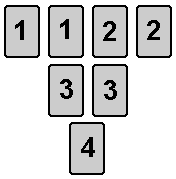
The last card of the pyramid – marked “4” in the diagram – must be included in every player’s five-card poker hand, together with any four cards selected from the five cards they were dealt and the other six in the pyramid.
The first two cards of the pyramid (marked “1” in the diagram) are exposed, and then the first round of betting takes place. Then the next two cards (“2”) are exposed and there is a second round of betting; then two cards in the second row (“3”) are exposed and there is a third round of betting; then the bottom card (“4”) is exposed for the fourth and final round of betting.
This is a high/low game and low hand must have its highest card as an 8 or lower. Players going for high and low can make two different hands from the 12 cards available to them, but both must include the last (bottom) card of the pyramid.
Kryky
A shared card poker variation by Tim Bates (TBATES@larsondoors.com)
This game is for up to 7 players. The procedure is as follows.
- Players place an ante and are dealt 5 cards each – 2 face up and 3 face down.
- Three cards are dealt face down to the table. The first two, dealt near the centre of the table will be the shared (community) cards. The third card, placed off to one side, determines the rank of cards which is wild, but is not part of any player’s hand.
- There is a round of betting, begun by the player whose two face up cards make the highest exposed hand.
- The first community card is turned face up.
- There is a second round of betting, starting with the highest exposed three-card hand (made up of the player’s two face up cards and the exposed community card).
- Each player now has the option to discard zero, one or two of their hand cards, and to be dealt replacements. When up cards are exchanged the replacements are dealt face up. Replacements for down cards are dealt face down.
- There is a third round of betting – again starting with highest exposed 3-card hand, including the exposed community card.
- The second face down community card is turned face up.
- There is a fourth round of betting, starting with the highest exposed 4-card hand, including the community cards.
- Flip over and expose the third (wild) card. This card is not to be used as part of any player’s hand, but all cards of the same rank as this card are wild (there are only three such cards available). It helps if you turn the wild card back over so that people won’t mistake it for a card they can use in their hands.
- There is a fifth and final round of betting, starting with the highest exposed 4-card hand, including the community cards and using wild cards to make the best possible hand.
- If there is a showdown, the player who can make the best five card hand out of the seven cards available to them wins the pot.
Optionally, the game can be played with high and low hands splitting the pot. The low hand winner can be either the worst poker hand (2, 3, 4, 5, 7 being lowest), or the lowest counting ace as low and ignoring straights and flushes (A, 2, 3, 4, 5 being lowest).

Circle Jerk
A shared card poker variation by Tim Bates (TBATES@larsondoors.com)
1. Deal two cards face down to each player.
2. Deal 7 community cards face down as in the diagram to the right.
3. Round of betting 4. Turn over alternate cards in the circle (cards labelled 1)
5. Round of betting
6. Turn over the remaining cards in the circle (cards labelled 2)
7. Round of betting
8. Turn over middle card (labelled 3). This card and all cards of the same rank are wild).
9. Players create a 5-card hand using the two cards in hand their hand plus any three adjacent cards in the layout – for example the sets of three cards connected by red, blue or green lines in the second diagram.
10. Final round of betting, followed by showdown if there is more than one player still in.
Cold Omaha
A poker variant based on the rules of Omaha 8 or better (hi-low), contributed by Brett Johnson (BRETTAJOHNSON@MSN.COM)
Players – 5-10
Deal out five cards to each player (one more than in standard Omaha) set the rest of the deck aside, it will not be needed.
Each player looks at their hand and chooses one card to discard face down to the middle of the table. The dealer gathers these cards and shuffles them. These cards make up the deck.
After an initial betting round the dealer deals out three cards face up in the center of the table from the shuffled discards for the flop. Players bet.
For the turn, a fourth card is dealt face up from the discards, and there is another betting round. The a fifth card is dealt face up for the river, and there is a final betting round.
Note that the cards that were discarded make up the stock for dealing so each player knows exactly one card that could show up (if there are more than 5 players) (or definitely will show up if there are exactly five).
Each player who has not folded during the betting shows their hand, using exactly two cards from their hand and three from the board to make their best high and low hands. High and low split the pot as normal.
This provides an interesting strategy and an out for player who are dealt either three of a flush or three of a kind.
Spots
A triple split game, contributed by Scott Pangle (wpangle@alltel.net)
The game begins with four hole cards dealt to each player and three rows of three face-down community cards, dealt in a square as in Tic Tac Toe.
There is a round of betting after players have looked at their hole cards. Then players take turns, starting with the player to dealer’s left and continuing clockwise around the table, to turn one of the community cards face up. Each player chooses which face down card to expose. There is a new betting round after each new card is turned up.
Players who have stayed in can combine any of the 8 horizontal, vertical or diagonal three card lines of the community card layout with their four hold cards to come up with the best five card hand for each of the three parts of the pot:
- 1/3 of the pot is won by the highest poker hand
- 1/3 of the pot is won by the lowest poker hand
- 1/3 of the pot is win by the best ‘spots’ hand. For ‘spots’, only cards of one suit can be counted; their values are added, counting 1 for an Ace, 0 for a picture and 2-10 at face value.
The cards speak for themselves. A player can use different community card lines for different parts of the pot, and can use from 1 to 4 hand (hole) cards with 3, 2 or 1 cards from a community card line to make each 5-card hand. It is possible that one person could win the whole pot using different combinations of hole and community cards.
When ties occur, the appropriate part of the pot is subdivided.
The game is best for 6-9 players. Scott Pangle describes it as a great ‘sucked-in’ game – often most or all players will stay in the pot for the showdown.
Strobe
Invented and contributed by George Weissenberger (gwprivatebox@cox.net)
Strobe is a Hold’em-like poker game using both a standard 52 card deck and a standard six-sided die to create the best five-card standard poker hand from their hole cards and the community cards. Standard poker hand ranking applies. Aces are high or low. A dealer button is used and rotates as in a Hold’em game. Ante, blinds and betting/folding also follow standard Hold’em rules.
The play begins with each player being dealt 2 hole cards (face down card). A round of betting/folding may or may not occur here depending on the local rules. Then six community cards are dealt face up onto the layout in boxes numbered 1 through 6. There is a first round of betting/folding based on each player’s hole card plus the community cards.
After betting is complete, the person with the dealer button rolls the die. The card in the box numbered the same as the number that came up on the die is removed from play. The remaining players then bet/fold again based on the remaining cards.
A community card is then dealt into the empty box and there is another round of betting/folding.
After the betting the dealer again rolls the die and again the corresponding card is removed from play and a final round of betting occurs, followed by the showdown.
Stop, Drop & Roll
A hold’em poker game invented and contributed by George Weissenberger (gwprivatebox@cox.net)
After anteing-in, two hole cards (face down) are dealt to each player. Each player checks their hole cards and there is around of betting.
Then, the dealer burns one card and turns up the next one for all to see. This card is called the “Stop” and it is eliminated from play. The players bet again based on this new information.
Again, the dealer burns one card and turns the next one up. This card is called the “Drop” and it too is eliminated from play. The players bet again based on this new information.
Finally, three community cards are dealt. This is called the “Roll”. Players engage in a final round of betting based on the five-card hand they now possess (2 hole cards and 3 community cards) and there is a showdown of the remaining players.
Note that the stop and the drop just provide the information that those two specific cards are out of play, which can make a difference to the probability of improving your hand on the roll, and slightly alters the odds that an opponent can beat you.
George Weissenberger writes: “When I play Stop, Drop and Roll, I only allow one round of raising between each action. That way I am actually spreading a three raise maximum over 3 game actions (hole cards, Stop and Drop), with just a little information added in between. It stretches out the game and makes it more fun. I usually allow three raises after the roll.”
Rails
A hold’em poker game invented and contributed by George Weissenberger (gwprivatebox@cox.net)
Rails is a Hold’em style poker game played with a standard 52 card poker deck and no wild cards. The object is to make the best ranked poker hand while betting, folding and bluffing your way to a win. The name originates from the train track-like appearance of the community cards on the layout, and the railroad terms used in the game.
In Rails, the aces are low ONLY (that is, they are not face cards and they have a value of “1”). Therefore, there are no royal flushes in Rails. However, Rails does have an additional ranked hand not found in other poker games; a “Ticket”. A Ticket is a four-card flush with a “royal Rider”. That is to say, any four cards of a matching suit plus one jack, queen or king of any suit. The “Rider” must be the fifth card though, not part of the flush.
The hand ranking in Rails is (highest to lowest):
- Straight Flush (five card),
- Four-of-a-kind,
- Full House,
- Flush (5 card),
- Straight,
- Ticket,
- Three-of-a-kind,
- Two Pair,
- Pair,
- High Card.
When comparing two tickets, the riders are compared first. If these are of equal rank, then the highest cards of the four-card flush are compared. For example suppose that:
- Player A has Q-8-6-4-2.
- Player B has K-Q-97-J.
Then player A wins because the
Q rider beats the
J rider.
To begin: Each player pays his ante and is dealt three hole cards (face down); then there is a first round of betting. Rules regarding blinds, betting/folding and use of the dealer button are applied exactly as they are in Texas Hold’em.
Flopping the Rails: After the first round of betting, there is a “flop” as in other Hold’em games. However, in Rails two sets of two community cards are flopped. Each of the two sets of community cards is called a “Rail”. After this flop there is a second round of betting. The players base their hands on their hole cards plus the cards in either one of the Rails, but not both.
Laying the Spikes: Next, another community card is added to each Rail and becomes part of that Rail. These cards are called “Spikes”. After the Spikes have been laid, there is another round of betting.
Strategy note: As the introduction of the Spikes may alter the desirability of one Rail or the other, the players may, at any time, vary the Rail on which they are basing their betting.
The Tie: Lastly, a single card is placed on the layout face-up between the Rails. This card is called the “Tie”. The Tie is a community card that may be played with either Rail (plus a player’s hole cards) to make a final hand. There is a final round of betting and then a showdown. Again, because the introduction of the Tie may alter the desirability of one Rail or another, the players may vary the Rail on which they are basing their betting.
The Showdown: Any remaining players now turn up their hole cards beginning with the last one to raise the pot. The hole cards are aligned with the Tie and Rail that creates the most favorable hand and the best five card hand wins. While a pot can be split by two players having exactly the same hand value, the board cannot be played alone as the best hand, since it will provide only four cards and the players’ kicker cards will determine the winner(s).
Breaker
Invented and contributed by George Weissenberger (gwprivatebox@cox.net)
Breaker is a variation of any type of Hold’em Poker. It is played with a typical 52 card deck plus one Joker, which is called the “Breaker”. The Breaker is not wild and has no suit. There are no wild cards in the game of Breaker.
When a player does not need five cards to make his hand (i.e. is not making a straight, a flush, a straight flush or a full house) and has the Breaker as one of his hole cards, the Breaker may be played, along with the other four cards in the hand, as insurance against a straight, flush or straight flush held by an opponent.
When played with the other cards making up a four-card or less hand (four-of-a-kind, or three of a kind or less), the Breaker “breaks” all opponents’ straights, flushes or straight flushes that would prevent the holder of the Breaker from having the winning hand. If a Breaker is played to break a straight, flush or straight flush, it also ranks as the highest kicker card, better than an ace. Note that a Breaker does not break a full house, and has no value at all unless it enables its holder to win.
In summary, the rules governing the Breaker are as follows:
- The Breaker can ONLY be played if it is held in a player’s hole cards. A Breaker that is dealt as a community card is considered dead (cannot be played). It is removed from the board and a replacement card is dealt from the deck.
- The Breaker only helps the holder, only breaks a hand that derives its value from all five cards (i.e., straight, flush or straight flush), and can only be played if doing so would make the holder’s hand the winning hand. Otherwise, the Breaker becomes dead at the showdown and the highest remaining kicker becomes the player’s fifth card.
- If the Breaker is playable per rule 2 above, it is also the top kicker.
- If the current deal results in multiple five-card hands (straights, flushes or straight flushes) and a breaker is played all five-card hands are broken by the Breaker, as a Breaker is intended to be insurance against a five-card winning hand.
- Breakers only affect a side pot when the player holding the breaker is in contention for that pot.
- If the board is a high-hand straight, flush, or straight flush, then a player with a playable breaker may break the board and win the entire pot. However, breakers only affect a side pot when the player holding the breaker is in contention for that side pot.
When a five-card hand has been “broken” by another player playing a Breaker, his hand can still be played as a non-five-card hand.
In the examples below, Breaker is played as a variation of standard Texas Hold’em.
Example 1: Simple example
- Player A has 10, Breaker
- Player B has 10, A
- Player C has 10, 2
- Player D has 7, 5
- The board has Q, K, 10, 7, 4
- Player A’s hand: Pair of tens with a Breaker kicker
- Player B’s hand: Pair of tens with an Ace kicker
- Player C’s hand: Flush
- Player D’s hand: Pair of sevens
Player C has a flush but Player A holds a Breaker in his hole. Player A plays his Breaker and ends up with a pair of tens with a Breaker kicker. Player C’s flush is broken so his best hand is now a pair of tens with a 2 kicker. Player A wins because the Breaker was playable and therefore is the highest kicker of the three “Pair of tens” hands. Note: If player C had folded, perhaps suspecting that someone held a Breaker, player B would have won.
Example 2: Playing a breaker forbidden because it does not create a winning hand (breaking creates winning hand for another player)
- Player A has 10, Breaker
- Player B has 10, 8
- Player C has 10, 2
- Player D has 7, 7
- The board has A, K, 10, 7, 4
- Player A’s hand: Pair of tens with a Breaker kicker
- Player B’s hand: Pair of tens with an Ace kicker
- Player C’s hand: Flush
- Player D’s hand: Three sevens
Player C wins with a flush. The Breaker does not break the flush because player A’s pair of tens would then be beaten by player D’s three sevens. Note: Had player D had folded, player A would have won by breaking C’s flush and having the Breaker as the highest kicker with his pair of tens. In this example, if player C had folded, player D would have won.
Example 3: Playing a breaker forbidden because it does not create a winning hand (breaking does not beat the player’s alternate hand)
- Player A has 10, Breaker
- Player B has 10, 8
- Player C has A, Q
- Player D has 7, 5
- The board has Q, K, 10, 7, 4
- Player A’s hand: Pair of tens with a Breaker kicker
- Player B’s hand: Pair of tens with an Queen kicker
- Player C’s hand: Flush
- Player D’s hand: Pair of sevens
Player C has a flush but Player A holds a Breaker in his hole. However, Player A cannot play his Breaker because it would not result in a winning hand. Breaking Player C’s flush would still leave Player C with two Queens, which would be the winning hand. Since Player A’s fails to break the flush, the flush officially stands. Player C wins either way.
Example 4:
Player A has K-Q, Player B has Q-Joker, Player C has 9-9, and the board shows J-10-9-8-3. In order to break player A’s high-hand straight, Player B would have to break his second high-hand (lower straight) to play the Breaker. This would leave him with a pair of Queens with a Breaker kicker. However, that would make his hand inferior to Player C’s three-of-a-kind so, according to the rules, he can’t play the Breaker. Since Player B cannot play the Breaker and win, the Breaker becomes dead and B’s best hand becomes the Queen-high straight. He must pray that Player A folds before the showdown (which isn’t likely).
Variations:
- Dual Breaker
In original Breaker, there is only one Joker so only one player at a time can hold a breaker. This variation uses both Jokers.
The same rules apply, so most of the time this will be a normal game of Breaker. However, it is possible that two breakers will come up in the same hand. As per the game rules, only the player who can win the hand by playing their breaker may play the breaker; the other breaker is dead. If a single player gets both breakers dealt as his hole cards, he must fold.
This variation gets a little tricky when there are side pots. For example:
Player #1 is all-in against two other players. Players #2 and #3 have a side pot going. Player #1 winds up with three-of-a-kind plus a Joker (breaker card), player #2 has a 9 to King straight, and player #3 has four non-sequential cards of varying suits plus a Joker (breaker). In the main hand, player #1 plays his breaker and wins the hand with 3-of-a-kind; player #3’s breaker is dead as he cannot play it and win. However, in the side pot, player #2 would have won with the straight except that player #3 played his breaker in the side pot and won that pot.
- Locked Breaker
This is a variation of either Breaker or Dual Breaker in which breakers are not considered separately in the side pot. The outcome of the main pot hand “locks” and the order of finish in the main pot hand is applied the side pot.
Wraparound
Invented and contributed by George Weissenberger (gwprivatebox@cox.net)
Wraparound is Pot Limit Texas Hold’em Poker with these two modifications:
- The maximum bet is equal to the pot size before and immediately following the flop, and 2x the pot size for bets made after the turn and river
- Aces are high AND low and thus can be used to make high straights, low straights, or “wraparound” straights (That is, straights involving aces may be 10-J-Q-K-A or J-Q-K-A-2 or Q-K-A-2-3 or K-A-2-3-4 or A-2-3-4-5).
Depot
A hold’em poker game invented and contributed by George Weissenberger (gwprivatebox@cox.net)
Depot Hold’em is played with a standard 52 card poker deck and no wild cards. The object is to make the best ranked poker hand while betting, folding and bluffing your way to a win. Depot uses some of the terminology found in Rails.
In Depot, the aces are low ONLY (that is, they are not face cards and they have a value of “1”). Therefore, there are no royal flushes in Depot. However, Depot, like Rails, does have one additional ranked hand not found in other poker games; a “Ticket”. A Ticket is a four-card flush with a “royal Rider”. That is to say, any four cards of a matching suit plus one jack, queen or king of any suit. The “Rider” must be the fifth card though, not part of the flush.
The hand ranking in Depot is (highest to lowest):
- Straight Flush (five card)
- Four-of-a-kind
- Full House
- Flush (5 card)
- Straight
- Ticket
- Three-of-a-kind
- Two Pair
- Pair
- High Card
When comparing two tickets, the riders are compared first. If these are of equal rank, then the highest cards of the four-card flush are compared.
To begin: Each player pays his ante and is dealt two hole cards (face down); then there is a first round of betting. Rules regarding blinds, betting/folding and use of the dealer button are applied exactly as they are in Texas Hold’em.
Flopping the Rails: After the first round of betting, there is a “flop” as in other Hold’em games. However, in Depot two sets of three community cards are flopped (see the illustration above). Each of the two sets of community cards is called a “Rail”. After this flop there is a second round of betting. The players base their hands on their hole cards plus the cards in either one of the Rails, but not both.
The Switch: Here’s where the game gets a bit mind numbing. A single card is placed on the layout face-up between the Rails. This card is called the “Switch”. The Switch is a community card that enables any straight line of cards to become a playable Rail (that means additional Rails are available up the center or diagonally through the center, as in the diagram below). The switch does not have to be played as part of the final hand, so you will actually have five Rails to choose from when constructing your best hand. There is another round of betting which could now be based on any combination of a player’s hole cards plus one of the five available rails.
Finally, another community card is placed (usually sideways) between the horizontal rails at the end. This is the “Depot”. The Depot is the 6th card that can be used to make up your best five-card Depot hand: you can use your hole cards, one of the five rails marked with colored lines in the diagram, and the depot card. After the Depot card has been dealt, there is a final round of betting.
The Showdown: Any remaining players now turn up their hole cards beginning with the last one to raise the pot. The hole cards are aligned with the Depot and the Rail that creates the most favorable hand and the best five card hand wins.
Same’Em
A hold’em poker variation invented and contributed by JDulius (webmaster@jdulius.max.io)
The procedure for each deal is as follows:
- Three cards are dealt to each player and there is a round of betting.
- A three-card flop is dealt, followed by a second round of betting.
- A fourth card is dealt to each player and a fourth card (the turn) to the table, and there is a third round of betting.
- A fifth card is dealt to each player and a fifth card (the river) to the table, and there is a fourth and final round of betting.
- Each player in the showdown makes the best possible 5 card poker hand out of the 10 available cards (five in hand and five on the table).
Texas (Kansas) Tornado
Contributed by Chris Gaskill (fathermcfeely@yahoo.com)
Texas Tornado is played using the standard rules of poker. Up to 10 players can play at once. Each player is dealt 2 down cards. Just as in regular hold’em, there is a betting round. Once the betting is complete, the dealer then counts out 10 cards and stacks them up tightly. Holding the pack of 10 cards face up, he then drops them on their backs in a twisting motion, the idea being that when they hit they table, some of them will be made visible. Cards that have at least one corner index (figure and suit symbol combination in the corner of a card) that is more than half exposed, but are still touching the pile (tornado) may then be used with the players’ down cards to make the best 5 card hand. There is a second betting round followed by a showdown if more than one player is still in.
The dealer is the arbiter on which cards are “visible”. If the dealer (and to keep the peace, at least one other player) can see more than half of the index, then it is in play.
The Kansas variation is played with 4 cards being dealt face down, as in Omaha (players must use only 2 of their hole cards).
Odds and Ends
Contributed by Chris Gaskill (fathermcfeely@yahoo.com)
This uses a standard 52-card deck and standard poker rules.
Each player gets 4 cards face down.
Three cards are dealt face down in the center. These will be the community cards. They are turned over individually, with a betting round before the first is turned and another following each flip.
The highest odd card in each player’s hand is wild (3,5,7,9, not face cards). It remains wild unless the same rank comes up as a community card (your 7 is wild unless a 7 shows up in the middle). If it does show up it is “ended” as a wild card (so for example if you hold J-J-7-5 and the first card turned up is a 7, your hand is reduced from three jacks to two pair). Players make their best 5 card hand from their four cards plus the three community cards, when all three have been turned up.
Royal Hold’em
This game is just like Texas Hold’em, but played with only 20 cards: the A K Q J 10 of each suit. Because of the reduced deck, only six players can take part (each deal then uses all the cards: 2 for each player, 5 on the board and 3 burned).
The only possible poker hands are (in descending order): Royal Flush, Four of a Kind, Full House, Straight, Two Pairs. The others do not arise because any flush must also be a straight (only 5 cards per suit), and with seven cards to use, if you have three of a kind your other four cards must either complete a straight or contain a pair for a full house. The worst possible holding is 10-10-J-J-Q-Q-K which makes two pairs with a king kicker.
Royal Hold’em was offered on line for a while on Ultimate Bet, but withdrawn in July 2007, according to the German Wikipedia page about this game.
Egyptian Hold ‘Em
Contributed by David Morrah (differencefilms@igrin.co.nz) ©2007
A variation of Texas Hold ‘Em where players build their hands based upon a pyramid of 6 table cards.
Number of players: 2+
Equipment: Standard deck and chips.
Aim: Players compete to win the most chips by holding the best hand. The winning hand in this version (made up of 6 cards) is chosen from the 2 cards in the players hand, and the 6 community cards on the table.
Game play: Play is essentially identical to Texas Hold ‘Em, except for the different layout of the community cards.
Round 1/the pre-flop: Two cards are dealt face down to each player. The player to the left of the dealer is assigned the little blind, and the second player to the left of the dealer is assigned the big blind, as per the usual rules of Texas Hold ‘Em. Bets for the first round are then made based upon each of the players two cards.
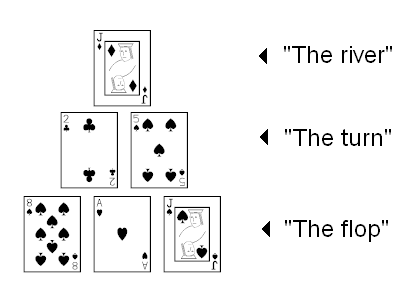
Round 2/the flop: The dealer deals three cards face up in a line along the table. As per Texas Hold ‘Em rules, the usual bets for the flop round are made (call, raise, check or fold etc).
Round 3/the turn: The dealer deals two cards face up directly above where the earlier flop cards were dealt. As per Texas Hold ‘Em rules, bets for the turn round are made.
Round 4/the river: The dealer deals one final card directly above where the earlier turn cards were dealt. As per Texas Hold ‘Em rules, a further and final round of betting is made for the river card.
The showdown: Any remaining players who haven’t dropped out at this stage must now show their hands. The player with the best 6 card combination (based upon the 6 cards on the table and their own 2 cards) takes all the chips. Because there are now 6 cards, the rankings are slightly different, with three new combinations possible:
Rankings:
| Royal Flush | – – 9 10 J Q K A |
| Straight Flush | – – 2 3 4 5 6 7 |
| House Party | – – K K K K A A (any 4 of a kind + any 1 pair) |
| 4 of a Kind | – – 8 8 8 8 A 2 |
| Double Happy | – – A A A 7 7 7 (two lots of 3 of a Kind) |
| Full House | – – 3 3 3 7 7 9 |
| Flush | – – 2 A 7 9 3 K |
| Straight | – – 3 4 5 6 7 8 |
| 3 of a Kind | – – A A A 2 7 9 |
| 3 pair | – – 10 10 2 2 8 8 (just as it sounds!) |
| 2 pair | – – 9 9 A A 3 4 |
| 1 pair | – – 2 2 10 7 5 9 |
Island Pineapple
A variation of Pineapple invented and contributed by Trevor Cuthbertson (tcuthber@hotmail.com) – Copyright © Trevor Cuthbertson 2007
The game is played with a standard 52 card deck with 3-7 players.
Deuces can be used to complete a Straight Flush of the same suit (for example: 6, 7, 8, 2, 10 would qualify as a spades Straight Flush). When used with four consecutive cards to make a Straight Flush, the deuce will be a replacement card for the lowest card in the sequence (example: the 2 in 2, 10, J, Q, K would qualify as a replacement for the 9).
When a suited Deuce is available for a Straight Flush, the suited Ace also becomes wild for the hand. The suited Deuce is the key power card. If you have a suited Ace for a Straight Flush, you have to get a suited Deuce to make the suited Ace wild. When the suited Ace combines with a suited Deuce, it will be a second replacement card for the highest card in the sequence.
A Deuce that is not used to complete a straight flush as above is restricted to its marked suit and value.
Players get three down cards. Immediately, the dealer must deal the flop cards using the following procedure:
- Burn a card and deal two cards in a vertical row (the first set). Each of these cards makes up a separate board.
- Deal two more cards in a horizontal row (the second set) beside the first set of cards. These cards should be placed between the cards from the first set as the second and third flop cards.
Next, the dealer will announce “Draw Three”. Each player in turn opts either to keep their three down cards (Stand Pat) or turn in the three down cards they are holding for three new ones (you must either turn in all three down cards or none). The dealer burns a card and each player wanting new down cards are dealt in turn from the deck new cards. If no players want new cards, the dealer will simply burn a card.
Now the first betting round occurs.
After the first betting round, the dealer burns a card and deals a card to the board (turn card). Second betting round proceeds.
After the second betting round, the dealer will announce “Pineapple”. All active players must discard one down card per turn. Failure to do so will result in a fouled hand. Once all players have discarded one down card, the dealer burns a card and two more cards are dealt in a vertical row to the board (split river). There are now four boards in the community to choose from. Final betting round proceeds.

Showdown comes after. Players may combine one or two down cards with three or four cards from one of the four boards to make a five-card hand. No playing the board – at least one card from the player’s own hand must be used.
This game can handle a maximum of seven players. In a seven player game, if all seven players draw three cards before the first betting round, there is no burn card before the split river. If the number of players exceeds seven, the dealer must accept the extra players at their own discretion.
Variations
Phantom Ship: “The Phantom Ship has been seen off the south coast of Prince Edward Island since 1786. It appears as a three-masted schooner on fire, or on some accounts, as a gray hulk looming up at dawn. Some claim to have seen people running on deck screaming in terror. Some say it’s the ghosts of six-hundred Acadians on a ship ablaze, while others say it’s a pirate’s pact with the devil. But no one can honestly explain the mystery behind its presence…”
The story of the Phantom Ship has been part of local folklore for generations in Prince Edward Island, Canada. Its presence can be witnessed as a special in Island Pineapple. In the variation, the player gets to call a showdown on the pineapple if they hold a special four-of-a-kind called a “Phantom Ship”. All three down cards must show a three-of-a-kind with a fourth match card in the community to make a four-of-a-kind. For example: player’s down cards are 10, 10, 10. The 10 appears on the turn. The player now holds a Phantom Ship and has the ability to initiate an early showdown with the four-of-a-kind 10s once all players complete their bet on the second betting round.
When the second betting round ends, the player with the Phantom Ship can flip their cards face-up out of turn without discard. All other players must flip their cards face up without discard as well. The dealer burns a card and adds the split-river to the community. All players can now use all three of their down cards with two cards in any of the four boards to make a hand. If no one can beat the player’s Phantom Ship (four-of-a-kind) with a straight flush, the player who initiated the early showdown with the special wins the pot.
Turning up a three-of-a-kind from all three down cards without a match card in the community or turning up the special after players begin discarding will result in a fouled hand. Don’t expect a Phantom Ship to happen frequently in Island Pineapple – witnessing this special as about as rare as seeing an apparition.
Arcade Ante: Another variation is played with no blind bets. Each player, except for the winner of the last hand, antes into the pot before down cards are dealt. All betting rounds start with the player to the left of the dealer. In tournament play, you would periodically increase the ante value in place of the blinds structure. Note: Arcade Ante is taken from “nexts”, a term once used in the arcade scene with fighting games. With “nexts”, players place tokens on the game’s front metal bezel to claim the next match. The winner stays to fight whoever is next. With Arcade Ante, the winner stays for the next challenge – all other players must ante in to mark their next turn.
Secondary Bonus in Texas Hold’em: In this variation, Island Pineapple is used as an enhancement to a regular Texas Hold’em game. When playing Texas Hold’em, the bonus is triggered on the showdown when one player gets a Three-of-a-kind or better. The next hand is then played as Island Pineapple, and the winner must now get a Straight or better on the showdown to qualify for the Island Pineapple to continue. The winner in the next hand must get a Flush or better and so on up to a Royal Flush qualifier. When the winner gets the advancing qualifier on the showdown, Island Pineapple remains in play. But once the winner gets anything lower than the qualifier on the showdown, or wins without a showdown when the other players all fold, the game returns to Texas Hold’em and the qualifier goes back down to Three-of-a-kind or better.
Straight with Wild(s): In this variation, Deuces and Aces can be used as wild cards in Straights in a similar way to their use in Straight Flushes in the basic game. Any one Deuce can be used as a wild card to complete any Straight, irrespective of suit. When a Deuce is used in this way, the Ace of the same suit as the Deuce (“suited Ace”) can be used as a second wild card for the same Straight. If there is a choice of where to add the Ace and Deuce, because the natural cards are consecutive, the Deuce is added to the bottom of the Straight and the Ace to the top. Examples: 5-2-7-8-A is a straight equivalent in rank to 5-6-7-8-9. 8-2-10-2-J is not a straight because only one Deuce can be used as wild. A-2-2-4-5 IS a straight because the 2 is used as a natural Deuce and only the heart Deuce is wild.
Playing the Board: The showdown rule of “no playing the board” is dropped. Players have the possibility of not using any of their down cards but instead making a hand from community cards only. If no one can make a hand that’s higher than a hand of five cards on one of the four boards, the pot is split among all active players.
Beat ’em up Hold ’em: A different way of playing Island Pineapple as a classic beat ’em up video game. Arcade Ante is either used with real quarters (25¢) or red poker chips each representing five dollars ($5). “Draw Three” is replaced by announcing “Choose Fighter” when opting to keep your three down cards or draw three new cards. After the first betting round, the turn card is now known as “Go Forward”. After the second betting round, the dealer will announce “Attack” when the Pineapple discard is made. Third betting round proceeds followed by “Renegade Boulevard” (split river). On the showdown, all active players choose their “Final Dragon” when combining their down cards with three or four cards from one of the four boards. Other additions include the Straight with Wild(s) variation and the Phantom Ship, which is now known as the “Silver Axe”. Standard rule of not playing the board still applies on the showdown.
The Game Called “The”
This shared card poker game contributed by Thomas Yarbrough (jy013175@erizon.net) is also called just “The” for short. It was created and played by a group of home poker players in the late 1980’s and was named by Ted Eichenlaub.
Each player antes and is dealt 3 cards and the 4 card board gets dealt in turn with the players cards. For instance with three players, Player 1 to the left of the dealer is dealt a card, then Player 2, then the dealer Player 3, then a card face down for the board. That process is repeated twice more so each player has three cards and the board has three cards face down.
The next card is dealt face up to the board and a round of betting begins with Player 1. The player who bet or raised last will always start the next round of betting. If there are no bets the turn to begin betting passes to the left for the next round.
The three face-down board cards are turned up one at a time with a round of betting after each – four betting rounds in all. In the showdown the best five card hand made using the three cards in your hand and the four cards on the board in any combination wins the pot.
KRG
Created by Craig Smith, Ryne Crawford, Ryan Groth and Chris Hoogstad (hoogstad@sonoma.edu) , who contributed this description.
Before starting a series of deals, each player contributes a fixed amount, say $5, to the pool, and the winner will take the whole pool. Players should agree in advance whether 3 or 4 wins are needed to win the series.
The game is dealt like texas hold’em, except that everyone is dealt 6 cards face down at the start, rather than just two. Before the flop each player must discard any two cards from their hand. The flop (3 cards) is laid out. After this everyone discards 1 card from their hand. Going to the turn each player should only have 3 cards in hand. The turn (1 card) is dealt on the board. Everyone discards one card so that going to the river you have a regular two-card hold’em hand. The river (1 card) is dealt and the person with the best 5 card combination wins. There is no betting during the actual hand and therefore no folding: all the hands are compared. The first player to achieve 3 or 4 wins, agreed in advance, wins the series and takes the pool.
Normally there are also side bets, such as who will win most times throughout the night, who will be first to make quads, etc. Each of these would have its own pool. Chris Hoogstad suggests that the game could be played a backgammon doubling cube, so that any time during the series a player can turn the cube and everyone must either double their contribution to the pool or drop out of the series immediately. This reintroduces something similar to poker betting, but on the result of the series rather than a single deal.
Jersey Holdem
Contributed by Mike Picollelli (spin11@gmail.com) and formerly known as Cosmic Poker.
This is a variation of Omaha High Low, 8 or better (O8B). In the “North Jersey” version, each player is dealt 5 cards face down rather than 4. Then the game proceeds like O8B, but you may use either two or three of your cards (together with three or two from the board) to make the best high hand and either two or three to make the best low hand.
In loose kitchen table games this can lead to huge pots, as every hand looks like a winner to the inexperienced player, even on the flop. But the turn defines your hand and the river can really kill you. Full houses are common and it’s not unusual for a quad to be beaten by a higher quad.
In the “South Jersey” version each player is dealt only 4 cards rather than 5, but may still use 2 or 3 of these together with 3 or 2 from the flop.
Double-Edge Trim-Saw
A Texas Hold’em variation, also known as Texas Trim, contributed by Chris Odell (chrismodell@gmail.com)
Each player is dealt two sets of 2 hole cards. Players are not allowed to mix their two hands around – in fact they are not allowed to pick both hands up at the same time. Deuces are wild. You do not have to declare which hand you’re betting with. After the the flop, turn and river, in a showdown you can use cards from either set of hole cards (but not both). Betting is the same as in No Limit Texas Hold Em. A pair of deuces is a monster pocket hand in this game and will usually win except in the rare case where someone catches the natural version of the same 5-card hand.
Pass ’em Poker
A Hold’em game with passing, contributed by Harvey Fish (hsfish@gmail.com)
Players: 5-6
Initial deal: three cards face down to each player.
Play: Each player must then give one card from his hand face down to the player on his left. These cards are passed simultaneously: they are picked up only after each player has passed on his “gift” to the next player. After all have received their card there is a round of betting.
After this three shared cards are placed one at a time face up in the middle and a new of round of betting takes place after each new card is revealed. At the showdown a player may use either two cards from his hand and all three from the table or all three from his hand plus two from the middle to make the best 5-card hand.
Winning hand: High hand wins, or High/Low split, according to prior agreement.
Blue Beacon
The game, contributed by Daniel J. Brooker (brooker.danny@gmail.com) was invented while at work at Blue Beacon.
Basically it’s 5 card draw but with 4 extra community cards, and 6 rounds of betting.
- Deal out 5 cards to each player, after which there is a first round of betting.
- Deal the first community card face up. Then there is a second round of betting.
- Then deal the second community card face up, followed by the third round of betting.
- After that players can discard unwanted cards and draw replacements from the deck, as in draw poker. After the draw, there is a fourth round of betting.
- After that deal your third community card, and there is fifth round of betting.
- After that deal your last community card out, followed by a final round of betting and showdown.
In the showdown players form the best 5-card hand they can from the 9 cards available to them: 5 private cards and 4 community cards.
Since the draw is half way through the game, it can be difficult to judge which cards to discard, since you don’t know what the last two community cards will be.
Waiting for Godot
Contributed by Andrew Foley (ludofortyfive@yahoo.com) who writes:
“I like this game quite a bit because of the cutthroat aspect of knowing half of people’s initial hand, and trying to get them out early before they get their third player card.”
Initial Deal: 4 cards are dealt, face down, in the middle of the table (these are community cards). Each player is dealt one card face down, and then each player receives one card face up.
The first round of betting takes place.
The first three community cards are flopped up.
The second round of betting takes place.
Each player is dealt a second card face down (their third player card including the one face-up card).
The third betting round takes place.
The fourth and final community card in the middle is turned up.
At this point each player has three player cards (two face down, one face up) and all four community cards have been revealed. Each player uses any combination of the seven cards to make a five card hand.
The fourth and final betting round takes place, followed by the showdown.
Indian Chief Poker
Contributed by Patrick St-Louis (herbapoux@hotmail.com)
This poker variant, related to the card game Triangle by the same author, uses a standard 52-card deck and standard poker rules. It can be played by 3 to 6 players. The number of players defines the number of cards each player gets and the number of community cards in the center.
- 3 players: 2 cards for each player and 1 community card.
- 4 players: 1 card for each player and 2 community cards.
- 5 players: 1 card for each player and 1 community card.
- 6 players: 1 card for each player and no community card.
Each player gets his cards face down. Without looking at the cards, each player places them on his forehead such that all the other players can see the cards but he cannot. The hand of a player consists of all the cards he “sees” plus the community cards. This means that depending on the number of players, the hands of each pair of players share all but two or one card.
The community are dealt face down and are turned face up one at a time, with a betting round before the first is turned and another following each flip.
To blur the odds a bit, one or two additional community cards can be used, so that each player can make a hand of 5 cards out of the 6 or 7 cards available.
Russian Roulette
Contributed by Patrick St-Louis (herbapoux@hotmail.com)
This is a mechanism that can be used in most Poker variants with community cards.
The idea is as follows: a (m,n) Russian roulette community consists in placing the “n” community cards face down in a circle formation. An object called “The Trigger” is placed on or pointing at one of the cards (the trigger can be anything like a coin or a lighter or – for dramatic effect – the tip of an unloaded gun rotated in the middle of the community).
The “active community” consists in the first “m” community cards in clockwise position starting at the Trigger. In the showdown, you will form your hand from your private (hole) cards plus the active community cards.
Typically the hand will start with a round of betting based solely on the players’ hole cards, with all community cards face down. Then one or more community cards are revealed, followed by another betting round. This is repeated until all the community cards are face up and there is a final round of betting. When a card from the community must be revealed, if the Trigger is on a card facing down, simply reveal the Trigger card. If the Trigger card is already face up, find the first face down card in clockwise position from the Trigger and turn it face up.
Here is the twist. Every time a player “bets” or “raises”, the Trigger is moved to the next clockwise position in the community (regardless of whether the card is face up or face down). When a player “checks”, “calls” or “folds” the trigger does not move. Thus the “Russian roulette” community allows to change your hand’s value by betting. Indeed, depending on the position of the Trigger, your hand might be incredibly good or incredibly bad. Also, pot can build rapidly as players attempt to move the Trigger to the best position for them.
Example

A good starting point to try out this variant is (3,5) Russian roulette with 2 private cards. So each player’s hand is formed of 2 private cards and 3 active cards from the community, 2 being inactive. One card is revealed after each round of betting. So a four player game might go like this. Here is the community card layout: grey cards are face down; white face up; the red spot is the trigger. Each player is dealt two cards and the first betting round begins. P1 bets; P2 raises; P3 calls; P4 raises; P1 raises; P2, P3 and P4 call.

The trigger has moved four times. Before the next betting round the card at the new trigger position is exposed. In the second betting round P1 checks, P2 checks, P3 bets, P4 raises, P1, P2 and P3 call.

The trigger has moved twice and the card at the new trigger position is revealed. The active cards are the three marked “X” in the diagram. If the trigger stays where it is, the first exposed card will not count towards anyone’s hand, but it will be brought into play again as soon as someone bets. But P4, P1, P2 and P3 all check.

Since the trigger card is already face up, the next card in clockwise order is exposed. P4 bets, P1 calls, P2 folds, P3 raises, P4 and P1 call.

The trigger has moved twice, changing the active cards, and a new card is exposed. P3 bets, P4 raise, P1 folds, P3 raise, P4 raises, P3 calls.

The trigger has moved four places and the final card is revealed. P4 checks, P3 bets, P4 raises, P3 raises, P4 calls.

The trigger has moved three times so the cards used in the showdown are the three cards marked “X” in the diagram below, plus the player’s two private cards.
Notes
An odd value should be preferred for the total size of the community to avoid “deadlocking” two players into an outrageous betting war. This can happen, for example, with a 4-card community if player 1 has a very good hand when Trigger is at position 1 or 3, and a very bad hand when Trigger is at position 2 or 4, and player 2 is exactly the opposite. If the Trigger is at position 1 and it is player 2’s turn to bet, he will bet in order to move the Trigger to position 2. Then it’s player 1’s turn and he will raise to move the Trigger to position 3, and so on until one of the two players runs out of money. Having an odd community size avoids this problem, because the Trigger will eventually be in a position where the current player is satisfied.
With a larger community it will be better to reveal more than one card at a time, in such a way that there are about 4 rounds of betting in total. Another variant could be to start by revealing several community cards at positions around the wheel – for example every third card with a 9-card wheel, so that players have some early information about the cards that might come into play when the trigger moves.
Crazy Blind Man
Contributed by Frank Kills In Water (h2oy2k1@yahoo.com)
The game is a mix of Blind Man’s Bluff and Crazy Pineapple. A big and small blind are posted as in Texas Hold’em or Pineapple. As in Pineapple, three cards are dealt to each player, but the players hold these cards to their foreheads, so that each player can see all the other players’ cards but not their own.
After a first round of betting, a “flop” of three face up community cards is dealt to the table. After the flop everybody removes one card from the player to the left of them. First the small blind player takes a card from the big blind, and continuing around the table, so that finally the big blind takes a card from the dealer. No one is allowed to see the card that was taken from him or her.
There is then another betting round, followed by a fourth community card (the turn), a round of betting, and a final community card (the river) and a final round of betting. In the showdown, surviving players put their two cards on the table the best 5-card hand wins.
Other variations are to remove the one card after the “turn” or after the “river”, or to play all three of these games in succession, which the players call “S#*T, Dam, F*#K”.
Chowaha
A hi-lo shared card game with an array of 12 community cards, by Mike Chow. See Wolf’s Chowaha Page.
Loco Poker
A drinking variant of Texas Hold’em, that does not require chips, described on the Poker Bankroll Blog.
Forty-Three
Contributed by Bob Procter (ncpokerchip@gmail.com)
This is a high-low split game and is dealt as follows:
- Each player is dealt 4 cards
- There are 3 cards placed as community cards face down on the table
- There is a round of betting
- Then each player is offered a chance to exchange up to 2 cards – discarding them and being given replacements by the dealer.
- There is a second round of betting
- The first community card is exposed
- There is a third round of betting
- The second community card is exposed
- Fourth round of betting
- Third community card exposed
- Fifth and final round of betting
The players then declare using chips held in a closed fist. All open their hands simultaneously: 0 chips low, 1 chip high, 2 chips both.
If you go both ways you must win or tie both high and low to win the whole pot – otherwise you win nothing.
Variant: Box
Instead of just three community cards deal two rows of three, one below the other. The cards are turned up two at a time (one column at a time). To make your hand you use the cards you were dealt together with either one row of three cards or one column of two cards.
Privacy Poker
Contributed by Magnificence (magnificence@live.nl)
This is a shared card / stud hybrid game: at the showdown each player has a hand of 5 cards, partly open, and there are two shared cards. Players make the best 5-card hand they can from these seven cards. As in any other poker games, various rules for antes/blinds, betting structures and so on can be used. The procedure is as follows:
- First, everyone is dealt 2 face-down cards.
- Then the first betting round starts with the player to the left of the dealer.
- Then everyone is dealt 1 face-up card, and 2 community (shared) cards are put face up on the table.
- Then the second betting rounds starts with the player who has the lowest poker hand showing, consisting of his face-up card plus the community cards. If there is a tie (two or more players who have the lowest poker hand), the player who is first after the dealer in clockwise order, goes first.
- Then everyone is dealt 1 face-down card.
- Then the privacy round begins with the same player who began the second betting round (the player with the lowest poker hand showing). At your turn, you may, if you wish, discard one card and obtain a face-up card from the deck in exchange. If you choose to exchange a card, then before doing so you must flip one of your face-down cards face-up (not the card you are exchanging). Thus a player who exchanges a face-up card has two face-down cards afterwards, but a player who exchanges a face-down card has only one card face-down and three face-up; a player who does not exchange keeps three cards face down and one face-up.
- After the privacy round there is a third betting round, begun by the same player who began the privacy round.
- Everyone is dealt one more card face down: the players now have 5 cards each.
- Now there is a media round, beginning with the player who has the lowest poker hand showing, based on his face-up cards plus the community cards, with the same tie rules as before. Beginning with this player, each player in turn has to flip one of his face-down cards face-up.
- Then the fourth and last last betting rounds begins with the player who has the lowest poker hand showing, with the same tie rules as before.
- Then at last, there is a showdown, in which the highest hand takes the pot.
Strategy
When everybody gets their first two cards, the game is much like Texas Hold’Em, because you expect to get 3 new cards in the next round like the flop in Texas Hold’Em. The only difference is that two cards will be community cards and one will be a personal face-up card. So you can also guess a little who has a better hand and who doesn’t.
When you reach the privacy round, you will have to make a strategic choice. If you choose not to exchange a card with the dealer, you won’t have to flip an additional card, which means that the other players have less idea how good your hand is. Ideally, you already have a fair/good hand and don’t need to exchange. If you choose to do so, it is better to change the face-up card because you will get a face-up card back anyway. You will then end up with 2 face down cards. If you change a face down card, you will get a face-up card back and you will have 1 face down card left.
In the next (media) round, you will get a face-down card, but you will have to flip one of your cards too. This means that you’ll keep the same number of face-down cards, but you will have the choice which you want to show. If you have a good hand, you might want to show a low card in order to get as much money as possible, but if you have a bad hand, you might want to show a high card to create the idea that your hand may be good.
Overall, this poker variant is more complicated than most, but allows more strategy.
Example
In this example, there is an ante of $1, a minimum bet of $1 and no wild cards. The players are: Alice, Bob, Carol, Danny. Danny is the dealer.
- Everyone puts in $1 (ante). The pot is now $4. Danny deals everyone 2 face down cards (face down cards are shown { in brackets }).
- Cards: Alice: { 5 7 } – Bob: { J K } – Carol: { J J } – Danny: { 8 9 }
- Betting begins with Alice, who bets $1. Bob calls. Carol raises to $2. Danny, Alice and Bob call. The betting round is over and the pot contains $12.
- Danny deals everyone 1 face-up card and puts two community cards on the table.
- Cards: Community: 3 3 – Alice: { 5 7 } 9 – Bob: { J K } 8 – Carol: { J J } K – Danny: { 8 9 } 6
- The second betting round begins with Danny because he has the lowest poker hand showing (3 3 6). Danny, Alice and Bob check. Carol bets $1. Danny calls, Alice folds and Bob calls. The pot is now $15.
- Danny deals everyone 1 face-down card.
- Cards: Community: 3 3 – Bob: { J K 2 } 8 – Carol: { J J 3 } K – Danny: { 8 9 6 } 6
- The privacy rounds starts with Danny who flips his 8, discards his 9, and deals himself A face-up. Bob flips his 2 and discards his h*8, Danny deals Bob Q face-up. Carol stays.
- Cards: Community: 3 3 – Bob: { J K } 2 Q – Carol: { J J 3 } K – Danny: { 6 } 6 8 A
- The third betting round starts with Bob, because he has the lowest poker hand (3 3 2 Q). Bob checks. Carol bets $1. Danny calls. Bob folds. The pot is now $17.
- Danny deals Carol and himself 1 face-down card.
- Cards: Community: 3 3 – Carol: { J J 3 8 } K – Danny: { 6 7 } 6 8 A
- The media round starts with Carol. Carol flips 8 and Danny flips 7.
- Cards: Community: 3? 3? – Carol: { J J 3 } K 8 – Danny: { 6 } 6 8 A 7
- The last betting round starts with Carol, who bets $2. Danny raises to $4, which Carol calls. The pot is now $25.
- Now there is a showdown: Carol and Danny show their cards. Carol has a full house (3 3 J J 3) and Danny has two pairs (3 3 6 6 A) so Carol wins the pot of $25.
Swiss Hold ’em
Contributed by Xavier Petit (Helvet5@hotmail.fr)
Swiss Hold ’em is a 2-10 player shared poker variant played with a standard deck of 52 playing cards (no jokers).
Shuffle the deck and deal 2 hole cards (face down) to each player (starting with the player left of the dealer). The two players to the left of the dealer place the small blind and the big blind (there is no Ante). Then there is a round of betting beginning with the player left of the Big Blind. After the first round of betting, the dealer flips over the first 3 cards (the flop), and there is a second round of betting. Next, the dealer flips over the fourth card (the turn), and there is a third round of betting. After this, the dealer flips over the last card (the river) and there is a fourth round of betting followed by a showdown.
The difference from Texas Hold ’em is a new option: on your turn to act, you still can fold / call / check / bet / raise / reraise (depending on the situation) as always, but you also have the option of folding your entire hand (2 cards) to get a new one (you are allowed to take another action after that).
The first exchange costs 1 big blind which goes to the pot (it is not a bet). The next exchange costs 2 big blinds. The third exchange costs 3 big blinds and so on. On his turn to play, a player can do multiple exchanges. This can be done preflop, flop, turn or even on the river. The number of exchanges is limited by the number of cards left in the deck. For example, heads-up, 4 cards are needed for the players (2×2) and 8 for the board (5 shared cards + 3 burnt cards), so there are 40 cards left, which means 20 possible exchanges. For 3 players : 19 exchanges, 18 for 4 players, and so on.
When exchanging you have to discard both your cards and take two new ones. You can’t keep one card and exchange the other.
Example: No one exchanged cards preflop. On the flop after player 1 exchanges 2 cards (for 1 big blinds) and checks. If player 2 wants to exchange cards, he’ll have to pay 2 big blinds to the pot (not one), and after getting his new cards he can take whatever action he wants (or exchange his cards one more time – at a cost of 3 big blinds this time, and so on). The only limit on the number of consecutive exchanges a single player can make is the size of the deck and the number of chips the player can afford!
Swiss Hold ’em is best played either limit or no limit. Playing pot limit is not recommended.
Xavier Petit writes: “Swiss Hold ’em is a very addictive game with a lot of action so should always be played for ‘table stakes’ (otherwise you’ll end up betting your car, your house and/or your girlfriend!). There is a lot of strategy and bluffing, somehow in different ways than in Texas Hold ’em. You will need to try it to find out whether you agree. Have fun!”
Variation: Suicide Swiss Hold ’em
The King of Hearts is considered a Joker (wild card). Of course a joker in your first two cards can only be used by you, whilst a joker in the center can be used by all players to represent whatever card they need.
Ruby Run
This game, contributed by H. G. Weissenberger (gweissenberger@cox.net), is best for 6 to 8 players and playable by two or more.
Object
To have the best five-card poker hand according to the rules below. Hands containing a set of three or more consecutively numbered cards of the same color (called a “run”) rank higher than the traditional poker hands and the traditional straight flush does not apply as this is a type of run. Standard poker rules for pot limits, antes, game style and termination, etc. are otherwise applicable except where indicated below.
Rules
For the purpose of this game, a “run” is defined as three or more cards of the same color that are consecutively numbered. “Color” refers to RED (aka “Ruby”) being Diamonds and Hearts and BLACK (aka “Coal”) being Clubs and Spades.
Winning hands are determined in this order (top-down):
- Run with the most consecutively numbered cards of the same suit (“Suited run”) [example 2D, 3D, 4D beats 6D, 7D, 8H, 9H]
- Run with the most consecutively numbered cards of the same color (red or black suits) but not all of the same suit
- Among tied runs (defined by applying rules 1 and 2 above), a red run wins over a black run
- If after all betting rounds a tie remains among the runs, the winning hand is determined according to the best standard 5 card poker hand (aces are high only) from among the players with the tied runs. If the poker hands tie, the pot is split.
- If after all betting rounds no players still in the game has a run, the winning hand is determined according to the best standard 5 card poker hand (aces are high only) from among the the live players. If the poker hands tie, the pot is split.
Hands without a run may be played for betting purposes (to steal the pot) but are always eliminated if a live player holds a run at the end of the showdown.
Name Origin
Based on the third rule of a winning run, “…a red run wins over a black run”, the name “Ruby Run” is meant to conjure an image of poker in an old mining town
Play
The game uses three hole cards per player and seven board cards. Three of these board cards are called “over” cards and three are called “under” cards (because of their position on the board), and the last card dealt is the “slam”.

- Ante and/or blinds placed.
- Three hole cards dealt to each player; one round of betting (check/raise/call/fold).
- “The pit” (three “streets” of community cards played):
- The first “over” and “under” cards are dealt to the board. This is “1st Street”. “Over” cards are live community cards. “Under” cards are community cards which will either replace the over cards or be rendered dead, depending on the slam card. In the standard game, both over and under cards are dealt face up, but see also the “Alternative Rule” below.
- One round of betting (check/raise/call/fold).
- The second “over” and “under” cards are dealt. This is “2nd Street”.
- Second round of betting. Re-raises are now allowed for each player but maximum 2 bets each; then call or fold.
- The third “over” and “under” cards are dealt (3rd Street). Betting rules for this round shall be according to the rules of the tournament type.
- The “Slam” card is dealt. The last card, the “slam”, is the last live community card. If the slam is a numbered card (2-10), the over cards and the slam card are played as the live community cards and the under cards are dead. If the slam is a face card (including aces), then the over cards are dead and the under cards are played along with the slam card as the live community cards.
- Showdown (also known in this game as the Shootout). Surviving players expose their hole cards and the best hand takes the pot.
Standard game:Over and under cards are dealt face-up. Betting strategy is based on each players’ ability to come out ahead regardless of whether the over cards or under cards are used after the slam. After the slam is dealt, the dead board cards are swept to the muck.Alternative rule: Face-down under cards:Under cards are dealt face-down. Betting strategy is based on making a run with the over cards, and is adjusted after the slam if the under cards are to be played. If the over cards remain live after the slam, the under cards are swept face-down.
Effect on game strategy: The under cards effectively become the hole cards of an additional player who gives no “tells”, won’t fold, and can’t be bluffed. They give no additional information for betting unless they become live in the slam; in which case they affect the shootout.
Oh Shit
Contributed by Britt Martin (minimoe59@yahoo.com)
In this variation of Omaha five cards are dealt to each person with ten cards dealt face down on the table (community cards). The game is played Hi/Lo. In Low hands, Aces are low and straights and flushes have no significance, so that the wheel A-2-3-4-5 is the best Low hand. Low hands have to be eight-high or better to qualify to win part of the pot.
There are six rounds of betting. After each of the first five rounds, one card from each row is turned face up. The final betting round takes place when all ten cards are exposed.
Players must use exactly two cards from their hand together with exactly three community cards, all from the same row, to make their high or low hand.
Slam-aha
 Slam-aha
This is played the same way as Oh Shit above, except that only nine cards are dealt to the board and they are placed in a cross pattern: a row of five and a column of five intersecting at one common card in the middle – see diagram. After the first four betting rounds, one card from each line is exposed; the middle card is exposed after the fifth betting round. This game may be played with the middle card wild or not wild.
Real Poker
Contributed by Paul Bedrosian (boxman072633@yahoo.com)
This is a high-low game using ace to six rules for the low hand. Each player is dealt 5 cards face down and there are 12 community cards, dealt as four groups of two and four single cards, initially all face down.
There are five betting rounds, the first before any community cards are revealed. After each of the first four betting rounds one group of two cards and one single card is turned face up. There is a final betting ground when all community cards are face up.
In the showdown, players must use at least two of their hand cards. The possibilities are:
- 5 cards from hand, or
- 4 cards from hand with a single card from the board, or
- 3 cards from hand with a group of two cards from the board, or
- 2 cards from hand with a group of two cards and a single card from the board.
As usual, players may use a different choice of cards for their high and and their low hand.
Players declare simultaneously using chips, whether they will go for high, low or both. A player going for both who loses for high to a high player or to low for a low player cannot claim any part of the pot. A both player who ties for high or low while winning the other way or ties both shares that part of the pot. See split pots with declaration for further discussion.
Two Eleven Poker
Two Eleven or 2-11 Poker is an Omaha variant invented by Bruce Paul of 211poker.com and listed here with his permission.
After the posting of blinds, four cards are dealt to each player and there is a first betting round. A flop of two cards is dealt to the table, followed by a second betting round. Then two single cards, the turn and the river, are dealt to the table. Each of these is followed by a betting round.
In the showdown, each player must used 2 or 3 of their four hand cards together with 3 or 2 of the four face up shared cards to make their best five-card hand.
Two Eleven can be played as a high-low game in a similar way to Omaha, except that a low hand must have no card higher than a seven to qualify. Low hands use A-5 ranking: aces are low and straights and flushes do no count, so the wheel A2345 is the best low hand.
El Dorado Hold’em
A variation of Texas Hold ’em invented by Tony Forbess (tforbess@suddenlink.net)
As in Texas Hold’em, the little blind and big blind are placed by the players to the dealer’s left and two cards are dealt face down to each player. Players look at their cards and can stay in by matching the big blind. Burn a card, then deal three cards face up to the table (the flop) followed by a round of betting.
Now beginning with the player on the dealer’s left, each player has the option of exchanging one card from his hand with any card from the flop. When a player puts his card in the flop, it becomes wild as well as all other cards of that rank. If another play exchanges a card, then it replaces the wild card – the newly placed card becomes wild and the previously exchanged card ceases to be wild. This continues until all players including the dealer have had an opportunity to exchange a card. Another round of betting follows.
Another card is burned and one last card is turned up. There are now 4 community cards and 2 cards in each players hand, and one card will be wild if any player has exchanged. There is a final round of betting and the best hand wins. This game can be played either high or low.
Note that it is possible to exchange a card with a card of the same rank – for example a player may swap a 3 with a 3 to make all 3’s wild.
Double Elevator
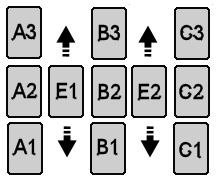
Contributed by Charles Pierce, (crp33966@mchsi.com)
In this game for 4 to 10 players, four cards are dealt to each player and eleven face down on the table, arranged in three columns of three (the shafts) with one card (the elevator) between each pair of shafts.
After the first betting round, the dealer turns up any three shaft cards (any three of A1, A2, A3, B1, B2, B3, C1, C2, C3 in the diagram) and there is another betting round. This is repeated twice more so that all the shaft cards are face up. Then the elevator cards E1, E2 are turned up one at a time, each followed by a betting round. So there are six betting rounds in all.
In the showdown, each surviving player chooses one elevator, and may consider it to be on either the bottom, middle or top ‘floor’. The player then has access to seven cards, namely the four in hand plus three from the table: the chosen elevator and the cards next to it on either side on the same floor. So the sets of three cards from the table that may be used are A1-E1-B1, A2-E1-B2, A3-E1-B3, B1-E2-C1, B2-E2-C2 or, B3-E2-C3. The player’s chosen elevator card (E1 or E2) and any other cards of the same rank in hand or on the table are wild for that player. From these seven cards the player forms his or her best 5-card poker hand, and the best 5-card hand wins.
Skyscraper Elevator

Contributed by Charles Pierce, (crp33966@mchsi.com)
In this game for 4 to 10 players, four cards are dealt to each player and eleven face down on the table, arranged in two columns of five (the shafts) with one card (the elevator) between the shafts.
After the first betting round, the dealer turns up any two shaft cards (any two of A1, A2, A3, A4, A5, C1, C2, C3, C4, C5 in the diagram) and there is another betting round. This is repeated four more times so that all the shaft cards are face up. Then the elevator cards E is turned up, followed by a final betting round. So there are seven betting rounds in all.
In the showdown, each surviving player may consider the elevator to be on any of the five possible ‘floors’. The player then has access to seven cards, namely the four in hand plus three from the table: the elevator and the cards next to it on either side on the same floor. So the sets of three cards from the table that may be used are A1-E-B1, A2-E-B2, A3-E-B3, A4-E-B4 or A5-E-B5. The elevator card (E) and any other cards of the same rank in hand or on the table are wild for that player. From these seven cards the player forms his or her best 5-card poker hand, and the best 5-card hand wins.
Cucamonga
Contributed by Douglas Wall (wall.doug@ymail.com)
This is a high-low split-pot poker game played with a standard 52-card poker deck with no jokers.
The Deal
For up to 8 players deal 5 cards to each player; with 9 to 11 players deal 4 cards each.
Two rows of 4 cards in a row (total of 8 cards) are dealt face down on the table.
The Bet
Betting starts with the cards originally dealt to each player. After each betting round, one card from each row is turned face up and another betting round follows. Continue until the last two table cards are turned face up, followed by a final betting round. There are five betting rounds in all.
The Showdown
For the showdown a poker hand consists of exactly 5 cards comprising one or two out of the player’s hand, one or two out of the top row, and one or two cards out of the bottom row. A different combination of cards can be used for the high hand and the low hand. With up to 8 players Doug Wall recommends playing ‘trips & 8’, meaning that you must have a least three of a kind or better to qualify for high and 8 or better to qualify for low. With more players when only four cards each are dealt, any high or low hand is allowed.
Boise
Contributed by Douglas Wall (wall.doug@ymail.com)
This is a high-low split-pot poker game for up to 9 players. It is a combination of Omaha (which uses two cards from each player’s hand) with ‘Seattle’ (which uses three cards from each player’s hand).
The Deal
Deal 5 cards to each player and five face down to the table.
The Bet
Betting starts with the cards originally dealt to each player. After which three cards are flopped from the 5 dealt faced down. Another bet is then made. Then of the remaining two cards then turned over, and other bet is placed. Then the final (river) card is turned up and a final bet is made.
The Showdown
To make a poker hand each player must use either three cards from hand with two from the table or two from hand with three from the table. A different combination of cards can be used for the high hand and the low hand.
Since there are so many options, this game is usually played with trips (three of a kind) or better required to qualify to win the high hand and eight or under to qualify to win the low hand.
Piles
Contributed by George Johnson (geoj1939@live.com)
This is a shared card high/low (8 or lower qualifier) split game. Each player receives 5 down cards and 13 shared cards are dealt to the table, face down: 4 cards in a 2×2 square (pile 1), 4 more cards in a second 2×2 square (pile 2) and 5 cards in a row (pile 3). These three sets of shared cards are called ‘piles’ even though the cards in each ‘pile’ are laid out side by side, not piled on top of one another.
In making their final 5-card hands players must use exactly two cards from their 5-card hand, exactly two cards from just one of the squares (pile 1 or pile 2) and one card from the row (pile 3) (so in total 3 shared cards and 3 from hand).
The figure shows a possible final layout.

After the deal, two cards are turned from pile 1 (cards marked A in the figure) then two from pile 2 (B), then the last two from pile 1 (C), then two from pile two (D), then one at a time from pile 3 (E, F, G, H, I). There are nine betting rounds, one after each of these stages. Suggested minimum bets are 25 cents after stages A-F, 50 cents after stages G and H and 1 dollar after the final stage I when all shared cards are exposed.
Players then declare high, low or both (pig) by putting a coin in their fist for high, no coin for low or two coins for both. A player who goes pig must win both ways to take the pot.
Best high hand wins high.
The best low hand is 5-4-3-2-A and at least 3 used shared cards must be 8 or less for a low qualifier to be possible. In the figure, low combinations are possible using the 2-A in pile 1 or two of the 6-7-A in pile 2 together with the 2 or the 4 from pile 3. If pile 3 where to have no cards lower than a 9 then there would be no possible low hand. The same if neither pile 1 nor 2 had two cards lower than a 9.
Best possible hands using the example in the figure:
- High: A player holds 6-6, pile 2 6-6, pile 3 K (6-6-6-6-K)
- Low: A player holds 3-5, pile 1 A-2, pile 3 4 (5-4-3-2-A) – could be tied as more than one player could hold 3-5.
Nine mandatory betting rounds make this game a pot builder and the numerous hand options keeps players in the hand.
Variation
Pairs, trips, etc. do not count for low, Full House qualifier for High, 5 or lower for Low.
Best possible hands using the example in the figure are then:
- High: same as above: player’s hand 6-6, pile 2 6-6, pile 3 K.
- Low: player’s hand A-A, pile 1 A-2, pile 3 2c, making A-A-A-2-2
In this variant 5-5-5-5-4 is the worst low qualifier, A-A-A-A-2 the best low hand possible.
The Bluffs
Contributed by David Migoya (dmigoya@denverpost.com).
Named after Council Bluffs, Iowa, this is a Hi-Lo game using Ace to Six ranking for low.
It was invented for 7 players but up to 8 can play. For 9 players one (wild) joker should be added to the deck.
The cost of exchanging a card after the third betting round is based on a game with a $20 buy in and bets of 25¢, 50¢ and $1 (maximum) with a three raise limit. If the basic stakes are higher or lower the exchange fee should be adjusted in proportion.
The dealer deals 4 cards to each player and two rows of 4 cards face-down in the middle of the table. The dealer can choose the order in which the cards are dealt, for example one card around, then two face-down in the middle, another around, then two, etc.
The table layout looks like this:

- For the high hand players must use 3 cards from their hand together with both cards of one column.
- For the low hand players must use 2 cards from their hand together with three cards from one row.
The numbers in the diagram indicate the order in which the cards of the layout are exposed, except that the dealer may choose whether to expose the ‘3-cards’ before or after the ‘4-cards’. The turn to start the betting round moves to the left after each pair of cards is exposed. The process is:
- Player left of dealer places a blind to begin the first betting round.
- Dealer turns over the two cards marked 1.
- Next active player to the left begins the second betting round.
- Dealer turns over the two cards marked 2.
- Next active player to the left begins the third betting round.
- Beginning with the player to dealer’s left, each player in turn has an option to buy a card, paying $1 to the pool to discard one card face down and be dealt a new card from the deck.
- Next active player to the left begins the fourth betting round.
- Dealer turns over either the two cards marked 3 or the two cards marked 4.
- Next active player to the left begins the fifth betting round.
- Dealer turns over the two remaining face-down cards.
- Next active player to the left begins the sixth betting round.
- Players declare which way they are playing (high, low, or both ways.
- Next active player to the left begins the seventh (final) betting round.
- Surviving players reveal cards and winners split the pot.
Example:
Table cards
| A | 10 | 6 | 5 |
|---|---|---|---|
| K | 4 | 2 | 9 |
Player holds Q 3 A K which makes
- high: two pair A A K K Q using left column
- low: 9 4 3 2 A using bottom row
Woodstock
A game in which shared cards are not just the luck of the deal but are chosen by the players, contributed by Ryan Plourde (plourde@ymail.com).
This game has been tested mainly with 2-4 players using a standard 52-card deck. It could perhaps be played by 5 or 6, but that would increase the chance that the deck would run out before all the shared cards had been placed. This changes the character of the game but does not necessarily spoil it, and can sometimes happen even with just 2 players.
After everyone has placed an ante, the dealer deals 3 cards face down to each player. These are personal hands which will never be exchanged, discarded or shared. The players look at their own cards and the remainder of the deck is placed face down in the center of the table.
The players then take turns to draw a card from the deck and decide whether to expose it as a shared card or discard it. The player to dealer’s left is the first to draw, and play continues clockwise as many times around the table as necessary until either there are five shared cards face up on the table or the deck runs out or all players but one have folded.
- If a player decides to discard their drawn card, it is played face down on the discard pile. The card is out of play for everyone and only the player who drew it knows what card it was. It then becomes the next players turn.
- If a player decides to play their drawn card as a shared card, the card is placed face-up in a common center area of table. The player who played the shared card must then immediately place a bet, which starts a betting round as in regular poker, in which players in turn must fold, call or raise the bet until the stakes of all the surviving players are equalised. The turn then passes to the next player who has not yet folded.
There are restrictions on which cards can be placed as shared cards. The common shared card area can never include
- any four cards which could be used together in a straight (for example 2-3-4-5, 2-3-5-6, 2-4-5-6) (straight draw)
- any four cards of the same suit (flush draw)
- more than one pair (full house draw)
- three equal cards (four of a kind draw)
If a player draws a card that, if added to the shared cards would create one of the above combinations, he/she must discard that card. For example if the shared cards include a King, Jack and Ten and the next player draws an Ace, the Ace must be discarded. The consequence of these restrictions is that a straight or higher can only be made by using at least two cards from a player’s personal hand. If a player correctly points out an improperly played card, the player who played the card must fold his/her hand and the incorrect card is moved to the discard pile.
If the play ends because all players except one have folded, the last surviving player collects the pot without showing any cards.
If the play ends because the deck runs out, there is a final round of betting before the showdown.
If there are two or more surviving players when the play ends, they each make their best possible 5-card poker hand using any combination of the cards available to them. Usually there will be 8 cards available: the player’s own 3 cards and the 5 shared cards on the table. (In the unusual case where the game ends because the deck runs out there will be fewer than 5 shared cards – maybe 4 or even only 3.) The holder of the highest hand wins the pot, or in case of a tie the pot is shared equally between the winners.
Tactics
Cards can be played to the shared area defensively as well as offensively. You can take up space on the board by adding useless cards to it.
If you’re a bluffer, playing large cards (that don’t match your hand) accompanied by a bold bet, can scare off opponents. Be careful, however, as you might be helping out one of your opponents.
Keep an eye on what other players are putting down to get an idea of what they’re going for.
Flaming Cross
This variant of Iron Cross was contributed by Arthur Buderick as one of the options in his Dealer’s Choice Poker game.
After the ante is paid, each player is dealt 5 cards face down, and five cards are dealt to the table in the shape of a cross: West, North, East, South and Centre. This is a high-low game with declaration. At the showdown each player will make up their final hand from 2 or more of their own cards together with 0, 1, 2 or 3 cards from the table which must lie either on the vertical (N-C-S) or the horizontal (W-C-E) line of the cross. A player declaring ‘both’ may use different lines of the cross for their high hand and their low hand if they wish.
The betting is different from normal Poker betting. The cards of the cross are turned face up by the dealer one at a time, and after each card is revealed players must pay the pot to stay in. The order of turning cards face up and the costs are West (1 chip), North (2 chips), East (4 chips), South (8 chips), Centre (16 chips). Instead of just paying the indicated amount a player may raise by paying twice the cost of the card, after which all other surviving players must call, fold or re-raise. Each raise doubles all subsequent costs, so for example if there have been two raises, the cost of staying in after the centre card is revealed will be 64 chips. The first betting round is begun by the dealer’s left and after each new card is revealed the turn to start then next betting round passes one place to the left.
Variation. In 3-card Flaming Cross just three cards are dealt to each player. The centre card of the cross is wild (along with all cards of the same rank), and the highest hand wins.
Ponsi
This is another variant contributed by Arthur Buderick in his Dealer’s Choice Poker rules, presumably named after the fraudulent investment scheme associated with Charles Ponzi.
After the $1 ante is paid the dealer deals 5 cards to each player and a row of five shared card face down to the table. After the first round of betting ($2 bet plus up to three $2 raises) each player in turn, beginning with the player to dealer’s left, must either pay $1 to see the first shared card or fold. After all have decided the first card of the row is turned face up and there is a betting round ($1 to bet and at most three $1 raises).
The same procedure is repeated for the other four shared cards. For each shared card the price to stay in and the bet/raise size increase by $1 and the first player to decide is the next surviving player to the left of the player who made the first decision in the previous round. In each round the betting is begun by the first player who stayed in. So for example for the fifth and final card it costs $5 to stay in and see it, and in the ensuing betting round the initial bet is $5 followed by at most three $5 raises.
Before the showdown the players declare simultaneously (using concealed coins) whether they will go for high, low or both (‘pig’). Players may use any selection of five cards from the ten cards at their disposal – the 5 in their hand and the 5 shared cards on the table, and if going for ‘both’ can use a different selection of 5 cards for high and for low. As usual a player declaring ‘both’ has to win both high and low to claim any part of the pot.
Five Rapid Poker Games for Fixed Stakes
These games were originally published on the Pokerlistings website. They were contributed to pagat.com by Ilya Bugreyev though in the Pokerlistings blog they are attributed to Mikolaj Domanski.
Although these games use mechanisms similar to shared card poker games to determine the winner, no poker betting rounds are involved. There is no raising, calling or folding. Instead each player plays a fixed stake, say $1 to play, all the players stay in to the end and the winner collects the pot.
Blind Hold’em
This is the most basic of the fixed stake games – essentially Texas Hold’em without betting.
- Each player is dealt two ‘hole’ cards face down and a ‘board’ of five cards is dealt face up to the table.
- Everyone reveals their two cards and makes the best poker hand they can from the seven cards available to them – their two hole cards and the five cards of the board.
- Whoever makes the best 5-card poker hand wins the pot.
That’s all there is to it – it is a game of pure chance. The author suggests that to increase the suspense the hole cards can be revealed one at a time, perhaps one after the first three board cards are dealt and the second after the fourth board card (the ‘turn’).
Blind Omaha
This fixed stake game is similar to Blind Hold’em but based on Omaha High.
- Four face down cards are dealt to each player. In this game the players do not look at these cards.
- A ‘flop’ of three cards is dealt face up to the table.
- Each player reveals two of their cards.
- A fourth face up card, the ‘turn’, is dealt to the table.
- Each player reveals one more card.
- A fifth face up card, the ‘river’, is dealt to the table.
- Each player reveals their final card.
- Each player makes the best poker hand they can using exactly two of their own cards together with exactly three of the table cards.
- Whoever makes the best 5-card poker hand wins the pot.
Again this is a game of pure chance with no decisions to be made.
Estonian Twist
Unlike the two games above, this fixed stake game involves some skill in that players must decide which of their cards to pass and then which to discard.
- Each player is dealt three cards face down that only he or she is allowed to look at.
- A flop of three face up cards is dealt to the table.
- Each player passes one card of their choice face down to their left hand opponent. This should be done simultaneously: each player places face down the card they wish to pass, and when all have done so each player picks up the card placed by the player to their right.
- Each player then discards one of their three cards face down to the muck, keeping two cards.
- A face up ‘turn’ card and a face up ‘river’ card are dealt to the table.
- Everyone makes the best poker hand they can from the seven cards available to them – their two hole cards and the five cards on the board.
- Whoever makes the best 5-card poker hand wins the pot.
According to taste, the players’ hole cards may be revealed any time after the players have discarded – for example one before the turn and the other before the river. This makes no difference to the outcome.
Crazy Dutchy
Another fixed stake game. As in Estonian Twist, players have to pass on one of their three cards and then discard a card, but in this game three separate 5-card boards are dealt.
- Each player is dealt three cards face down that only they are allowed to look at.
- Three separate flops of three cards are dealt face up to the table.
- Each player passes one card of their choice face down to their left hand opponent. This should be done simultaneously: each player places face down the card they wish to pass, and when all have done so each player picks up the card placed by the player to their right.
- Each player discards one card of their choice, keeping two cards.
- Three face up ‘turn’ cards are dealt, one to each flop.
- Three face up ‘river’ cards are dealt to complete the three 5-card boards.
- Each of the three boards is resolved separately. The winner of each board is the player who can make the best 5-card hand using 3, 4 or 5 cards from that board together with both, one or neither of their hole cards.
- If any player wins two of the three boards they collect the pot. If any player wins all three boards they collect a double pot (everyone has to contribute an additional stake). If no one wins more than one board, then the players who won one board resolve the tie between them, for example by each drawing a card from the shuffled deck.
Slovak Double Barrel
In this fixed stake game based on Texas Hold’em each player has an opportunity to exchange each of their original two face up cards for an unknown card.
- Each player is dealt two cards face down and two cards face up.
- Starting to dealer’s left each player in turn has the option of discarding one of their face-up cards to the muck, and turning one of their two face up cards face up to take its place.
- A flop of three face up cards is dealt to the table.
- Players once again have the option of discarding one of their two face up card to the muck, and turning one of their face down cards face up to take its place.
- A face up ‘turn’ card and a face up ‘river’ card are dealt to the table.
- Everyone makes the best poker hand they can from the seven cards available to them – their two face up cards and the five cards on the board. At this point players who did not use both their opportunities to exchange a card will still have one or two cards face down. These remaining face down cards are discarded and cannot be used.
- Whoever makes the best 5-card poker hand wins the pot.
Texas Hold’em
- Introduction
- Players and Cards
- The Deal and Betting
- The Showdown
- Strategy
- Variations
- Pineapple – Crazy Pineapple – Crazy Pineapple Hi-Lo
- Tahoe
- Irish
- Casino Versions
Introduction
Texas Hold’em is a shared card poker game. Each player is dealt two private cards and there are five face up shared (or “community”) cards on the table that can be used by anyone. In the showdown the winner is the player who can make the best five-card poker hand from the seven cards available.
Since the 1990’s, Texas Hold’em has become one of the most popular poker games worldwide. Its spread has been helped firstly by a number of well publicised televised tournaments such as the World Series of Poker and secondly by its success as an online game. For many people nowadays, poker has become synonymous with Texas Hold’em.
This page assumes some familiarity with the general rules and terminology of poker. See the poker rules page for an introduction to these, and the poker betting and poker hand ranking pages for further details.
Players and Cards
From two to ten players can take part. In theory more could play, but the game would become unwieldy.
A standard international 52-card pack is used.
The Deal and Betting
Texas Hold’em is usually played with no ante, but with blinds. When there are more than two players, the player to dealer’s left places a small blind, and the next player to the left a big blind. The big blind is equal to the minimum bet and the small blind is typically half that amount. When there are only two players (a “heads-up” game), the dealer places the small blind and the non-dealer the big blind.
The cards are shuffled and cut, the dealer “burns” one card and then deals the cards one at a time face down until each player has two cards. These are known as the player’s hole cards or pocket cards. Players may look at their two hole cards and must not show them to any other player.
The first betting round is begun by the player to the left of the big blind. The blinds count as bets, so the small blind need only pay the difference between the blinds to call. The big blind player acts last and is allowed to raise, even if the other active players have all called.
After the first betting round the dealer burns one card and deals three cards face up to the table. These three cards are known as the flop. There is then a second betting round begun by the first active player to the left of the dealer seat.
When the second betting round is complete, the dealer burns a card and then deals one card face up to the table. This card is known as the turn or fourth street. There is then a third betting round, again begun by the first active player to the left of the dealer seat.
After the third betting round the dealer burns another card and deals one more card face up – the river or fifth street. There is fourth and final round of betting before the showdown, again begun by the first active player to the left of the dealer seat.
In a fixed-limit or spread-limit game, any betting round that has more than two active players at the start is normally limited to one bet plus three (sometimes four) raises. In the first (pre-flop) betting round the big blind counts for this purpose as the first bet. If a betting round begins with only two active players, there is no limit on the number of raises.
In limit poker, the betting limits are usually doubled before the third betting round. So for example a $10-$20 game would typically have blinds of $5 and $10, bets of $10 in the first two rounds and bets of $20 in the last two.
The Showdown
Active players show their hands in clockwise order, beginning with the player who was the last to bet or raise in the final betting round. If everyone checked in the final betting round, the first active player to the left of the dealer seat is the first to show. See the betting and showdown page for further details.
Each player makes the best possible five-card poker hand from the seven available cards: the player’s two hole cards and the five face-up table cards, which are known as the board. This can be in any combination: both hole cards with three from the board, one hole card with four from the board, or just the board cards without using the hole cards at all, which is known as playing the board.
Note that:
- For a hand to be considered for winning the pot, the player must show both hole cards, even if only one or neither of them is used to make the best hand.
- The cards speak for themselves: the best hand is entitled to win the pot if shown, even if the owner does not realise that it is the best hand.
- As always, poker hands consist of just five cards. The two unused cards have no bearing on whether one hand is better than another.
Example. On the board is A-Q-Q-9-6. Player A has K-9; player B has 9-6; player C has 9-3. This is a three-way tie, since all three players have Q-Q-9-9-A as their best hand. The pot is split equally between A, B and C.
Strategy
Because of its great popularity as a tournament and online game, much has been written about the strategy of Texas Hold’em.
The Poker Strategy page provides a list of sites with useful Texas Hold’em Strategy articles.
The Poker Books page reviews a couple of good books about how to play Texas Hold’em.
To improve your Texas Hold’em skills, you can register for a poker course at Texas Hold’em Questions. They offer courses on bluffing and on continuation betting. Use the code “PAGAT” when signing up to obtain a 10% discount.
Variations
The game described above is Texas Hold’em as played formally in public card rooms. When it is played at home, the same procedure can be used, but in some informal games the burning of cards is omitted, and the five community cards are dealt face down to the table at the start. Three of these cards are turned face up after the first betting round, one after the second and one after the third. The result is similar to the formal game, but there is an increased risk that a player might, by accident or by cheating, learn the identity of some of the table cards before they are officially exposed.
The practice of dealing the community cards to the table at the start and turning them face up later is commonly found in community card poker games with more complex layouts, such as Iron Cross and Tic-Tac-Toe. Several of these are listed on the Poker Variants page.
Pineapple
This is played the same way as Texas Hold’em, except that each player is initially dealt three hole cards and must discard one of them before the first round of betting.
Crazy Pineapple
As in Pineapple, each player is dealt three cards, but in Crazy Pineapple they are kept until after the second betting round. Each active player must discard one card immediately before the fourth board card (the turn) is dealt.
Crazy Pineapple Hi-Lo 8 or Better
Crazy Pineapple is often played in such a way that the pot is shared between the players with the highest and lowest hands. The deal and betting are exactly as in Crazy Pineapple. At the showdown, as well as making their best hand, each active player makes the lowest possible hand from their seven cards. When making a low hand, the five cards must all be of different ranks, the aces count as low, straights and flushes do not count, and no card can be higher than an 8. So the best low hand is A-2-3-4-5 and the worst is 8-7-6-5-4. Cards are compared from the top down, so 7-5-4-3-2 is better than 7-6-3-2-A because the 5 is lower than the 6. Players can use a different selection of cards for their high hand and their low hand.
The pot is split equally between the highest hand and the lowest hand. If none of the active players qualifies for low (which will automatically be the case if there are three cards higher than 8 on the board), then the player with the highest hand wins the whole pot.
Tahoe
As in Pineapple, each player is dealt three hole cards, but in this version players keep all three cards until the showdown. In the showdown a player can use 0, 1 or 2 of their hole cards (but not all three) together with 5, 4 or 3 cards from the board to make their final hand.
Like Crazy Pinapple, Tahoe can be played as a hi-lo game. In this case, although players can only use at most two of their hole cards for each hand (hi and lo), they can use a different selection of cards for each hand.
Tahoe is sometimes known as Wichita Hold’em.
Irish
This Texas Hold’em variant is similar to Crazy Pineapple, but each player is initially dealt four hole cards. These can all be kept until the end of the second round of betting. Before the fourth board card (the turn) is dealt, each active player must discard two of their hole cards, keeping just two for the turn and river.
Stud-Jack
Invented by Ken McKenzie and contributed by Dave Kinney (DKinney@fhi.org)
This is straight 7 Card Stud except that your two cards down comprise a blackjack hand. You may pay to have the 7th card dealt up so as not to take a hit on your blackjack hand. The high poker hand and the best blackjack hand split the pot.
Widow Jack
A variation of Stud-Jack contributed by fran (montspaw@rochester.rr.com)
This game is dealt and played just like “stud jack“, but with the “black mariah” rules. If the “black mariah” (Q) appears, the hand is reset and even a great blackjack hand gets wiped out.
New York New York
Contributed by Dave Kinney (DKinney@fhi.org)
This game was invented by Ellen Czeh several years ago and it has become a staple around the kitchen table. She called it New York New York as she lived there at the moment of inspiration.
This is a seven card stud high low poker game. Each player is dealt the first three cards, two down, one up and then there is a betting round. The deck is then placed in the middle of the table and two cards turned up, one on each side of the deck. Each player in turn selects a card, either one of the turned up cards or a card from the top of the deck, which would be turned up except on the seventh card. As turned up cards are removed, the dealer replaces them from the deck turning it up on vacant spot. After all players have selected a card, there is a betting round. Play continues until all players have seven cards. On the last card, if an up card is selected it stays up, if a down card is selected it stays down. Typically there is a declare, because both high and low can be won by the same person. A betting round would typically follow the declare, but this is optional.
Note: after all the players have 7 cards, there will be either one or two central face-up cards remaining, depending whether the last card taken is an up card or a down card. These central cards are out of play, but known to the players during the declaration and final betting round.
Weeping Willow
Developed by the Monday Night Poker Club and contributed by Roger Shuman (rdshuman@hotmail.com)
Ante: There is no “ante” but each player must place 6 nickels (or whatever your group chooses) in front of him. These will be used to purchase trades with other players once the game begins)
DEAL: 5-7 cards to each player (as long as everyone gets the same amount)
PLAY: Once the cards are dealt, optional trading begins. A player may exchange any equal number of cards with any other player (e.g. Player A trades 3 cards with Player B). Each trade costs a player one nickel. Upon making the trade, he or she places one nickel into the pot. Each player has a maximum of six trades (one for each nickel). There are no requirements for trading (i.e. players can trade mixed cards, pairs, sets, single cards, whatever) as long as the exchange consists of the same amount of cards for each player – 1 for 1, 2 for 2, etc. Once trading is done, each player selects the five cards he will use for his hand and places them face down in the order he wants to reveal them one at a time (i.e. “roll your own”). The betting round starts with each player turning over his first card. Once the card is turned up, the highest showing card bets. Play continues until the fifth card is turned over and there is a winner.
Clarification of trading process.
- If you wish to trade, you call out just the number of cards you want to trade – for example “three”. You are not allowed to give any information about the identity of the cards.
- There is no obligation on anyone to participate in a trade.
- If two players agree to trade some number of cards, each of them must pay a nickel to the pot.
STRATEGY FOR TRADING ROUND: Many players will use up all of their trades. However, some may opt to stop trading early. One might stop early in order to get other players to assume the presence of a good hand. Or, one might stop early to ensure that his or her cards (if traded) do not increase the chances of someone else trading into a better hand. Then again, some players are just too cheap to give up all of their nickels.
STRATEGY FOR BETTING ROUNDS: As in any “roll your own” variation, players carefully choose the order in which they will reveal cards. Since other players (especially those who are apt at keeping track of cards) will know the location of certain cards, it might make sense to play those early. Players like to keep opponents guessing at the actual value of their hand until late in the game. This allows for bluffing.
Sex in the Middle East
Contributed by Ian Blessing (discomonkey@mail.com)
The game is dealt like basic 7 card stud. The only real difference is that 5’s are wild, and whenever a 5 is dealt up the card after that is wild as well. So say I get a 5 dealt up to me. The next person gets dealt a 2. 2’s are now wild for everyone, throughout the deal. Potentially then, you can have 5 wild cards by the end of the deal. The rest is the same as 7 card stud, with betting after every card.
Two Thirds
Contributed by Andrew Demkovich (stratz9@aol.com)
The deal and betting are the same as in Seven Card Stud, but in order to win a showdown you must have at least two of the following:
- the best hand;
- the lowest spade in the hole (face down);
- the highest spade in the hole.
If no one has two out of three of these, the pot rolls over to another hand.
The spade can be separate from the best 5-card hand. For example it is possible to win with a diamond flush and the lowest face down spade.
Note that if there is only one spade among the hole cards of the players in the showdown, that spade is both the highest and the lowest and its owner wins the pot.
Faces of Death
A variation of Black Mariah suitable for a small table (4-5 players) contributed by fran (montspaw@rochester.rr.com)
The game is dealt and played just like 7 card stud and “Black Mariah“, but instead of just the queen of spades being the “mariah”, any spade face card kills the hand – thus the “faces of death” name.
Chameleon
Invented by Paul DeLuca (paul_deluca@adelphia.net) and Fritz Stei.
Players: 3-7
Initial Deal: After the ante, players are dealt seven cards face down, no-peek.
Play:This is the same as midnight baseball but the wild cards (3s and 9s) can change during the game, only if a 7 is turned up. If one is turned up, the player who receives it has the option to change-out one of the initial wild cards (3 or 9) for a pre-determined fee. If the fee is paid, have the player decide which wild card he would like to change. Using a second deck draw the top card and place it face up next to the deck. This is the new wild card along with the other remaining wild card. At this point the wilds cards are; one of the initial ones and the one turned up by the second deck. If another seven is drawn the same option applies. Play continues until the person with the best 5 card hand wins.
Tip: Folding earlier can prove later on to become a bad move as a dead hand may be revived as cards within can suddenly become wild.
Luck of the Irish
A variation of seven card stud poker with a wild card, contributed by Alan Frandsen (afrandse@ca.ibm.com)
 | Deal the traditional 2 cards down, 4 up and last one down. Betting is as per normal 7 card stud. However, fours are wild. The four of clubs is double wild in the sense that if it shows up as one of cards dealt face up, that person will get one extra card, face down. If it is one of the cards dealt face down doing regular play, then it is just wild, no extra card.The dealer could also specify a cost associated with collecting the bonus card prior to dealing hands, meaning a person receiving the four of clubs in the face up cards would have to pay a predetermined dollar amount to the ante if he/she decides to accept the extra card. Declining doesn’t mean you have to fold, just that you don’t want, don’t need or can’t afford the bonus card. |  |
Woolworth’s Jackpot Penalty Multiple Joker Twist and Flip
Craig Roy (craigroy@iinet.net.au) writes:
This note is to tell you about a variant of poker that we play regularly. It has a lot of risks and bluffing involved. We generally play this variant with Woolworth’s, but can be played with any other stud variant where wilds are involved.
If you do not know the rules for Woolworth’s:
- 7 card stud 5 and 10 are wild
- If a 5 is turned up you must pay $5 to continue or fold
- If a 10 is turned up you must pay $10 to continue or fold
- All normal 7 card stud rules apply
Variations
Woolworth’s Jackpot penalty
As with normal Woolworth’s but
- the first wild card turned: normal penalty to continue
- second wild card: double penalty
- third wild card: 4 times penalty
- forth wild card: 8 times penalty. and so forth
This changes the dynamics and really makes buying the wild card a big decision. As the game goes on you know more of your hand, so it costs more to buy the wild card.
Joker Twist
Joker is wild if by itself. If joker and other wild cards combine in one hand you have killed all wild cards.
Joker twist and flip
Same as above except whoever holds the Joker, after all betting is done, before the showdown, they have the option to flip the joker to someone else.
Multiple joker twist and flip
(You will require more than 1 deck of identical cards. Remove jokers from the other decks and add them to the playing deck. We have found the more jokers, the better, up to 8 jokers. More than 8 jokers is not very successful. The more players, the more jokers should be used. What seems to work well: 4 players with 4 jokers; 6 players with 6 jokers; 8 players with 8 jokers)
Same as above except after betting on the final round, the player on the left of the called person goes first and has the option to flip 1 (one) of their jokers to anyone they choose or pass. The person called goes last. Any flipped joker cannot be re-flipped: only jokers in the original player’s hand can be used. Either hidden or showing jokers can be flipped depending on the player’s strategy or bluff. Note that in this game there will be only 4 raises are allowed for any one person in the final betting round. One chip is placed in front of each player as they do their raises.
Please note
We generally do not play the earlier versions of the game we now play quite extensively Woolworth’s Jackpot penalty Multiple joker twist and flip, if you try this you will find that big decisions are made during the initial rounds, and some people will buy the card at high price, also there is always a great betting duel in the final where the control of the game end is decided. With only 4 raises to play with you have to decide when to call instead of raise, and you may not get what you want. There is a lot of bluffing in this game as some people will need a joker to be flipped to them to improve their hand but will have to hope it happens.
Who da Baby Daddy Is?
Contributed by Ten Ox (NoLonger@attbi.com)
In this 5- or 7- card stud variation, the rank of last card dealt to each player (‘da Baby Daddy’) is wild for that player only.
To begin, two cards are dealt face down to each player. Then there is a betting round.
Then one card is dealt face up to each player, and there is another betting round.
Another card is dealt face up to each player, and there is another betting round. Now each player has 4 cards (2 down and 2 up). If it is a 7-card game, this is repeated two more times, so that each player has cards (2 down and 4 up).
Then a final card is dealt face up to each player who has not folded. Any other card in the same player’s hand, whether up or down, that matches the rank of this last card dealt (the wild card – ‘da baby daddy’) is also wild. There is no further betting after this last card is dealt: the hands are exposed and the best hand wins the pot.
Smack My Bitch Up
This poker variant, based on Follow the Queen, was contributed by Andy “Sprocket” Noreen who writes:
“It’s called ‘Smack My Bitch Up‘ after the song from Prodigy. I do not condone hitting a woman – ever, but the song was popular at the time and we had thrown back a few cold ones. I have called it ‘Pimp Daddy‘ as an alternative name.”
This game uses the same rules as Follow the Queen, except that if a King shows as an “Up” card (face-up), it cancels ALL previous wild cards, including any Queens [that’s the “Smack” and the word or game title is usually shouted when that happens].
From then on, only Kings are wild, unless another Queen shows up, which cancels the King and then it reverts back to basic “Follow the Queen” rules [the Queens are wild again and have taken revenge on the King(s)].
The wild card alternates back-and-forth depending on whether a King or Queen is the last up card. If there are no Kings dealt face-up, it’s a straightforward “Follow the Queen” game.
Seven and What Makes It
A variation of 7 card stud with up to 7 wild cards, contributed by Dan Mathe (Lucky7DJM@aol.com) .
Players: 2-7
Initial deal: Dealt like 7 card stud
Play: Cards are dealt out like 7 card stud. The one variation is that any sets of your cards that add up to 7 (including 7 by itself) are wild. So, let’s say you have a 3 and 4 down, and a 7 dealt up. 3+4 = 7, and 7 =7, so you have 3 wilds right off the bat. Aces count as one. Another example: you have an Ace, 3 down and a 2, Ace up. 1+3+1+2 = 7, so all four cards are wild. You cannot use a card in more than one combination at a time to make 7. So if you have a 4,3,3,2,King,9,8 hand, only the 4 and one 3 can be wild, not the four and both 3’s.
Winning hand: High hand wins. Best hand is 5 Aces.
Tip: Be sure to stop betting and fold in this game if you don’t have a full house or higher, unless you have some possible cards up to make 7, like a 3, 5 up. Then you can bluff people into think you have a 4 or 2 down.
Eddie’s Choice
A variation of 7 card stud, contributed by Dan Mathe (Lucky7DJM@aol.com) . Match either of your down cards with one of your up cards and both the matching up and down cards become wild.
Players: 2-7
Deal/Play: Two cards dealt down to each player. The dealer then flips the card on the top of the deck and asks the person to his left whether they want the card.
- If the player does not want the card, the next card in the deck is given to that player (face up), and the face up card that the player rejected is offered to the next person in turn.
- If a player does take the offered face up card, a new card is flipped and the next player is offered a choice between this new face up card or a card from the deck.
This continues around the table until the dealer’s turn. If the dealer does not take the face up card offered to him, he draws the next card from the deck and the face up card is placed on the bottom of the deck. There is then a round of betting.
Each player receives three further up-cards, by the same process, with a round of betting after each new card. If you match any of your up cards with a down card, they both become wild. So if you have a 3 down and a 3 is offered to you, take that card.
This continues until the 7th card, which is dealt down. If this card matches any of your up cards, they also become wild.
Winning hand: High hand wins. Best hand is 5 Aces.
Tip: Be sure to stop betting and fold in this game if you don’t have a full house or higher. To bluff, take a card that is offered to you to make it seem as if you’ve matched.
Low Hold
A variation of 7 card stud [similar to low hole but with buying], contributed by Dan Mathe (Lucky7DJM@aol.com) . The lowest card in your face down hand is wild.
Players: 2-7
Deal/Play: Dealt exactly like 7 card stud, but the last card can be bought face up to save a wild card. The price is fixed by the dealer before the start of the deal and paid to the pot. A player not wishing to pay can receive the last card face down for free as usual. The lowest face down card in your hand is wild.
Winning hand: High hand wins.
The same game is included in Arthur Buderick’s Dealer’s Choice Poker under the name Low Hold. Aces always count as high and the cost of having the seventh card dealt face down is equal to the size of the final round bet or raise (this is a fixed limit game). Before the seventh card is dealt players declare simultanoeusly whether they want their last card face down or face up by holding one or two coins in a closed fist, and revealing their choices when everyone is ready.
Train wreck
A seven card stud variant contributed by Kevin Borror (kitchensoldandnew@comcast.net)
As usual in seven card stud, players are dealt two cards face down (hole cards), four cards face up (table cards), and a final one face down. The cards are dealt one at a time, and there are five betting rounds: one after each round of face up cards has been dealt and one after the final round of face down cards is dealt.
Certain combinations of table cards dealt to a player cause special actions.
- A player whose table cards include a natural pair of twos is immediately dealt an extra card face up.
- A player whose table cards include a natural pair of threes or fours must immediately select a table card belonging to another player and remove it from play by discarding it.
- A player whose table cards include a natural pair of fives immediately takes a table card of their choice from one of the other players and adds it to his or her own hand as an extra face up card.
Note that extra card received from the dealer for a pair of twos or from another player for a pair of fives cannot be used as part of a pair to trigger a new special action. Nor can a player’s hole cards be used. Only the four table cards count towards these special pairs.
It is possible to have two pairs in your four table cards, resulting in two special actions. Trips among the table cards (three twos, threes, fours or fives) have no effect beyond that of the pair.
When giving the players their second table card, the following procedure is used. The dealer turns the top card of the deck face up and offers it to the first player (the nearest player to dealer’s left who has not folded). This player may either accept the card or pay 25 cents to the pot to be dealt the next (unseen) card from the deck instead. If the first player accepts the offered card, a new card is turned and offered to the second player. If the first player rejected the offered card and paid for a card from the deck instead, the same face up card is offered to the second player. The second and subsequent players have the same options as the first player: to accept the offered card free or to pay for an unseen card from the deck instead. At the end of the round, if the last player rejects the offered card it is placed at the bottom of the deck and not used in that deal.
When dealing the third and fourth table cards, the same procedure is used, but the fee to be dealt a card from the deck is 50 cents for the third card and 1 dollar for the fourth card.
Spokane Open Wild
Contributed by Dave DeLine (deline49@esen.coe)
Each player is dealt one card face down as the first card of his hand; he looks at it but doesn’t reveal it to the other players. Then the dealer then deals to the center of the table, face up, a number of cards equal to the number of players plus one. For example with 5 players, 6 cards are dealt face up to the center of the table.
Each player, in turn, then chooses one of the face up cards from the center of the table starting with the player to the left of the dealer, then the other players in turn, and ending with the dealer who will have just two cards to choose from. Each player keeps his chosen card face up in front of him and the unchosen card remains in the center of the table. After all players have chosen there is a betting round beginning with the player to dealer’s left.
After the initial round of betting. The dealer deals another set of face up cards to the center of the table, equal to the number of remaining players. Since one card remains from the previous deal, there will again be one more exposed card than there are active players. The next active player to the left of the player who chose first in the previous round of the deal has first choice of card, and then the others choose in order. The player with the best hand showing starts a new round of betting.
Provided that more than one player remains in, this continues for two more rounds of dealing, choosing and betting, after which each active player has one hand card and four exposed cards. If there are any active players who have not yet had first choice of center card, there are further rounds of dealing and betting until all active players have had an opportunity for first pick of the center cards.
Throughout the game all cards of the same rank as the face up center card are considered wild cards.
After the final round of betting, if there is still more than one active player, each player makes the best 5-card hand he can from his face up cards and his hole card, and the best hand wins the pot.
Five Card Roll Your Own
A 5 card stud game contributed by Dave DeLine (deline49@esen.coe)
Each player is dealt a 6 card hand face down. After examining their cards, each player discards 3 cards face down to a common pool, without exposing them to the other players. The dealer shuffles all the pool cards together.
Each player now simultaneously turns up one card from his hand, his choice. The player with the highest upcard starts the betting. After the betting all players (starting with the player with the highest up card) draw one card from the face down pool. Each player looks at his new card and chooses one of his three down cards to expose. All players simultaneously turn their chosen card. Players should now have 2 cards up and two cards down.
Another round of betting followed by another draw from the pool. The player with the two highest cards starts the betting and draws first from the pool. Players again select one card from their hand and place it face up followed by a round of betting.
The player with the lowest hand showing selects one of the remaining cards from the pool and turns it face up. This card is the designated wild card – it does not belong to any player but all cards of the same rank as this card are wild. For example a Queen is turned up and all the remaining Queens are wild. (The turned up Queen is not part of any players hand – it only designates that Queens are wild.)
Now there is a final round of betting followed by a showdown if two or more players are still in.
Vancouver Stud
This hybrid of Stud and Hold’em Poker was invented by Torey Jones (toreytjjones@gmail.com)
Before the deal, the player to the left of the dealer puts in the agreed big blind (for example 2 or 4 chips) and everybody else puts in half that amount (1 or 2 chips) (or you can use any other system of blinds or ante that you prefer).
Each player is then dealt 2 face down cards. There is a round of betting.
After the first round of betting, each surviving player is dealt one face up card of their own (counting only toward their hand) and one community card is dealt (counting towards everyone’s hand). There is a second round of betting.
Each surviving player is then dealt a face down card that counts toward their hand only, and a second community card is dealt face up. There is a third round of betting.
Each surviving player is dealt another face up card, and another community card. At this point, active players should have five cards each – three face down and two face up, and there are three face up community cards in the middle. There is a final round of betting.
In the showdown, the person with the best 5-card hand wins. This hand can use 2, 3, 4 or all 5 of the player’s own cards together with some, none or all of the community cards.
Babies’ Daddy
A 7-card Stud variant by Bill Curran (myonlineemail@verizon.net)
First, two cards are dealt face down to each player. Then each player receives a third card face up, and the King of the suit of the first up card dealt is the “Daddy” and is wild. The deal continues as usual for 7-card stud: three more cards each face up and a final one face down. The low card (and any matching cards) in each player’s hand is/are wild for that player only. The Queen of the same suit as the “Daddy” King is the “Mommy” and gets half the pot.
High-Low Chicago
Contributed by Josh Breid (Jman79@i29.net)
This variation can be combined with most versions of poker – for example it would work well with 7-card stud.
At the end of the hand, if there is a showdown the pot is split 3 ways:
- person with best poker hand
- person with highest spade
- person with lowest spade
If playing a game with exposed cards, only concealed spades in player’s hands qualify for the highest or lowest spade portions of the pot.
There is no declaration or which part of the pot one is playing for: the pot is automatically split.
If there is only one qualifying spade, its owner wins both the high-spade and low-spade portions of the pot(two thirds of the pot). If there are no qualifying spades the whole pot goes to the owner of the best poker hand. It is of course possible for the player with the best poker hand to hold the highest or lowest spade as well, or both. Thus there can be 1, 2 or 3 winners.
Dead Deuce
Contributed by Harry Carter (jhcarter1@hotmail.com)
In this variation of seven card stud, face up deuces are wild but face down deuces count only as deuces.
First, all players are dealt three cards face down. They then “roll their own” by looking at their cards and turning just one of them face up. Then there is a betting round.
The fourth, fifth and sixth cards for each player are dealt face up, with a betting round after each. Then the seventh card is dealt face down, followed by a final betting round.
Note that since there is only one opportunity to “roll your own” in this variant, a player who is dealt two or even three deuces in the first three cards can only make one of them wild. The others remain as deuces, as does the seventh card, if that happens to be a deuce.
Baseball, National League Rules
Contributed by John Noriega (johnqs@earthlink.net)
This version of Baseball is called “National League Rules” to keep it from being confused with the standard Baseball variant.
Baseball, National League is a seven card stud game and as in standard baseball, 9’s are are wild.
Since any good baseball game has a seventh inning stretch, any player who gets a seven as an up card gets is dealt an extra card face up (dealt after every player has their card for that round).
Since it’s “three strikes and you’re out”, getting a three face up puts you out of the hand.
Football (3)
Contributed by John Noriega (johnqs@earthlink.net)
This is a seven card stud game with extra rules inspired by American Football.
There are four quarters in a game, so 4’s are wild.
An Ace as an up card is an extra point – everybody has to pay a buck (or more or less depending on the agreed ante/stakes) to whoever gets an up Ace.
A three is a field goal – any player who gets a 3 as an up card gets to cut the deck. The card they cut to becomes their personal wild card. (For example if they cut to a 5 they don’t take that 5 out of the deck, but any fives in their hand are wild.)
The four up cards count as your four downs. You need to get ten yards to continue, that is the value of your up cards must be 10 or more or you’re out of the hand. Aces count as 1 point, numeral cards face value. Dealer must state before the deal whether picture cards (K, Q, J) will count as zero points or 1 point.
The Punt: a player who is not likely to meet his ten yards in four downs, and does not wish to risk being put out of the hand, may punt. To punt the player puts ten times the ante into the pot and does not receive a fourth up card. Dealer must ask players at risk if they wish to punt, or at least make a definite “Punt Now” announcement, before dealing the fourth up card.
Hearts Poker
Contributed by Jack Namazukage (Namazukage7@fresnomail.com)
- All players are dealt two cards face down and one card face up. There is a betting round based on the players’ three cards.
- Players simultaneously pass one of their face-down cards to the player to their left. There is a second round of betting.
- Everyone gets a fourth card, face up. Players simultaneously pass one of their face-up cards to their right. There is a third round of betting.
- Every player discards two cards. These have to be both the face-up cards or both the face-down cards: they cannot be one of each. A player who discarded his face-down cards now picks up his face-up cards and holds them concealed for the remainder of the hand. The dealer shuffles the discard pile and turns up one card as a community card. The dealer also turns up two cards from the original remaining deck. Players now have two hole cards and three community cards. There is a fourth round of betting.
- If there are two or more hearts among the community cards, then the dealer turns up three more cards from the original remaining deck and a fifth round of betting occurs. If there are fewer than two hearts among the community cards, this step is omitted: play stops after the fourth round of betting.
- The surviving players show their cards.
- If a player holds the Queen of Spades as one of his hand cards, that player must forfeit (discard) his higher ranking card. If that player has a pair of Queens, the Queen of Spades is discarded.
- If a player is holding the Jack of Diamonds, that player is dealt one additional card.
- The Queen of Spades or Jack of Diamonds among the community cards has no effect.
- The player who can make the best five-card hand from his own cards and the three or six community cards wins the pot. A player who has access to only four cards (one hand card having held the Queen of Spades plus three community cards) can compete on the basis of these four cards, but cannot make a straight flush or full house.
Delaware Stud
A Stud / Omaha-Holdem hybrid, contributed by Mr. White (spin11@gmail.com)
- Blinds are placed, each player is dealt two cards face down, and this is followed by a betting round. (like Holdem)
- The dealer burns a card, and exposes a three card flop, and there is a second round of betting. (like Holdem)
- A card is now dealt exposed to each player, followed by a betting round. (like 6th street in 7 card stud)
- Finally, the dealer burns a card, and each player is dealt a river card face down, followed by a betting round. (like the river card in 7 card stud)
With only a three card widow, each player must use at least two of his own cards, but may instead use three of his own cards with two table cards or all four of his own cards with just one table card, to make the best hand. The highest five-card hand wins the showdown.
With its four betting rounds and forced bet structure, this game lends itself to tournament play.
Riding Ramone
Contributed by Les Stanwood (Les.Stanwood@skagit.edu)
This is a five card stud ace to five lowball game (aces low, straights and flushes don’t count, best hand is the wheel A-2-3-4-5).
Deal five cards to each player, but they must not look at their cards (or they are out of the game). Then deal a 3-card “boot”, face down.
Everyone turns over their first card and then the betting starts. (First better is low card showing; we play three raise limit.) Then everyone turns over their next card and there is another betting round. This continues until all the cards are face up, so there will be four betting rounds in all. Each betting round begins with the lowest hand showing, and up to three raises are allowed.
The person with the lowest hand is the winner, but only if he also wins against the three-card boot (Ramone). If he does not win against Ramone, deal again, but include only the players who have not folded. Anyone who drops out is out of the game until someone beats Ramone and collects the pot.
Note: When comparing a 5-card hand with Ramone only the cards that make your highest three-card hand are used, and Ramone wins ties. Example: Ramone has 9-6-5. A player with 9-6-4-3-2 would win against Ramone, but 9-6-5-3-2 would not win (tied with Ramone) and 8-5-3-3-2 would not win (pair of threes beats 9-high).
Variation: Play that face cards count as zero, as in More or Less.
More or Less
Contributed by Les Stanwood (Les.Stanwood@skagit.edu)
This is a seven-card stud ace to five lowball variant. Deal two cards face down and one face up; betting round; then three cards face up with a betting round after each; then one card face down and a final betting round.
In this variant all face cards (King, Queen and Jack) count as zero and do not pair. So the lowest hand consists of five face cards, but hands with fewer than five face cards need not necessarily be good. For example (10-9-)9-K-K-Q-J counts as a 9-high, and so is beaten by (for example) 10-10-8-7-6-4-3 (8-high). But where hands are otherwise equal, face cards are the best – for example (10-10-)8-6-5-K-J beats (9-8-)8-6-5-2-Q.
Motown
Contributed by Patrick Koestler (pjkes@comcast.net)
In this seven-card stud variant:
- each player puts an ante into the pot
- each player is dealt 2 cards face down and 1 card face up – there is a betting round
- each player is dealt 1 card face up (4th card) – there is a betting round
- each player is dealt 1 card face up (5th card) – there is a betting round
- each player is dealt 1 card face up (6th card) – there is a betting round
- each player is dealt 1 card face down (7th and last card) – there is a betting round, followed by the showdown.
In the showdown:
- The player with the Jack of spades gets 1/4 of the pot.
- The player with the 5 of spades gets 1/4 of the pot.
- The high hand gets the remainder of the pot.
Exception. If one player has both the Jack of spades and the 5 of spades, that player has “Motown” and wins the whole pot. In this case the player with the high hand gets nothing.
Examples:
- If no player has the Jack or the 5 of spades, then the high hand gets the whole pot.
- If only the Jack or the 5 of spades is held by a player, that person gets 1/4 and high hand gets 3/4 of the pot.
- If the high hand also holds the Jack of spades and another player holds the 5 of spades, the high hand plus Jack of spades gets 3/4 of pot (i.e., 1/2 plus 1/4) and the 5 of spades gets 1/4.
- If the high hand holds the Jack or 5 of spades and no one has the other Motown card, then the high hand gets the whole pot.
Note: if you are dealt “Motown” in your initial (and ideally, down) cards, play it cool and keep the betting going. The holder of “Motown” is not required to declare it until the showdown.
Patrick Koestler writes: ‘The nice thing about this game is that it tends to keep more people in the game longer, especially those with the Jack or the 5 of spades (sometimes they don’t realize that getting “1/4-ed” is a losing proposition, depending on the betting and number of players still “in”.)’
Four Up, Four Down
This variant, also known as ‘Respect the 4’, was contributed by Robert Dier (tantalus@pobox.com), who has been playing it since 1972. It is a kind of eight-card stud in which the fours have special properties.
First 4 cards are dealt face down to each player. Any 4 dealt face down is wild. Players then bet.
Then a face up card is dealt to each player. Any player who is dealt a 4 face up is knocked out (forced to fold). There is then another round of betting.
This is repeated three more times – one face up card to each surviving player, anyone with a face up 4 is knocked out, and there is another betting round.
When all surviving players have eight cards – four up and four down – after the final betting round there is a showdown. High hand wins.
No Peek High-Low
Invented by George Johnson and contributed by his son Brian (bjohnson203@cox.net)
This is a modified version of the well-known No Peek. It is played as normal but with a low hand split in addition to the high winning hand. In the play there are two phases. Low hands use ace to five ranking.
The first phase is the same as normal No Peek. Each player is dealt seven cards face down and the next card is dealt face up for the first player to beat. At your turn you flip cards face up until you can beat the highest hand so far showing or until you have flipped all seven. Each player’s turn is followed by a round of betting starting with the high hand. If after exposing the last of your 7 cards you can’t beat the high hand, you then check to see whether have the best low hand. If you don’t have the best low hand either you will have to fold in the ensuing betting round, but if you do have the best low hand you can stay in and the game enters phase two.
In the second phase play continues in turn around the table. Now each player flips cards until they have either the best high hand or the best low hand or they have exposed all seven of their cards. This continues until everyone has either folded or exposed all seven cards.
Now the high hand and the low hand split the pot. It is recommended that the high hand should win 75% of the pot and the low hand 25%.
Two-Spit
Contributed by David Migoya (dmigoya@denverpost.com) .
This is a high-low variant of 5 card stud – one card down and 4 cards up followed by two opportunities to pay to exchange a card. For low hands Ace to Six ranking is used.
Deuces are wild only for the high hand, not for the low hand. This makes it easier for players to declare both ways (high and low).
The cost of exchanging a card is based on a game with a $20 buy in and bets of 25¢, 50¢ and $1 (maximum) with a three raise limit. If the basic stakes are higher or lower the exchange fee should be adjusted in proportion.
The game process is as follows:
- Deal each player one card, then one card each face up.
- There is a round of betting beginning with the player with the highest card showing.
- Deal resumes, one face-up card each, followed by a betting round, repeated until each player has one down and four up cards before them.
- When everyone has 5 cards and the betting is over, there is a “spit”. Each player in turn may exchange an “up” card for a new up-card by paying $1 to the pot or their down card for a new down-card by paying $1.50.
- There is another round of betting, starting with the player whose 4 face up cards make the highest hand.
- Then there is a second spit, in which it costs $2 to exchange an up-card and $2.50 to exchange a down-card.
- There is another round of betting, starting with best (highest) face up cards.
- All surviving players declare (high or low or both ways)
- There is a final round of betting, beginning with highest 4 up-cards.
- Then there is a showdown between the surviving players.
Note: a player may choose to not spit (exchange) a card, but or if a player chooses not spit the first time but does spit the second time, the cost the higher $2/$2.50 fee, not the $1/$1.50.
Liege Lord
Contributed by Justin du Coeur, from his poker variants collection.
This is a Seven Card Stud Roll Your Own variant in which cards are passed to the left and the winner splits the pot with the nearest surviving player to their left. The game process is as follows.
- Deal three cards face down to each player.
- Each player passes one card to their left.
- Each player chooses one of their three face down cards to reveal – it could be one of the two they kept or the card that was passed to them. The chosen cards are revealed simultaneously.
- There is a round of betting, begun by the player with the highest card showing.
- Deal one more card to each surviving player.
- Each player passes one of their three face down cards to the nearest surviving player to their left.
- Each player chooses one more card to reveal – again it could be the card they just received or one of the two they had during the previous betting round, and the chosen cards are revealed simultaneously.
- There is a round of betting begun by the player with the best poker hand showing.
- Repeat steps 5-8 twice more, so that for the fourth betting round each surviving player has two cards face down and four face up on the table.
- Deal a seventh card face down to each surviving player.
- Each player passes one of their three face down cards to the nearest surviving player to their left, but this time no card is revealed. So each surviving player now has four cards face up and three face down.
- Fifth and final betting round begun by the player with the best poker hand showing.
- Showdown in which the highest five-card poker hand wins. The winner shares the pot equally with the nearest player to their right who has not folded.
In theory, if all players but one were to fold, that one player would win the whole pot. In practice, however, this never happens: when there are only two players remaining, it is always right to call rather than fold, as each player then receives half of the final pot.
Justin du Coeur writes: In my opinion, [this is] the best invention we’ve come up with. You want to pass good and consistent cards in Liege Lord, to help the person you are passing to win. By convention, table talk about what you are trying for is forbidden: signalling is done only through the passes and the revealed cards.
5-2-1 Roll ‘Em
This High-Low Five Card Stud game, a variant of Roll Your Own, was contributed by Arthur Buderick as one of the options in his Dealer’s Choice Poker game.
Ace to Five ranking is used for low hands.
Five cards are dealt to each player and there is a betting round begun by the player to dealer’s left.
Players may discard one or two cards and be dealt replacements or may keep their original hands. There is then a second betting round begun by the next surviving player to the left of the one who begun the first round of betting.
Players may then discard one card and be dealt a replacement or keep their cards. After this everyone stacks their cards face down in front of them in the reverse of the order in which they want to display them, so that the first card to be displayed will be on top of the pile.
All surviving players turn over the top card of their pile, and there is a round of betting begun by the player with the highest card showing. This procedure is repeated for the players’ second and third fourth cards, the betting being begun by the player with the highest hand showing.
Then the survivors declare high or low (using coins). It is possible to declare both (for example when holding a wheel A-2-3-4-5 which is the lowest hand as well as a straight) but in that case the player will collect nothing if they lose or tie for either high or low.
Horn-A-Vika
This Seven Card Stud variant with an extra spit card and pot matching was contributed by Arthur Buderick as one of the options in his Dealer’s Choice Poker game. The principle is that whenever a player acquires a new face-up card that matches the rank of another of their face-up cards, creating a pair, trips, two pair, etc. on the board, they must either pay the pot an amount equal to what it contains at that moment or fold. Bets and raises are subject to a fixed maximum, except for players who have paired on the board who can bet or raise up to half the amount they paid to match the pot the last time they did so.
The dealing and betting process is as follows.
- The dealer antes $1 and then deals two cards each face down, followed by one card each face up. Then there is a betting round begun by the owner of the highest card showing, with a maximum bet of $2 and a maximum of three raises allowed.
- The dealer deals another card face up to each surviving player and everyone whose two face up cards form a pair must immediately either match the pot or fold. There is a second betting round begun by the player with the best hand showing. Again up to three raises are allowed and the maximum bet or raise is $2 for players who do not have a pair, but players who have a pair may bet or raise up to half the amount they paid to match the pot (if that was more than $2).
- The dealer deals a third face up card to each surviving player and as before anyone who pairs up must match the pot or fold. Then the dealer deals a shared ‘spit’ card face up to the table and anyone who has a face up card equal to the spit card must match the pot or fold (if there is more than one such player the player with the highest hand showing decides first). Then there is a third betting round beginning with the highest hand showing, again with a maximum of three raises. Again the maximum bet or raise is half the amount the player most recently paid to match the pot, or just $2 for anyone with no pair.
- The dealer deals a fourth face up card to each surviving player, and if it matches any of that player’s board cards or the spit card the player must match the pot or fold. There is a fourth round of betting as before – starting with the highest hand showing, maximum bet or raise $2 or half the amount the player paid to match the pot, maximum of three raises.
- Finally the dealer deals a card face down to each surviving player and there is a fifth and final betting round, this time with a maximum of $5 or half the amount the player most recently paid to match the pot if greater, and again with at most three raises. In the showdown the highest hand wins the pot, each player making their best 5-card hand from the 8 cards they have access to (3 face down, 4 face up and the shared spit card).
Note that in this game any player who makes three of a kind or two pairs face up will have to match the pot twice to stay in. In the exceptional case of four of a kind or a full house on the table, they could even have to match the pot three times.
Murder with the Twos
Another Seven Card Stud variant from Arthur Buderick’s Dealer’s Choice Poker, similar to Horn-A-Vika but with Deuces wild and no spit card.
A player who is dealt face up a wild 2 or a card that creates a pair for them on the board must immediately match the pot or fold. In this game each player only has to match the pot once – after matching further wild cards or equal cards have no extra cost.
This is a fixed limit game ($1 dealer’s ante, $2 bet plus up to three $2 raises in the first four betting rounds, $5 bet plus up to three $5 raises in the final betting round), but a player who has matched the pot can from that point onward bet up to half the amount they paid to match the pot (if that is more than the current fixed bet).
If there is a showdown the highest hand wins the pot.
Spades
A Seven Card Stud variant from Arthur Buderick’s Dealer’s Choice Poker, in which all spades are wild. Dealer pays a $1 ante. In the first four betting rounds the initial bet is $2 followed by up to three $2 raises. In the final round the initial bet is $5 followed by up to three $5 raises.
Whenever a player is dealt a spade face up on the board they must immediately pay for it. For each player, their first spade costs $2, the second spade $5, the third $10, and the fourth $20. These payments do not affect the subsequent bet amounts.
Since a player cannot avoid paying for a spade if dealt, a player who is unwilling to do so should fold during the previous betting round (even if no one has bet).
In the showdown the highest hand (which in this game is usually 5 of a kind or a straight flush) wins the pot.
Switch
Contributed by Brenton (LaTourCH6@aol.com)
This is a poker variant called switch which can be added to most other poker games. The primary bet is made. The deal of five cards (or seven, if that is the rule in your game). A round of betting and folding follows as usual.
Now the first switch is made. Each remaining player takes a card from their neighbor in the direction of play, all at the same time. As in old maid, you do not know what card you are going to take, and the player you are taking the card from does not know which one you will take. Each of the players fans out their cards, and then the player behind them, in order of play, takes a card.
Next the draw is made, if your game involves a draw. After the draw another switch is made. Then betting commences with raises, calls and folds as usual.
Screwin’ Herman
Contributed by Ian Blessing (discomonkey@mail.com)
This game is based on basic poker hands, but 5’s are always wild. Deal two cards to each player. Everyone looks at their cards, picks one card to keep, and discards the other. Two more cards are dealt to everyone, and another card is thrown out. Now comes a round of betting. Two cards are again dealt to everyone, and another one is discarded. Everyone has three cards now. Go around and bet again. Now the last two cards are dealt, and everyone must keep them. Everyone should have 5 cards by now. Everyone bets for the last time, and then shows.
High Card Poker
Contributed by Andy Drew (acrogods@yahoo.com), who says it is his party favorite: exciting, with a lot of bluffing.
Players: 3 to 8
Deal: 3 cards to each player, and an extra hand of 5 cards.
Each player secretly orders their hand from smallest to largest (aces high). Players are trying to get as many high cards as possible. After a round of betting, each player gets dealt two more cards and orders them into their hand. After another betting round, the player who started each betting round turns the extra hand face up and arranges them in order. Any player whose lowest card is not higher than the extra hand’s lowest card is eliminated. Then (if more than one player is left in) the players’ second lowest cards are compared against the second lowest card in the extra hand, and any players whose cards are lower are knocked out. This is continued, if needed, with the third, fourth and fifth cards until there is just one survivor, who wins the pot. If the last two or more players are knocked out by the same card, or there are two or more survivors after all five cards have been turned, the pot is carried over to the next deal.
Variations:
There is a non-playing dealer who takes charge of the extra hand and arranges its cards in order without showing the other players. As dealer reveals these cards one by one, there is a further round of betting after each card is revealed.
Five cards are dealt to each player initially and no extra cards are dealt.
Five cards are dealt initially. After the first betting round, each player discards their two lowest cards and receives two replacement cards from the dealer.
In the final round, only the dealer’s highest card is shown. There is a round of betting. The person with the most cards in their hand that beats the dealer’s high card wins.
In case of a tie the pot is split.
Craps
Contributed by Ella Bowerman (ellyb711@hotmail.com)
This game for 3 to 6 players requires a 52-card pack (no wild cards) and one 6-sided die.
Deal seven cards face down to each player. The player to dealer’s left can check or bet based on the player’s hand. If the player bets, there is a betting round which continues as usual until all except the player who bet or raised have called or folded. If player #1 just checks, there is no betting round. Then the player #1 throws the die and whatever number comes up, player #1 selects that number of cards from his or her hand and passes them face down to the next active player on the left – player #2 if this player has not folded. This second player picks up the passed cards and has the same choices as the first player.
This continues around the table, skipping any players who fold before the turn to roll reaches them. At your turn you either check and roll the die, or you bet, which initiates a complete betting round, and roll after the stakes are equalised. You then select as many cards from your hand as the number you rolled and pass them to the next active player.
It’s possible that a player might choose to bet at their turn, but then fold during the consequent betting round when raised by another player. The player who began the betting must still roll the die and pass cards.
The turn to bet and roll passes once around the table. When all the active players have rolled and passed cards, any players left without enough cards to make up a five card hand are dealt enough replacement cards from the deck to make up their hands to five cards. Then there is one last round of betting, followed by a showdown in which the best five card hand wins.
In a 3-player or 4-player game the dealer can deal 11 cards each and specify that the turn to roll and pass will go twice around the table rather than just once.
Mystery Wheelbarrow
Created by Richard Peluso and Jason McCrone (cpeluso@iprimus.com.au)
A maximum of four players can play, the game requires a normal 52-card deck of playing cards (Jokers removed).
Each player gets dealt three cards, which they keep hidden from the other players. Then, five cards are dealt face up on the table in the shape of a pentagon. One card is then placed face down in the middle of it. This is the mystery card. These six table cards form the “wheelbarrow”.
Then in turns, starting with the player to the left of the dealer, players can exchange one of their cards for one of the cards in the wheelbarrow. For example, if they want to swap one of their cards for one of the face up ones, they can do so, placing their discarded card in place of the picked up one (face up). However, if a player wishes to pick up the mystery card, they can do so, but they must place their card face down where the mystery card was, thus causing additional mayhem. Note: a player can pick up the mystery card and look at it before they throw down, but they must keep it as soon as they pick it up (the player can choose to look at the mystery card and put it back if they don’t want it, but their turn ends).
Each player gets two trade ins. If you wish to keep all three cards in your hand, say “puncture” and your turn ends. When each player had had two turns each, the mystery card is turned over, and players make their best five card poker hand, which must include all three cards in their hand. So in deciding a winner, normal poker hand rules apply.
Betting: This game can be played for a fixed stake or with normal poker betting. In the latter case there would be a betting round after the deal to the players, a second after the wheelbarrow had been dealt, a third after the first round of trading, and a fourth just before the showdown.
3-Hole Poker
Contributed anonymously.
Best for 2-6 players.
Players ante and each is dealt 3 cards face down.
Players look at their cards and there is a betting interval.
The players who have not folded then select one card from their hand and place it face up on the table. All players do this simultaneously so that their selection does not influence other players.
There is another betting interval.
A second card from each player who has not folded is placed face up in the same manner as the first.
There is a third and final betting interval.
All players still in the pot show their final card. The best hand is selected using ALL 3 of the player’s own cards plus any other 2 cards showing on the table, including cards revealed by players who may have folded in betting rounds 2 and 3.
Tips to the Fat One
Contributed by Alan Kross-Vinson (ndsand96@yahoo.com)
This is a two-player game with five unequal pots, the object being to win as much money from the pots as possible. The pots are placed side by side in a line between the two players. They progress in size from one end to the other. For this example, each player will contribute 2 to pot A, 3 to pot B, 4 to pot C, 6 to pot D, and 9 to pot E. Any amount of money or tokens can be used, but should follow this formula: A<B, C=A+B-1, D=B+C-1, E=C+D-1.
Ten cards are dealt to each player. Players make a five card poker hand and lay it face down in front of them. Five more cards are dealt to each player then again, and each again lays a five card poker hand face down. This is repeated until there are just two cards left. Each player must make two hands with their last 10 cards. Then each player assigns each of their hands to a different pot by moving it close to that pot, still face down, ready for a showdown from pot A to pot E. Typically, players might put their worst hands at pot A and best hands at pot E. But here’s where strategy comes in – if you feel your best hand may not win pot E, you might scrap that pot by putting your worst hand there and try to win the other four pots. Of course, your opponent may be thinking the same thing.
There are two notable variations to this game. One is to place the last two cards in the deck face up near the E pot and they can be used as community cards for that hand. The other is to deal 15 cards to start and replace 5 cards at a time. This gives players the opportunity to make much bigger hands, lots of flushes and full houses.
Bonus Round
A variant on dealer’s choice poker by Jason Krueger (JKrueger@datadimensions.com)
This is not a single game, but way of organising a whole card evening, as an alternative to dealer’s choice poker in which the dealer selects the variant to be played.
You need a randomising device. Jason suggests a 20-sided die (obtainable from specialist game stores) or a Prize Wheel, but a pair of 6-sided dice of different colors is a practical and maybe preferable alternative. Then you list the game variants you like to play and assign them to the different outcomes. Now, before each deal, instead of pondering what game to play, the dealer simply rolls the die (or dice) and you play the indicated game. If using two six-sided dice, they should be read in a particular order – for example if you have a red die and a white die, always read them in the order red-white, so that 2-5 can designate a different game from 5-2. So with a pair of dice you can have 36 possible variants, which for convenience of reference you can list in a 6×6 grid. If you have fewer games or if you prefer some games to others, you can list the same game in more than one place on the grid.
Because the game selection is random, it is possible to include some outcomes that are “bonus rounds”, which are special games that give an advantage to the dealer. For example when using two dice, the six “doubles” 1-1, 2-2, etc. could be bonus rounds. Jason gives some examples of possible bonus rounds:Winner, Winner, Chicken DinnerThe dealer rolls the die or dice and whatever result comes up is that player’s ‘lucky number’ for the rest of the night. He gets paid a quarter by anyone who rolls that number during the game selection process. If he rolls his own lucky number when it’s his turn to select a game, everyone at the table has to pay him a quarter. Each roll for the rest of the night becomes exciting to any player that has a lucky number.Jack and CokeTake a Coca-Cola deck and a Jack Daniels deck (found in many American department stores) and leave the Jokers in. Dealer shuffles both decks separately and places them side by side. Dealer takes the top cards off each deck and lays them down face-up. For a perfect match (e.g. 2 of clubs / 2 of clubs) everyone pays the dealer a quarter. For a value match (e.g. 2 of clubs, 2 of spades) everyone pays the dealer a dime. For two Jokers everyone pays 50 cents. The dealer continues dealing the top cards from the decks and comparing them until both decks are exhausted, getting paid whenever matches come up.Everyone Loves ElvisThe dealer shuffles the deck and deals 15 cards face down. He then rolls a 6 sided die to determine the size of his bonus pile. One by one the player flips over cards from his original 15 cards. Any Heart is worth a dime from everyone. ‘King’ of hearts is worth a quarter from everyone. Once the original 15 cards are exhausted, the player has a choice of taking his winnings or risking them by going through his bonus pile. All payouts are double if hit in the bonus pile. However, if any Ace comes up in the bonus pile the player wins nothing and all money paid out from his first 15 cards is placed in the pot as a ‘booster’ in the next game played.
With the right group of players, the conversation when selecting the next game changes from ‘Hmmm…. what should we play? How about… hmm…’ to ‘Come on! Bonus round… Bonus round…’ with lots of excitement.
It would also be possible to have an anti-bonus result in which on a certain result the dealer has to pay everyone. That should give the non-rollers something to cheer for when someone else is rolling the die.
Rochester Poker
A five card game by Mark Brown in which players pass four, then three, then two, then one card to the left, each followed by a betting round. See this archive copy of his simple games page for further details.
NASDAQ
Contributed by Les Stanwood (Les.Stanwood@skagit.edu)
In this high-low split game, players place an agreed ante in the pot and everyone is dealt six cards. Players look at their hands, and each in turn will have an opportunity to sell one of their six cards to the highest bidder.
First, players bid for the privilege of being the first to sell a card. The highest bidder pays the amount he bid to the pot. If no one bids, the player to dealer’s left is the first to sell.
Now the first seller selects one of his six cards to sell, puts it face up in front of him, and may state the minimum price he is prepared to accept for it. The other active players bid to buy the card. The highest bidder pays the seller the amount of his bid, adds the offered card to his hand, and discards one card. If no one bids, or the bids do not reach the minimum price, the seller takes back the offered card and discards one card from his hand face down – this could be the card he was trying to sell or a different card. When an auctioned card is unsold the seller must also pay the amount of the minimum price, if any, to the pot.
After each auction there is a betting round, begun by the buyer of the card, or by the unsuccessful seller if it was not sold. In each betting round, there is a maximum of one bet and three raises, and a player who has checked or called is not allowed to raise subsequently in the same betting round. After the betting round, the next surviving player to the left of the previous seller offers a card for sale, and so on around the table, until all active players have had a turn to sell and everyone has five cards.
After the final betting round, the hands are revealed and the highest and lowest hand split the pot. (The showdown can alternatively be played with “chip declare“).
7-card NASDAQ
Ed Stack (estack76@yahoo.com) has contributed a seven-card version of this game.
Before playing, the ante and the minimum price for which a card can be sold are agreed. After placing their ante the players are dealt five cards each face down. There is then a betting round begun by the player to dealer’s left. In each betting round there is a three raise betting limit with no check raise permitted.
After the first betting round, a sixth card is dealt to each surviving player. Starting with the nearest to dealer’s left, each of them may put any one of their six cards up for auction, showing the card and stating an asking price which cannot be less than the agreed minimum price. Only bids at or above the asking price are accepted. The card is sold to the highest bidder, who pays the amount of the winning bid to the seller and discards one unwanted card face down. If no one bids as much as the asking price, the seller takes the offered card back into their hand, discards any one card from hand face down and pays the amount of the asking price to the pot.
A player who does not wish to put up a card for auction may instead simply discard any one of their six cards face down, and in this case there is no payment to the pot.
After all players have had a turn to auction or discard a card, all players have 5 cards again and there is a second betting round, begun by the player to dealer’s left.
After the second betting round, if there is still more than one surviving player, the dealer deals them one more card each so that they again have six cards. Each of them in turn auctions or discards any one card as before. There is then a third betting round, beginning with the first active player to dealer’s left.
After the third betting round, each active player simultaneously turns a hand card of their choice face up and there is another betting round. This is repeated until each each player has four cards face up and one face down. Therefore there are 7 betting rounds in all, one after the initial deal, one after each of the two auction rounds and one after each of the four card exposure rounds.
Finally there is a showdown with a “chip declare” for high-low.
Variants and suggested stakes.
Some players have suggested also setting a maximum amount for which a card can be sold, but this seems unnecessary. Buyers should in any case take care not to bid more than they can reasonably expect to win from the pot.
In order to make higher bids more attractive, some groups have a rule that if the winning bid for a card exceeds a certain amount, the excess should be paid half to the seller and half to the pot (in the case of odd amounts the odd chip goes to the pot).
Ed Stack suggests the following scale of payments, which can of course be increased in proportion if the group prefers higher stakes:
- ante 5 cents
- bets and raises 10 cents
- minimum price for a card 10 cents
- for any auction bid over 25 cents, half the excess goes to the pot – for example if the final bid is 60 cents that is 35 cents over the limit, so 20 cents goes to the pot and 40 cents (25+15) to the seller
Mountain
Contributed by Charles Pierce, (crp33966@mchsi.com)
Players ante as usual, then 5 cards are dealt face-down to each player. 7 cards are laid out face down in a row representing the journey from the base of the mountain to the top.
After the first round of betting, the first (base camp) mountain card is turned face-up. All players whose 5 cards cannot beat the first card must fold.
Then there is another round of betting after which the next mountain card is turned up. Again all players who cannot beat the mountain must fold.
This procedure is repeated until the sixth mountain card is turned up. Now players must fold if their hand cannot beat the best 5-card poker hand that can be made from the 6 face-up mountain cards.
After the seventh round of betting the final card at the mountain top is turned face-up. This time no one has to fold, but all cards held by the players that are the same rank as the mountain top card become wild.
There is a final round of betting followed if necessary by a showdown in which the highest poker hand wins.
If all players are beaten by the mountain and forced to fold before the seventh card, the money in the pot is carried forward to the next deal, and all players add a new ante.
Seven Card Stud Poker
- Introduction
- Players and Cards
- The Play
- Order of Betting
- Size of Bets
- Running Out of Cards
- Seven Card Stud High-Low
- Razz
- London Lowball
- Seven Card Stud with Wild Cards
- Low Hole
- English Stud
- Aces, Straights and Flushes
- Deuces and Jacks and the Man with the Axe
Introduction
This has become one of the most popular forms of poker, both in formal play and in home poker where it is the basis of numerous variants. Each player is dealt a seven-card hand, some of the cards being face up, with several betting rounds during the deal. At the showdown players use any five of their seven cards to make the best poker hand. Seven-card stud works well as a high-low game, and there is also a low only form known as Razz.
This page assumes some familiarity with the general rules and terminology of poker. See the poker rules page for an introduction to these, and the poker betting and poker hand ranking pages for further details.
Players and Cards
A standard 52-pack is used and from 2 to 8 players can take part. The game is best for 5 to 7 players. When 8 play there is the problem that the cards may run out towards the end of the deal.
The Play
The sequence of events is as follows (as usual the cards are dealt clockwise one at a time):
- All players place an ante in the pot.
- Each player is dealt two cards face down and one face up. There is a betting round (third street).
- Each player is dealt a fourth card face up. There is a second betting round (fourth street).
- Each player is dealt a fifth card face up. There is a third betting round (fifth street).
- Each player is dealt a sixth card face up. There is a fourth betting round (sixth street).
- Each player is dealt one final card face down. There is a fifth betting round (seventh street).
- Surviving players have four face up and three face down cards. They show their cards and whoever can make the best five-card hand from their seven cards wins the pot.
The concealed cards – the first, second and seventh card dealt to each player – are sometimes known as “hole” cards.
Order of Betting
Traditionally, each betting round is begun by the player with the best hand showing. For this purpose pairs, triplets, two pairs and quads count in their normal poker order – so for example with three cards showing 3-3-3 is higher than 7-7-8, which is higher than A-K-Q. Incomplete straights and flushes do not count. If there is a tie it is resolved by comparing the suits of the highest cards in the tied hands using the ranking order clubs (low), diamonds, hearts, spades (high).
Some play that in the first betting round (third street), the first player must place a compulsory bet, called the bring-in. In this case there may be no ante, though an ante is usually paid as well.
Some play that the first betting round starts with a compulsory (bring-in) bet by the player showing the lowest card. This is now the normal rule in formal games hosted by American casinos. The subsequent betting rounds from fourth street onwards are begun by the highest hand showing as usual.
Size of Bets
This is of course for the players to agree. Seven Card Stud is often played as a fixed limit game with the following arrangements.
- A small bet and a big bet size are determined – say for example $5 and $10.
- When there is a compulsory bring-in bet, the ante amount is generally much smaller than the small bet – say $0.50 in the example.
- The compulsory bring-in bet is normally less than the small bet but more than the ante – say $2 in the example.
- The player who opens the betting has the option to place a full small bet ($5) instead of just the compulsory minimum $2.
- If the opener just places the minimum bring-in, subsequent players have the option to complete the bet to a small bet ($5), to call the bring-in ($2) or to fold. Only if someone completes the bet are later players allowed to raise. If the opener chooses to begin with a full bet ($5), subsequent players can raise.
- In the first betting round (third street) no big bets are allowed.
- If there is no compulsory bet in the first betting round, then a larger ante should be used, and only full small bets are allowed in the first betting round.
- Only one bet and a maximum of three raises are allowed in any betting round, if there were more than two active players at the start of the betting round. A bring-in of less than a small bet does not count as a bet for this purpose – after it is completed there can be three raises.
- From fourth street onward, big bets ($10) are allowed if any player has a pair (or better) showing. In this case anyone can place a big bet or raise, even if they do not themselves have a pair.
- Note that if the rule is played that each raise must be at least as large as the last bet or raise, then after a player places a big bet, only big raises are allowed in that round. However, many home poker games do not have this rule, in which case a player may respond to a big bet with a small raise, thereby “using up” one of the three raises and limiting the potential size of the pot.
- Some play that from fifth street onwards, only big bets are allowed. This is the normal rule in casino hosted games, but not in home poker games.
Running Out of Cards
If there are eight players and after sixth street no one has folded, there will not be enough cards to deal everyone a seventh card. In this case a single “community” card is dealt face up to the table and this counts as everyone’s seventh card. Everyone then effectively has five cards showing, including the community card, and seventh street betting is begun by the player for whom this makes the highest poker hand – straights and flushes not count. Ties are resolved by the suit of the highest card as usual.
In formal games it is usual for the dealer to “burn” one card – placing the top card of the deck face down under the pot – at each stage of the deal. In this case the card can run out even with only seven players. If the dealer determines that there are not enough cards to complete the deal, the burned cards are retrieved from under the pot and shuffled with the remains of the deck, and if possible a card is then dealt to each player.
Note that in no case are cards discarded by a player who has folded returned to the deck to be dealt. These cards are dead.
Seven Card Stud High-Low
The deal and betting are mostly the same as in ordinary seven card stud. Some play that in high-low games, a pair showing does not give players the option of a big bet or raise.
At the showdown, each player selects five cards to make a high hand and five possibly different cards to make a low hand. The pot is split equally between the highest and lowest hands, the odd chip going to the high hand if the amount cannot be divided exactly by two. Any of the possible low hand ranking methods can be used – see low hand ranking on the poker hand ranking page.
Since different selections of cards can be used for the high and low hands, it is entirely possible for one player to win both halves of the pot.
In formal games, the rule is that “the cards speak for themselves”. That is – at the showdown each player is entitled to compete with the highest and lowest hand that can be made from his or her seven cards, even if the player does not correctly identify the best selections of five cards.
Eight or Better
In formal games there is often a qualification rule that a low hand cannot contain any card higher than an 8. In this case the ace-to-five system of low hand ranking is used. This variant is called Seven Card Stud Hi-Lo Eight or Better, often abbreviated to Seven-Stud/8. If none of the players has a qualifying low hand at the showdown, the high hand wins the whole pot.
With Declare
In home games, Seven Card Stud High-Low is often played with declaration. After the seventh street betting round each player has to declare either “high”, “low” or “both”. This can be done either in sequence around the table or simultaneously. In the simultaneous method each player holds out a closed fist containing one chip for “high”, no chips for “low” or two chips for “both”, and when all are ready, everyone reveals their choice.
In the showdown, if no one declared “both”, the highest hand among the players who have declared “high” shares the pot with the lowest of the players who have declared “low”. If all declare “high” or all declare “low”, the winner takes the whole pot. A player who declared “both” has to have the highest hand or all the “high” and “both” players and the lowest hand of all the “both” and “low” players to win the whole pot. A “both” player who loses or ties either high or low cannot win any part of the pot.
See the sections on declaration methods and the showdown in split pot games on the poker betting page for further details and variations.
Razz
Razz is seven card stud played for low only, using ace-to-five ranking (see hand ranking in low poker). In the first betting round the compulsory bring-in bet is made by the owner of the highest card showing. In subsequent rounds, from fourth street onwards, the lowest hand showing bets first. Ace is low and king high throughout, and as usual the suit of the highest card is used to break ties, so if on fourth street two players tie for lowest with 6-2 and 6-2 the second hand will start the betting, because the six of clubs is lower than the diamond.
In fixed limit games the limits double at fifth street: on third and fourth street only small bets are allowed, and from fifth street onwards only big bets. Pairs showing have no effect on the size of bets.
The RAZZ page of the Play Lowball Poker site (archive copy) has further information on the history and variants of this game.
London Lowball
London Lowball is seven card stud played for low only, using ace-to-six ranking (see hand ranking in low poker).
Normally a pot limit betting structure is used (see betting limits).
Seven Card Stud with Wild Cards
In home poker, seven card stud is often played with wild cards, which of course increases the frequency of the higher hand types. In the simplest case the wild cards can be all cards of a certain rank, as agreed by the players or specified by the dealer in a dealer’s choice game – for example seven card stud, deuces wild. The game with wild cards can of course also be played high-low or low only.
There are also some more elaborate seven-card stud variants in which the wild cards are determined by the players’ cards in the course of the deal.
Low Hole
This game, also known as Late Show, is seven card stud in which each player’s lowest concealed card is wild for that player only. That means for example that if your first three cards are 9-4 face down and 3 face up, all your fours will be wild unless your seventh card, which will also be face down, is a 3 or a 2, making that rank wild instead.
Low Hole is normally played as a high game, but can also be played low or high-low. In the case of high-low, if you use ace-to-six or ace-to-five ranking of low hands, then an ace in the hole will make aces wild for the purpose of low hands but not for high hands.
English Stud
Six players are the maximum for this variant, in which players can improve their hands by substituting cards.
Deal, play and betting are the same as in seven-card stud up to the point where each player has five cards (two down and three up). After the subsequent betting round and before the sixth card is dealt, each player in turn, starting with the player to dealer’s left, has the option to exchange any one card. The player may either discard a down card and be dealt a new down card or discard an up card and be dealt a new up card, or choose to stand pat and not exchange any card. Then a sixth card is dealt to each player face up, there is a betting round and another round of exchanging. There is a final betting round followed by a showdown.
Variations
If there are five or fewer players, a seventh face-down card can be dealt, as in seven-card stud.
Some set a price for exchanging, which may be equal to the minimum bet at that point. In this case, anyone who exchanges must pay that amount to the pot. This does not count as a bet and does not have to be matched by the other players.
Aces, Straights and Flushes
Brian Johnson describes this game, in which each player is dealt six cards and there is a joker in the centre of the table that acts as everyone’s seventh card. The joker is not fully wild, but functions rather like the “bug” in 5-card draw. It can represent an ace, or a card needed to complete a player’s straight or flush, but cannot be used to form a set of equal cards other than aces. Deal and betting are the same as in seven-card stud up to the point where each player has five cards (two down and three up). After the ensuing betting round each player gets one last face down card and there is a final betting round.
Deuces and Jacks and the Man with the Axe
Arthur Buderick includes this variant in his Dealer’s Choice Game. All Twos, all Jacks and the King or diamonds (who holds an axe in standard American poker decks) are wild. The highest hand is a natural pair of Sevens.
The deal and betting proceed as in normal 7-card Stud, with the highest exposed hand beginning each betting round. In addition players must pay into the pot whenever they are dealt an exposed wild card or exposed Seven – the suggested amounts are 1 ante for each wild card and 5× the ante for each Seven.
Palace Poker
Contributed by Scott Henneman (malenien@gmail.com)
- Introduction
- Players
- The Cards
- The Deal: Banner Cards; Palace Cards
- The Play: Buy; Discard; Bet (or battle); Stay; Fold
- Winning the Pot
- Example Game Continued
Introduction
Palace Poker (or Castle Poker or Banner Poker) is a game played much like regular poker, with betting rounds and pot-taking, with several major variations. It has elements of stud and draw games in it, but is unique in that all betting is done heads-up, or man-to-man.
In general it requires more strategy than any other poker game and thus the element of luck is somewhat reduced.
It can be played for high or low stakes, and even for points (family style) instead of money.
Players
Just like many poker games, palace poker can be played with 2 to 10 players.
The Cards
Palace poker is played with a standard 52-card deck. The card ranks are:
Suits are not ranked. The winning hands are the same as in any poker game.
The Deal
The first dealer is chosen by dealing out a single card. There is no suit rank; in case of a tie, the holders of the high cards are dealt one more card each, until the dealer is decided.
Banner Cards
This long description may make this seem complicated, but in fact is extremely simple.
Each player in the hand must first ante to pay for their initial card, called the banner (or sometimes, the flag). Usually the ante is equal to half of a small bet, rounded down (i.e. if the stakes were $5/$10, the ante would be $2).
Starting with the player at the dealer’s left, each player is dealt one face up card each. This is the banner card. However, the dealer often deals these cards more slowly, because it must be done in a way that the maximum number of different suits are represented on the table as banner cards. In other words, if there are four, three, or two players, each player must end up with a different suit for their banner card.
This is done by dealing one card to the player on the dealer’s left, then one card to the next player. If the card is the same suit as the first player’s card, another is dealt; if that is the same, then another, and so on until the second player is dealt a banner card that is a different suit from the first player’s banner.
The third player must then receive a banner card with a different suit than either of the first two players, and the fourth player must receive the fourth and final suit.
The 5th through 8th players are then treated as a separate group when dealing banner cards. Their suits are not compared to the 1st through 4th players’.
The 9th and 10th players also are treated as another separate group.
On the off chance that the dealer runs out of cards before the deal is through, all the extras (the cards that were not used as banner cards) are collected, re-shuffled, and the deal continues at the player where the dealer left off.
Example:
Here is a banner deal example from a 6-player game. Players are: from the dealer’s left, Aaron, Brad, Christine, Dave, Elena, and Frank (the dealer).
All players ante. Frank deals 8 to Aaron, and J to Brad. Since Aaron already has clubs, he deals another card to Brad, 3. Then on to Christine, 10. Dave must be dealt a diamond. He gets 2, then 5, then 10, then K, and finally J.
The 4 is dealt to Elena, but since she is the 5th player, the suit counting begins again, so it doesn’t matter that Dave just received diamonds; she keeps the 4 as her banner. And finally, to Frank the dealer himself, he can receive anything but diamonds (because he is the 6th player, and Elena was just dealt diamonds). He deals himself 10, then Q.
See Figure 1 for an illustration of the results of the above banner deal.

Figure 1. Here, white chips are $1.
Palace Cards
When the banner deal is done, the dealer takes all of the extra cards, puts them back in the deck, and shuffles 2-3 more times. He then deals three cards facedown to each player, one card at a time, again beginning with the player at his left. These are the “palace” cards (also often called “hole” or “pocket” cards in other versions of poker).
Each player places their banner card in front of them, with the lengthwise edge facing them, as seen in Figure 2. The dealer then places the deck in the middle of the table.

Figure 2. The palace deal.
The Play
Turns proceed clockwise, starting from the dealer’s left.
On his/her turn, a player can choose to do one of five things: Buy [a soldier card], Discard [soldier cards], Bet [battle], Stay (do nothing), or Fold.
Buy
This action is also sometimes called Draw. The player pays a small bet into the pot and receives the top card from the unused deck in the middle of the table. He/she places this new card face up right below the banner card, but with the short side facing the player (perpendicular orientation to the banner card). Cards positioned in this way below the banner are called soldier cards. The player may then, on the same turn, discard any number of their soldier cards into the discard pile, including the one he/she just bought.
The discard pile is placed on the right side (from the dealer’s point of view) of the unused deck. Sometimes, it is also tilted at a slight angle to further differentiate it from the unused (draw) deck. Important note: although in most card games, the discard pile is face up, in Palace Poker, it is always face down.
A player can only have 5 soldier cards at any one time. If a player Buys when he/she already has five soldier cards up on the table, at least one must be discarded (note that any number from one to all of the soldier cards may be discarded on such a move).
If there are no cards left in the draw deck, the dealer takes the whole discard pile, reshuffles it, and places it down as a new draw deck. The dealer will do this only when it is needed, i.e. not in the turn when the last card has been taken from the draw deck, but in a subsequent turn when a player wishes to Buy and finds there are no cards available in the draw deck.
If there are no cards in either the draw or discard piles (which rarely happens but can occur with a large number of passive players), then the Buy option is simply not available.
Discard
Basically the same as Buy, except the player pays nothing and draws nothing. He/she may discard one or more of his/her soldier cards.
Bet (or battle)
This is where the action of the game happens.
When it is his/her turn, the player says he is going to bet, and declares one particular player to bet against. That player can be declared by name or, more commonly, by their banner card. One cannot bet against another player whose banner card is of the same suit as their own (a situation that would only happen if there were 5 or more players).
In the example game, if Dave was going to bet against Christine, he would say, “Bet (or battle) against Ten of Spades.”
The amount of the bet is equal to the amount of face up cards that player currently has (soldier cards plus one banner card), multiplied by the small bet amount, i.e. (# of Soldier cards + One Banner card) × Small bet. Thus, if the player had no soldier cards, he/she would pay one small bet, and if he/she had 5 soldier cards, 6 small bets would be necessary to Bet battle.
Note that this simple formula provides the cost for bet battling in limit games. In a no-limit game, the formula simply defines the minimum bet.
Also note that all chips bet during a battle are placed in the central Pot, which is not necessarily won by the winner of the bet battle, unless the battle winner is the last surviving player. The Pot may be ultimately won by a player who was not involved in the current battle. This will become clearer below.
When a player is Betting against someone, he/she is said to be the attacker, and the player who is being attacked is thus called the defender.
When a defender first gets bet against, he/she has three options: Fold, Call or Raise.
Fold
If the defender Folds, he places his palace cards in the discard pile. He pays nothing more and is out of the hand. The attacker then takes the defender’s soldier and banner cards into his own soldier pile. He treats the newly obtained cards as new soldiers – he can only end up with a total of five, but can discard as many as he wants.
Call
If the defender Calls, he must pay (# of his own face up cards) × Small bet. Note the distinction; he does not necessarily have to meet the full amount bet by the attacker – he may end up calling a little more or less, based on the amount of soldier cards he himself holds.
In a limit game, this is easy. The defender just looks at his face up cards, counts them, multiplies this by the small bet, and places that amount in front of him to call. In a no-limit game, it can be a little trickier. The difference between attacker and defender’s soldier cards decides the difference between the total amount needed to call. This is explained best in the example below:
Example:
In a past game, Dave had bet against Christine. He had three soldier cards and she had one. It was a ($5/$10) no-limit game. He bet $100 (he needed to bet at least $20). To call, she had to put in $90 (she had two less soldier cards than Dave, and thus owed $10 less to the pot). If she would have had 4 soldier cards, she would have had to put in $105 to call, because she would have had one more soldier card than her attacker and would thus owe $5 more.
When the defender calls, the attacker must slide or pass his palace cards across the table (facedown of course) to the defender. The defender then examines them and determines the winner of the “battle”.
This decision is made in much the same way as 7-stud or hold-em, or any poker game where there are more than five cards from which to make your hand: you simply make the best 5-card hand you can. So, in this case, the defender would be looking at his attacker’s palace cards and at his attacker’s face up cards (including the banner), and would figure out the best 5?card hand his opponent could have (all palace, soldier and banner cards can be used to determine the best 5-card hand). If it is better than his own best 5-card hand, he slides the cards back to the attacker and says “I’m out,” or “I’m beat,” or “You won,” or something to that effect. The defender then puts his own palace cards in the discard pile, and gives his banner and soldier cards to the attacker; the same effect as if the defender had folded (see Fold, above).
If the defender realizes his own 5-card hand is better than the attacker, he passes back the attacker’s palace cards, says, “I won,” or “You’re out,” etc, and passes his own palace cards to the attacker so he can examine them and confirm that the defender actually won. When the defender wins, the same process happens; the attacker is out of the game, and the defender gets his opponent’s banner and soldier cards for his own soldier ranks.
Banner Suits:
There is an important additional rule. During a bet battle, any cards of the same suit as the opposing player’s banner card cannot be counted; they are essentially worthless for that bet battle.
In the example game, suppose Elena had bet against Frank. Because he is spades (has the Q as his banner), any spades Elena has cannot be used to make a 5-card hand against him; they are worthless for her in that battle. Conversely, because Elena has the 4 as her banner, any diamonds that Frank holds cannot be used to defend against her attack-diamonds cannot be included in whatever 5-card hand he deems is his best.
This rule is obviously important because it can radically change one’s hand: if your banner is clubs and you hold a flush of hearts, you would never attack the player with hearts as his/her banner and, conversely, would almost always fold at an attack from that player. Because a player can never bet against someone whose banner is the same suit as their own, this makes cards of one’s own suit the most valuable; they can be used in any bet battle.
The only exception to this rule is with four-of-a-kind. If a player has four of a kind in his cards, all four cards will count toward the hand, regardless of the fact that one of the four would of course be of the opposing player’s banner suit.
Ties
On the rare occasion that an attacker and defender have the same hand (5-card hand with the exact same hand values), the player with the highest amount of his/her own suits in his hand will win the bet battle. See the example in Winning the Pot, below. If there is still a tie and the two bet battling players are not the only two players remaining in the hand, they both must fold, and all of their cards, including their banner and soldiers, go into the discard pile. If they are the only two left, of course, they split the pot.
Raise
If the defender Raises, first he/she must meet the attacker’s bet, as determined by his/her own face up cards (see Call, above). Then, they may raise as determined by the structure of the game.
If it is a limit game and the defender wishes to raise, he/she must raise one big bet, unless they have no soldier cards. In this one case he/she needs only to double it to two small bets.
In a no-limit game, of course, the defender can raise (add to what he/she owes for a call) whatever amount he/she wishes equal to or greater than the big bet (or equal to or greater than a small bet if the defender has no soldier cards).When raised, the attacker now can decide to fold, call, or re-raise.
- If the attacker folds to a defender raise, only the attacker’s original bet and the amount that was needed for the defender to call goes into the pot; the defender keeps whatever he/she raised. The attacker is then out of the game, and the defender receives his face up cards.
- If the attacker calls, he of course must meet however much the defender raised.
- The attacker may decide to Re-raise. In a limit game, he must put down a big bet. Re-raises like this are uncommon in no-limit games, but of course, when they happen, they can be any amount the re-raiser wants.
The defender can then re-raise, but that is usually the limit in most games (3 raises).
The player who finally calls, whether that be the attacker or defender, gets to look at the opposing player’s cards first to determine the winner.
Example:
In the first round of a $5/$10 limit game (the game illustrated in Figures 1 and 2), Aaron Buys and draws a 5. Brad is next. He had been dealt a pair of aces (A A 9) in his palace cards. Instead of Buying, he decides to go early after Frank and his Q. He bets against Frank, placing down a $5 chip (because he only has one face-up card, his banner). Frank calls (he also only has one face up card, so he puts down $5) and raises, putting down another $5. Brad thinks that Frank only has a pair of queens at best, so he re-raises, calling Frank’s $5 and dropping down the additional required big bet, $10. Frank re-raises, dropping down $20, and Brad follows with a call, putting another $10 in the pot. Because Brad ended up being the one who called, Frank passes him his palace cards. Brad reaches over, picks them up, and sees Q Q 8. Trips. Groaning, he passes back Frank’s palace cards, places his own palace cards to the side of the deck in a new discard pile, and passes over his 3 banner to Frank.
Stay
A Stay is simple – it means no action; the player forfeits his/her turn and the next player clockwise takes a turn.
If at any point all the players at the table Stay, Discard or Fold in a row, the hand will end. This sequence of Staying/Discarding/Folding players does not have to end at the dealer, or last player. In the example game, if Dave had said Stay, and all other players back to Christine had done the same, Discarded or Folded, the hand would end. Basically, if every player takes their turn and no money is put into the pot, the hand ends.
All players, starting from the player who initiated the string of Stay/Discards/Folds show their palace cards (a showdown). Whoever has the best 5-card hand wins the pot. There are no suit constraints in this situation, like there are during a bet battle. This is the only way to end a hand without bet battles.
Fold
Although a player technically can fold, because Staying is free, it is quite improbable and foolish for a player to fold, and thus he/she will probably only do it if there is an emergency and needs to leave the table.
Winning the Pot
If there are only two players left, and one bet battles the other, it is obvious that the winner of that bet will win the pot.
However, if there end up being only two (or even three) players remaining, and they all have the same banner suits, the hand is immediately over and they split the pot.
If all players in a row decide to Stay/Discard/Fold, the hand ends and there is a showdown. The best 5-card hand will then win the pot. If there is a tie for top hand (exact same 5 card values), the hand with the highest amount of cards with the player’s own banner suits wins the pot.
If this ties, the pot is split.
Example:
The previous hand, there was a showdown. Elena and Aaron ended up having the same top 5-card hand. They both had a pair of kings, with J, 9, and 8. Elena had K K J 9 8, with the J as her banner. Aaron had K K J 9 8 with a 5 banner. Because Elena had 3 of her suit in her hand, and Aaron only had 2 of his, Elena takes the pot. Notice that Aaron can still use the 9 in his hand, because he was not bet battling against Elena – it was just a showdown.
Example Game Continued
Here are the results of the example game between Aaron, Brad, Christine, Dave, Elena, and Frank.
The game continues where we left off in the example in the Raise section, above. Brad had just lost a Bet battle to Frank, and so he is out.
It is now Christine’s turn. She Buys, drawing 7. Dave Buys, the 9. Elena thinks, then Buys and draws 2. Frank, thirsty for another 8 to complete his full house, Bets against Aaron, putting $5 into the pot (he had discarded the 3 he received from Brad). Aaron looks at his palace (4 K 10), thinks that since Frank had a better hand than Brad, Frank must have at least a pair. Since Aaron has no pair, he folds. Frank takes the 8, placing it in his soldier area. He then takes the 5 and discards it. At the same time, Aaron places his palace cards into the discard pile. The end of this round is displayed in Figure 3.

Figure 3. Here red chips are $5 and blue chips are $10.
Round two begins with Christine Buying again, drawing J. Dave is noticeably transfixed on the J that Christine just drew. His palace cards are (J J 5). The J doesn’t count against her, so he technically has only a pair of jacks – his banner and the J. He Bets against her, placing $10 into the pot. She looks at her hand (6 6 8). She has a pair, but it is useless against Dave because he has a diamonds banner. She folds, tossing her palace cards on top of the discard pile. Dave takes her 10, 7, and J, thinks, and then discards the 10, 7, and the 9 he had bought on the previous round. Elena looks again at her palace (9 4 3). She doesn’t want to pay anything else unless there is a chance she can take a 5 and 6 or 5 and ace in one bet battle to complete a straight. She stays. Frank interprets this (correctly) as a bad hand and Bet battles her, placing $10 into the pot. She folds. He takes her 2 and 4 and discards them. The result of this round is shown in Figure 4.

Figure 4.
Third round. Dave, with his four of a kind Jacks, is certain he can beat Frank, so he Bets against him, moving $10 into the pot. Frank thinks that Dave might have three of a kind, jacks. Since his Q is useless against Dave, bringing him to two pair, he hesitates, but decides to call, placing $10 into the pot. Dave passes his palace cards to Frank, who sees the 2 jacks in the hand and the 2 on the table. He mucks his hand, tossing them onto the discard pile, and Dave takes the pot, winning $142, as Aaron begins gathering the cards to shuffle for his deal. This final result is shown in Figure 5.

Figure 5.
Note that this was a short hand; normally one doesn’t see a full house and four of a kind go heads up like that. Also, four out of the six palace hands contained pairs, a rare event. In addition, none of the figures show multiple soldier cards, but this of course is possible (up to five) as Christine actually held two soldier cards at one time.
Variations
No Pot Sharing Rule
The most common variation is to eliminate pot sharing when two or three same-banner-suited players end up being the only players remaining. This is accomplished by immediately having a showdown, and the pot awarded (or divided up, in rare cases) according to the normal rules of a showdown, as illustrated in Winning the Pot, above.
Open Market Rule
This common variation allows a player the option available of also Buying the top card on the discard pile. Rather than one small bet, it costs one big bet. This does give the opportunity for collusion between players seated next to each other, though, and should be watched.
Kings in the House Rule (or Royal Palace Rule)
This is a variation in which the royal cards (King, Queen, Jack) of one’s own suit can become [semi] wild when held in the palace cards.
- The Ace is still the highest card, but cannot be used as a wild card.
- The King of one’s own banner suit can be used as any card King and below, of any suit.
- The Queen of one’s own suit can be used as any card Queen and below, of its own color only. (For example, if one had a clubs banner, and they held the Q in their palace cards, they could use it as any card 2-Q, of either clubs or spades, but not hearts or diamonds.)
- The Jack of one’s own suit can be used as any card Jack or below, of its own suit only.
Note the emphasis on palace cards: royal cards of one own suit in the banner or soldiers cannot become wild.
These three royal cards can only be used as an Ace in one situation: a wheel, i.e. a straight or straight flush A-2-3-4-5.
Palace Poker without money
Palace Poker can be played without money or chips also. Play proceeds as normal; it is obviously free to draw and free to attack. So, during a bet battle, one player attacks another, and the defender looks at the attacker’s cards and declares who is out, without, of course, the calling or raising, etc.
The winning player scores 10 points minus the number of soldier cards that ended up in the winner’s hand, i.e. winning scores range from 5-10 points. The final winner is the first to score 100 points (or whatever the players decide).
There is no pot-splitting, of course. All same-banner-suited players do a showdown if they are the only ones left, a la the No Pot Sharing rule. Thus, there is only one winner per round. However, if there is an absolute tie (exact same hand denominations, exact same amount of banner suits in hand), then there is no winner and no points are awarded that hand.
Six-card draw poker
This is a version of draw poker with six card hands, invented by Jeff Cross. It’s played pretty much the same way as Five-Card Draw, but with the following changes:
- NUMBER OF PLAYERS: 2 to 8
- THE DECK: 104 cards (2 decks shuffled together)
- THE DEAL: Six cards to each player
- DRAWING: Up to five cards may be discarded in exchange for new ones. Drawing six cards requires paying another ante.
- RANKING OF HANDS:
- Six of a kind: Six cards of equal rank.
- Straight flush: Six cards of the same suit and in sequential order, such as 5-6-7-8-9-10. The highest-ranking straight flush is the royal flush, consisting of the A, K, Q, J, 10 and 9 of one suit.
- Five of a kind: Five cards of one rank.
- Spillover: Three cards of one rank and three cards of another rank.
- Four and two: Four cards of one rank and two cards of another, as in 9-9-9-9-4-4.
- Flush: Six cards of the same suit, but not in sequence.
- Straight: Six cards in sequence, but not of the same suit.
- Four of a kind: Four cards of one rank.
- Three pair: Two cards of one rank, two cards of another rank, and two cards of a third rank.
- Full house: Three cards of one rank and two cards of another rank.
- Three of a kind: Three cards of the same rank.
- Two pair: Two cards of one rank and two cards of another rank.
- One pair: Two cards of one rank.
DUPLICATION: Since two standard decks are being used, players might receive two cards of identical rank and suit. This is used to break ties in hands, with a pair of identical cards being better than a pair in different suits. For example, the hand A-A-A-A-A-A would beat A-A-A-A-A-A, and the hand J-J-7-9-5-4 would beat J-J-7-9-5-4.
Michael Keller of World Game Review comments as follows:
Normally poker hands are ranked, as much as possible, on the frequency with which the hands occur on the deal. This is the case with standard five-card poker, although logic dictates that this principle is not universally followed in every variant (e.g. one pair ranks above no pair, even when one pair occurs more frequently). There are also paradoxes which make it difficult to set up a consistent ranking based on frequency (with wild cards, for example, it is often the case that triplets are more common than two pairs; reversing the rankings doesn’t work either, since two pairs will then be more common because of the large number of hands containing a wild card and a natural pair, which will be classified as whichever hand ranks higher).
It is also reasonable to relax the frequency principle a bit if the same variant is played with different combinations of decks/wild cards. For example, if you sometimes play six-card poker with one deck and sometimes with two, it makes sense to use the same rankings for both even though the relative frequencies differ. Here are the counts of how many times each hand occurs with one and two decks – I have listed them in the ranking order for two decks, except that no pair as usual ranks lowest.
Frequency of six-card poker hands
                      One deck           Two decks
                      No jokers          No jokers
  Six of a Kind           ----                364
  Straight Flush            36              2 304
  Five of a Kind          ----             69 888
  Double Triplets        1 248*           244 608
  Four and Two             936            305 760
  Flush (6 cards)        6 828            436 992
  Straight (6 cards)    36 828*         2 356 992
  Four of a Kind        13 728          3 843 840
  Three Pairs           61 776          6 278 272
  Full House           164 736         21 525 504
  Triplets             732 160         82 001 920
  Two Pairs          2 471 040        215 255 040
  One Pair           9 884 160        738 017 280
  No Pair            6 985 044        447 042 816

  Total             20 358 520      1 517 381 580
For an extensive list of hand frequencies in multiple deck five-card poker, see Mark Brader’s probability tables.
3-2-1
Contributed by Treetop Collier (Nigel.Collier@newcastle.ac.uk)
For 3-5 players – the following rules are for 4 players:
- Deal all players 6 cards down (batch of 3, batch of 2, 1)
- A single card is dealt into the center of the table, face down to form the ‘trash’ hand (If 3 players, deal 2 trash cards. If 5 players, deal none)
- Round of betting
- Everybody MUST either change 3 cards (no fewer, no more) or fold – round of betting
- Everybody MUST either change 2 cards (no fewer, no more) or fold – round of betting
- Everybody MUST either change 1 card (no fewer, no more) or fold – round of betting
- Each player must discard one card, face down, into the ‘trash’ hand to makes 5 trash cards. If any players have folded, more cards may need to be added from the deck to make up 5 cards in the trash hand.
- Showdown – best hand wins the pot
- Now the ‘trash’ hand is revealed one card at a time, any of the players failing to beat the trash hand must pay forfeit (e.g. in our game, that means they must ante the equivalent of half of their pot to buy in to the next hand).
Variations:
- wild card – the first ‘trash’ card is dealt face up – its opposite color equivalent is wild (e.g. a black 3 is turned, so red 3s are wild). If more than one trash card is dealt in stage 2 (i.e. 3 players) then the player to the right of the dealer may turn one of the trash cards to determine wildcard
- instead of drawing new cards each change, players could ‘pass’ cards to his left
- the trash hand could form community cards and can be incorporated into each player’s hand just like Cincinnati or Hold ‘Em. A round of betting would follow the turning of each trash card.
The inventor writes: “There are a couple of things I particularly like about this game: that extra card in your hand makes a big difference. With 5 card draw poker, there is usually a very obvious potential hand and so deciding which cards you need to change is relatively easy. With 6 cards, you often find you have 2 potentially good hands and so deciding which cards to change is more of a dilemma. Also, the chance of being beaten by the ‘Trash’ hand at the end of the game adds some fun and rubs salt in the wounds of already losing chips in that game – it adds ‘degrees of losing’ – you might not have won the game but at least you didn’t get beaten by the Trash hand.”
Jackpot Poker
Contributed by Matt Molver (resocfm@verizon.net)
To play, deal everyone five cards. Place the deck in the middle and let everyone look at their cards. They may set one of their bad cards down in a pile by the deck and draw a card from the deck. Let everyone do that until someone gets a good hand and says, “I Call”. Then everyone bids to see who has the highest hand. This game is just like five card draw, except everyone draws until someone calls. You may use two’s as wild cards.
Freak of Nature
Contributed by Doble J.
The game is played the same as 5 card draw. Sixes are wild. Here’s the catch: at the end of all the betting and the draw, if none of those who chose to stay in has a six then fives become wild. Again if no one has a five then fours become wild. And so on and so forth.
Assassin Poker
Contributed by Joel Lau (sir_ringwraith@yahoo.com)
Any betting formulas may or may not be used. Played Like 5-card draw except for one variation:
The twos (jokers may be used) are wild, but not in the normal way, if you receive a two in the deal (before the draw) you may if you wish turn it face up when trading it in – you won’t want to save it – and receive an extra card, however only one extra card may be received regardless of the number of twos traded in. But, if your final hand has a two in it, as a result of the draw, or because you saved it, you are “assassinated”, and automatically lose.
Notes:
- The player does have the option of not revealing the two when drawing, so as not to receive an extra card and thereby lessen the risk of being “assassinated”.
- A player who trades in one or more twos face up will have a six-card hand after being dealt replacent cards. In a showdown, the player chooses five cards to make the best poker hand, but must also show the sixth card to prove it was not a two.
- If you have a two in your final hand, you don’t have to reveal it. You may continue betting, and if you convince all the other players fold you escape the assassination and win the pot without having to show your hand. However, you automatically lose any showdown.
- If it turns out that all the players in the showdown have twos, they all lose and the pot is carried forward to the next deal.
Low-Die, High-Die
A pair of 5-card Draw Poker variations contributed by Mike Thompson (mikealan@magma.ca)
In Low-Die, aces, twos, and threes are wild, but only if you have the card of the value on the opposite side of the dice (adding up to seven). That is, any ace in your hand is wild if you have at least one six in your hand, any two in your hand is wild if you have at least one five in your hand, and any three in your hand is wild if you have at least one four in your hand.
High Die is exactly like Low Die, except fours, fives, and sixes are wild only if you have a corresponding three, two, or ace in your hand, respectively.
It’s possible to have wild cards of more than one rank – for example in Low-Die, if you have A-6-5-2-2 your ace and twos are wild, and you have four of a kind, or a straight flush if your 6 and 5 are the same suit.
Natural hands have definitely won this game quite often!
Before the players look at their cards, the dealer calls what draws are allowed, depending on the number of cards remaining. For example, in a 6-player game there are 22 cards left over, so up to 3 cards for each player. The dealer could call one 3-card draw, or a 2-card draw followed by a 1-card draw, or just a 2-card draw, or three 1-card draws, or any other combination, including no draw at all. If the dealer allows more than one draw, there is a new betting round after each draw.
Mike Thompson reports that this method of allowing the dealer to call the draw is widespread in Canadian Draw Poker.
Crazy 4 of Spades
Contributed by Ryan Turnbaugh (boringredundant@yahoo.com)
This is a 5 Card Draw Poker Game. It is played just like a normal 5 card draw game. You are dealt 5 cards. There is a round of betting. You are able to draw up to 3 cards (4 cards with an Ace). Another round of betting. Then any remaining players call their hands.
The difference is that the Four Of Spades is wild. If you have the 4 in your hand it is automatically wild no matter what. But if you have the 4 in your hand and have another four in your hand as well (the 4, the 4 or the 4) that four also becomes wild. But if you have one of the non-Spade fours without the 4 then it is just a four.
This variation is usually played “two to win” – you have to win two hands in succession to win the pot. The winner of the first hand does not collect any money but is given a token. If a different player wins the second hand the token is passed to the new winner. Only when the player holding the token wins the next hand as well does that player collect the pot, and the token is returned to the middle, to be taken by the winner of the next hand. This “two to win” method also works well in a normal 5 card draw game (Jacks or Better), since pots tend to be small.
Ryan writes: When you try and explain this game to other people while playing poker they usually get all annoyed with you and think it’s a “stupid wild card game”. But if they are willing to actually play it, a lot of them tend to enjoy it. This is because the chances of getting some insane hand with the limited wild cards is usually small. But once in awhile someone will hit big and get a few fours and mop up. So, in most hands the game is actually similar to a Suicide King Wild type of game, but every so often someone will hit the 4 Of Spades with other fours and clean up (if bet properly).
This game, of course could be called the “Crazy any kind of card” game. Just replace the spade 4 with any other card and the rules work the same. I chose 4’s because I usually like low cards to be the wilds and 2’s and 3’s are already so commonly used as wilds that 4’s seemed to be the logical choice.
Draw poker variants with open discards
Contributed by Bruce Leban (bruce@leapyear.org) , who writes: “I’ve always found draw poker a bit weird in that you’re betting with very little information and I’m not good at pure bluffing. Here, in the first round of betting each player knows how many cards their opponents discarded and replaced. The second round is after players get to see their opponents face up discards which gives them information about what cards are available and what cards their opponents consider less valuable than the cards they’re keeping.”
Six-Card Open Draw Poker
Each player is dealt six cards. They discard up to four cards (face down) which are replaced. There is a round of betting. They then discard one more, face up, leaving a standard five card poker hand. There’s a final round of betting after the face up discard. This game is limited to 5 players. (With more players, you could use two decks.)
Seven-Card Open Draw Poker
Each player is dealt seven cards. They discard up to three cards (face down) which are replaced, followed by a round of betting. This is followed by two rounds where each player discards a card, face up followed by a round of betting. This game is limited to 5 players. (With more players, you could use two decks.)
Five-card open draw (simple)
Same as standard five-card draw poker, except that after all players discard, the discards are turned face up.
Five-card open draw (sequential)
Each player is dealt five cards. Go around the table and each player has a chance to discard one card face down. After each player has had a chance to put a card down, all the discarded cards are turned face up. Then there is another round of discarding. (Players may of course change their mind about what cards to discard in the second round after seeing the first round of discards from other players.) A player who passes may not discard in a subsequent round.** Continue with further rounds of discarding, turning the discards face up after each round, until everyone passes. Then all discards are replaced. In this variation, you can have a round of betting after each round of discards.
Open discarding can be used with any other discard game, to create for example six-card open draw and seven-card open draw.
**Note: the reason players may not pass in one round and then discard in the next round is that otherwise the last player would have a big advantage: the possibility of passing in every round while others are discarding, knowing that there will be another round of discards. This player would then get to see all the others’ discards before having to commit.
Five-card Double Draw High-Low
A variant for 3 – 5 players, contributed by Chris Hood (christopherhood@hotmail.com)
This is played like 5 card draw poker, but each player gets two opportunities to change out their cards. If the cards run out during the second draw, discarded cards are shuffled and reused. There is a betting round after the initial deal, a second betting round after the first draw and a third betting round after the final draw.
When all betting is done, all players who have not folded lay out their hands and the lowest hand and the highest hand split the pot. Players do not declare high or low, so sometimes a player unexpectedly wins half the pot by having the lowest hand when all were going for high or vice versa.
When comparing hands for low, aces can count as low and straights and flushes do not count, so the lowest hand is A-2-3-4-5. Note that this same hand could at the same time win high.
Auction Flop Poker
Contributed Charles Magri (cmagri2001@yahoo.com.au) , who writes: “This version of poker was inspired by a posting by Jean Roche in the newsgroup fr.rec.jeux.cartes entitled Poker aux enchères on 5th December, 2003.” Here is a link to Charles Magri’s own page on Auction Flop Poker.
Players have at the beginning an equal number of chips for play. A dealer is selected at random.
At the beginning of each hand, players contribute a fixed ante eg. 3 chips. The dealer distributes five cards to each player face down as in standard poker. The remainder of the cards form a stock pile.
Phase one
The players each look at their cards and may discard some of them face down into a central discard pile if they wish. Payments must be made to the pot according to the number of cards discarded:
- No discard – no payment.
- Discarding 1 card costs 1 chip.
- Discarding 2 card costs 3 chips.
- Discarding 3 cards costs 6 chip.
- Discarding 4 cards costs 10 chips.
- Discarding all 5 cards costs 15 chips.
The dealer does not replenish the players’ hands as in normal Draw Poker. Instead the players complete their hands by buying cards from face up sets of cards dealt to the table in the next phase.
Phase two
The top three cards of the stock pile are now revealed. These are called “the flop” as in Texas Holdem poker but they are not shared cards. They can be used only by the player who bids highest for them.
The player to the dealer’s left is known as the “First voice” and may either “pass” or bid “one” for the flop. Each player in turn, in clockwise order, can either pass or bid one higher than the highest bid so far (or open the bidding for one if all before him / her have passed). Players who have passed are permitted to bid if the turn comes round to them again. Players who already have five cards must always pass. This continues until the flop is “sold” to the player who bids the highest followed by passes by all other players. The winner of the auction then pays the price bid into the pot, picks up the flop, keeps at least one card from it, and discards any unwanted flop cards face down to the discard pile without revealing which they are. This process is repeated, the turn to be first voice passing to the left to the next player who has fewer than five cards, until everyone has a hand of five cards.
Note that
- During phase two you cannot discard any cards from the hand. You must keep all the cards you had at the end of phase one and any cards you added to it from previous flops.
- When you buy the flop, you must keep it separate from your hand until you have decided which cards to keep and which to discard.
- You cannot have a hand of more than five cards. Therefore if you already have (for example) three cards and buy a flop, you must discard at least one of the flop cards.
- Players who have five cards do not take part in any further auctions until the showdown.
If, for a flop, all players pass, then the first voice must decide whether to take the flop for nothing (which obliges him to keep at least one card from it) or pay 1 not to take it. If the first voice pays 1, the next player who has fewer than five cards has the choice of taking it for free or paying 2 not to take it, the next player would have to pay 3 not to take it, and so on around the table until someone takes the flop.
If the stock pile is exhausted and not all players have received their full hand(s), the discard pile is picked up, and shuffled to become the new stock pile.
NB: The last participating player gets to complete their hand for free by formally refusing to bid, then accepting the flop for free. Note that like all other flops, this flop cannot be rejected: if there are no other players with incomplete hands the last remaining player is forced to take at least one card from each flop until his hand is complete.
Showdown
All players’ hands are shown and the pot is divided as follows:
- 60% for the player with the highest ranking poker hand
- 30% for the player with the second-highest ranking hand
- 10% for the player with the third highest ranking hand.
Dealer for the next hand passes to the left.
Bounce Back
A 5-card draw poker variant, also known as Boomerang, contributed by George Weissenberger (gweissenberger@cox.net) .
- The deal passes clockwise after each hand.
- Round 1: After antes are laid, the dealer deals 5 cards down to each player (one card each, five times around). The players look at their hands and, beginning with the dealer, either bet (or call) or fold.
- Round 2: Beginning with the dealer, one or two cards may be discarded and replaced. The discarded cards are laid face-down in front of the player and the dealer deals the replacements from the deck. Another round of betting/folding occurs beginning with the dealer.
- Round 3: Each player may discard the same number of cards that they discarded in the first round and replace them by picking up the cards that they had previously discarded. Another round of betting/folding occurs beginning with the dealer.
- The players’ hands are revealed and the winner determined using standard 5 card poker rankings.
Uncle Bob’s Left Nut
This game, also known as UBLN, was contributed by Grey Doffin (gdoffin@cpinternet.com).
It is simply Five Card Draw Poker in which at the showdown, the lowest card in each player’s hand is wild for that player only. Ace is low only when used in a 5-high straight. For example, A-A-3-4-5 is a 5-high straight, with one wild ace used as a 2.
Fives
Contributed by Don Cunningham (swordsmann@hotmail.com)
5s or Fives is a five card draw poker game.
Each player antes and receives 5 cards face down. There are five draws of up to five cards each draw. In each draw, players discard as many or as few cards as they like and they draw and equal numnber of replacement cards, but they must pay a set amount to the pot for each card (the amount per card is usually equal to the ante). So for example with a $1 ante, you would pay $3 to draw three cards, and if you did this five times looking for cards to match your pair it would cost you a total of $15.
There is no betting until after all five draws have been completed, then one round of betting.
The twist is that the winning hand must contain a five. If the best hand does not contain a 5, then all players who did not fold ante up and play again. So for example if there are just two players in the showdown and their hands are:
- Player A: 9-9-9-K-K
- Player B: 7-7-7-5-3
neither player wins and these two ante and play again for the same pot. Thus it is worthwhile for a player holding a good hand without a five to stay in to prevent another from winning the pot cheaply. Quite often this results in pots building up to 200 or more times the ante before they are won.
In the unlikely event of a tie, the player with the five takes the pot, if both players have a five and identical hands, split the pot
Because of the draws, it is more than likely that the cards will run out. When this happens, simply shuffle the discards and continue. [It would also be possible to use two decks, but this does alter the odds and strategies significantly, and raises problems about how to deal with hands containing identical cards.]
Two possible variations of this game:
- Fives are wild
- Twos are wild, fives are not, but you still need a five to win (this one is often called Fucked Up Fives)
Buck Thirty-Five
A variation of five-card draw poker for 4-6 players contributed by Alfred Carter (casper@tidalwave.net)
Five cards are dealt face down to each player, laid out as in the diagram below.

The players pick up and look at cards 1, 3, and 5 but are not allowed to look at the other two cards yet. There is a round of betting. Players then pick up and look at their card 2. There is a round of betting. At this point players will have those four cards in their hand. Finally, players look at card 4 but it must stay face down on the table and must not be mixed with the rest of player’s hand. Card 4 and any others of that rank are wild for the player. There is a round of betting. Each player can exchange up to three cards, but wild card 4 cannot be traded. There is a final round of betting.
High hand wins, or the game can be played High/Low split, according to prior agreement.
Editor’s note: For convenience and to avoid accidental exposure of cards, players may prefer to deal just three cards each initially (1, 3 and 5), then card 2 after the first round of betting, and finally card 4, the wild one, after the second round of betting.
Variations:
- Cards 2 and 4, and any others matching, are wild in the player’s hand. In that case, cards 2 and 4 should not picked up after being looked at. They cannot be traded in draw.
- Cards 2 and/or 4, and any others matching, are wild in the player’s hand only if either matches card 1, 3, or 5. Cards 2 and 4 should not be picked up when looked at. They cannot be traded in draw.
- If there are no more than 5 players, allow cards 2 and 4 to be traded as well, for a fee for each one traded. Charge fee for the first, and double fee for the second. These new cards take the place of the exchanged cards face down on the table.
- Any variant can be made High/Low split. Low is determined as per house rules. This will probably lead to less trading of cards in the game.
Mississippi Gonorrhea
A two-card high-low split pot draw game contributed by Robert Dier (tantalus@pobox.com).
Each player is dealt 2 cards, one face down and one face up.
There are three opportunities to exchange cards, known as breakfast, lunch, and dinner. Each time the player can opt to exchange his or her down card for a new down card, or the up card for a new up card, or go to the library and get a full “book”, exchanging both cards for a new up and a new down card.
After the deal and after each round of exchanges there is a round of betting.
The pot is split equally between the best high and the best low hand. Aces are always high so the best high hand is A-A and the best low hand is 2-3. However, a pair of 7’s wins the whole pot against any other hands (“hog pot”).
J-Lo
Contributed by Dana Collins (danac123@hotmail.com)
J-Lo is a combination of two games: Jacks or Better and Deuce to Seven Lowball.
Each hand is played exactly like Jacks or Better. The difference is that if no one opens, the hand is not thrown away and wasted. The game switches to Deuce to Seven Lowball. If every hand has an opener, you’re just playing Jacks or Better. If not, you’re not wasting time shuffling a “non-hand”. You’re playing a hand of lowball where no one really has “good” cards. This keeps the game moving because every hand of cards gets played. Since we started playing this around 2007, we never play just plain Jacks or Better anymore.
The game is even better with a picture of Jennifer Lopez (the original J-Lo) in a bikini in the center of the table.
Rake
This is an adaptation by Jeff Cross (blackjac5000@yahoo.com) for the standard 52-card pack of the variation invented by author Chris Wooding for his Tales of the Ketty Jay book series, described in the appendix to the first book Retribution Falls. It has some elements of both Draw and Stud Poker.
After all players have placed an ante, three cards each are dealt face down and there is a round of betting begun by the player to dealer’s left.
Then the dealer deals to the cntre of the table twice as many cards as there are active players. Half these cards are dealt face up and half face down. Beginning to dealer’s left each surviving player in turn picks up one card – either a face up card or a face down card which is not shown to the other players – and adds it to their hand. Then there is a second round of betting beginning to dealer’s left.
After this each surviving player in turn picks up another card – again either a face up card or a face down card – and there is a final round of betting beginning to dealer’s left.
In a showdown the highest hand wins using normal Poker ranking except for a special property of the Ace of spades. If a player holds the Ace of spades with at least two other Aces they automatically win the hand against any other combination, even a royal flush, but a hand containing the Ace of spades with only one or no other Aces automatically loses to all other hands.