

Personal
Poker
Phil Ivey: The Tiger Woods of Poker and 11-Time WSOP Bracelet Champion
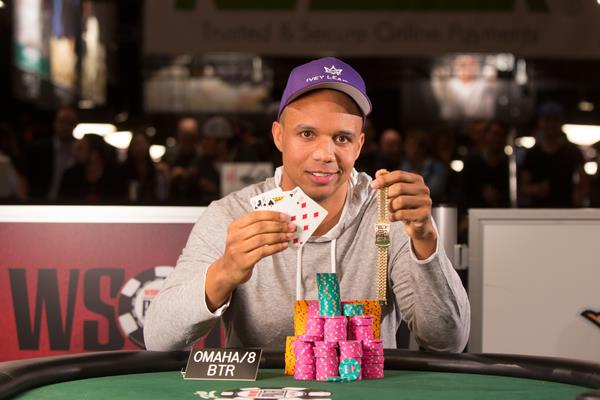
Phil Ivey is an American professional poker player widely regarded as the greatest of all time. Born in Riverside, California, and raised in Roselle, New Jersey, Ivey built one of the most celebrated careers in poker history through a combination of unmatched technical skill, elite versatility across every poker format, and an ice-cold composure that became his trademark. With 11 World Series of Poker bracelets — the second most in history — a World Poker Tour title, five Triton Super High Roller Series victories, and over $54 million in documented live tournament earnings, Ivey stands alone as the most decorated player of his generation. Inducted into the Poker Hall of Fame in 2017, the youngest person ever to reach that milestone at the time of his eligibility, Ivey has spent more than two decades defining what it means to be the best in the world.
Phil Ivey’s Personal Life
Phil Ivey was born Phillip Dennis Ivey Jr. on February 1, 1977, in Riverside, California. When he was three months old, his family relocated to Roselle, New Jersey, where he grew up and attended school. His grandfather played a pivotal role in shaping his future, introducing a young Phil to five-card stud around the kitchen table. Those early sessions planted the seed of a lifelong passion that would eventually become one of the most remarkable careers in the history of competitive card playing.
Ivey spent most of his formative years in central New Jersey. As a teenager, he was drawn to the action of Atlantic City, a short drive from Roselle, where poker rooms offered real money games. He reportedly used a fake ID under the alias “Jerome Graham” to gain access to the tables, playing against adults years before he was legally permitted to do so. Those late-night sessions sharpened instincts that no classroom could teach.
He was married to Luciaetta Ivey for approximately seven years; the couple filed a joint petition for divorce in December 2009, which was granted on December 29, 2009. After years of intense tournament travel and a demanding lifestyle, Ivey settled in Las Vegas, where he has remained a fixture in the city’s high-stakes poker ecosystem. Beyond the felt, he is known to enjoy golf, sports betting, and prop betting, pursuits that reflect his broader love of competition and edge-finding in any form of wagering.
Phil Ivey’s Beginning in Poker
Phil Ivey turned professional in the late 1990s after years of grinding low-stakes games in Atlantic City. His early career was defined by relentless table time and a hunger to test himself against the best players in the world. He quickly established a reputation as someone who could not only hold his own against experienced professionals but consistently outplay them.
His breakthrough at the WSOP came in 2000, when he captured his first bracelet in the $2,500 Pot-Limit Omaha event, earning $195,000. He was just 23 years old. Two years later, at the 2002 WSOP, Ivey accomplished something virtually unheard of in the modern era, winning three bracelets in a single series. That summer he took down the $2,500 Seven-Card Stud Hi/Lo ($118,440), the $2,000 S.H.O.E. ($107,540), and the $1,500 Seven-Card Stud ($132,000). The feat tied the then-record for most bracelets won in a single year and immediately announced him as a generational talent.
He followed that performance with a fifth bracelet in 2005, winning the $5,000 Pot-Limit Omaha event for $635,603. Alongside his tournament successes, Ivey was earning a formidable reputation in high-stakes cash games, regularly playing the biggest games in the world at Bobby’s Room inside the Bellagio. His combination of tournament dominance and cash game mastery set him apart from virtually every other player on the scene and established him, in many peers’ eyes, as the best player alive.
Phil Ivey’s Strategies and Playing Style
Phil Ivey’s playing style is defined above all else by his ability to make difficult decisions appear effortless. He operates with a rare combination of technical mastery and intuitive read-making that allows him to adapt fluidly to any opponent, any format, and any stake level. Across more than two decades of high-level competition, no other player has demonstrated the same breadth of excellence across every known form of poker.
Ivey is perhaps most celebrated for his work in mixed games and non-Hold’em formats. All 11 of his WSOP bracelets came in events other than No-Limit Hold’em, a feat that speaks directly to his commitment to mastering every corner of the game. He holds five bracelets in mixed-game disciplines, a WSOP record, and has won titles in Seven-Card Stud, Omaha, 2-7 Lowball, HORSE, Eight-Game Mix, and hybrid Hi/Lo formats. This encyclopedic command of poker variants gives him edges that specialists in any single game simply cannot match.
In No-Limit Hold’em and particularly in Short Deck Hold’em, Ivey developed a reputation as one of the most dangerous opponents in the Triton Super High Roller circuit. His five Triton titles, the majority of which came in Short Deck events, reflect an ability to adapt quickly to variant-specific math and dynamics while leveraging a psychological presence that intimidates even the most experienced competition.
His famous “poker face” — a virtually expressionless demeanor regardless of hand strength — is not merely a stylistic quirk but a carefully cultivated tool. Combined with exceptional timing, balanced aggression, and a deep understanding of hand ranges and pot equity, Ivey’s calm at the table has become a model for aspiring professionals worldwide. Many peers and analysts refer to him simply as the greatest poker player who ever lived.
Phil Ivey’s Greatest Achievements
Phil Ivey’s trophy case reads like no other in poker history. His 11 WSOP bracelets place him second on the all-time list, behind only Phil Hellmuth’s 17, and every single one of those victories came in a non-Hold’em discipline — a distinction without precedent in the modern era. In 2002, he became one of very few players ever to win three WSOP bracelets in a single series. His 2005 PLO title for $635,603 announced him as a dominant force in big-bet games as well.
After a period focused largely on cash games and high-stakes Super High Rollers, Ivey returned to the WSOP winner’s circle in 2024 by capturing the $10,000 Limit 2-7 Lowball Triple Draw Championship for $347,440, ending a ten-year bracelet drought and eclipsing $11 million in career WSOP earnings in the process. He was inducted into the Poker Hall of Fame in 2017, the same year he turned 40 and first became eligible — the youngest inductee in the Hall’s history at that threshold.
His WPT title came at the 2008 LA Poker Classic at Commerce Casino, where he claimed $1,596,100 after a string of seven final tables without a win on that circuit. Beyond those headlines, his three victories in the Aussie Millions $250,000 Super High Roller Challenge (2012, 2014, 2015) — including the biggest cash of his career at $3,582,753 in 2014 — cemented his place at the very top of high-stakes tournament poker.
Phil Ivey in WSOP
| Year | Event | Prize |
|---|---|---|
| 2000 | $2,500 Pot-Limit Omaha | $195,000 |
| 2002 | $2,500 Seven-Card Stud Hi/Lo | $118,440 |
| 2002 | $2,000 S.H.O.E. | $107,540 |
| 2002 | $1,500 Seven-Card Stud | $132,000 |
| 2005 | $5,000 Pot-Limit Omaha | $635,603 |
| 2009 | $2,500 No-Limit 2-7 Draw Lowball | $96,367 |
| 2009 | $2,500 Omaha Hi/Lo / Seven-Card Stud Hi/Lo | $220,538 |
| 2010 | $3,000 H.O.R.S.E. | $329,840 |
| 2013 | A$2,200 Mixed Event (WSOP APAC) | A$51,840 |
| 2014 | $1,500 Eight-Game Mix | $166,986 |
| 2024 | $10,000 Limit 2-7 Lowball Triple Draw | $347,440 |
Other Achievements
Beyond the WSOP, Phil Ivey has stacked a remarkable collection of titles across every major poker series. His lone World Poker Tour victory came at the 2008 LA Poker Classic at Commerce Casino in Los Angeles, where he took down the $25,000 buy-in championship for $1,596,100 after making seven WPT final tables without a win. That victory silenced the rare skeptics who wondered whether he could close on the biggest stages.
On the Triton Super High Roller Series circuit — the highest-stakes tournament tour in the world — Ivey has been dominant like no other player outside of Jason Koon. He has five Triton titles, including back-to-back victories at the 2023 Triton London series: the $60,000 No-Limit Hold’em Turbo for $1,007,000 (his fourth career Triton title) and the $25,000 Short Deck Turbo for $280,500 (his fifth). His earlier Triton wins include the 2022 Triton Cyprus $75,000 Short Deck event for $1,170,000. With five career titles, he ranks second on the all-time Triton victories list behind only Jason Koon.
His three wins at the Aussie Millions $250,000 Challenge represent the richest domestic high-roller side event in the Southern Hemisphere. Ivey’s consecutive victories in 2012 (A$2,000,000 / $2,058,948), 2014 (A$4,000,000 / $3,582,753), and 2015 (A$2,205,000 / $1,710,854) remain among the most dominant stretches any player has had in a single recurring event.
Top 10 Biggest Cashes
| Place | Prize | Event | Year |
|---|---|---|---|
| 1st | $3,582,753 | Aussie Millions $250,000 Challenge | 2014 |
| 1st | $2,058,948 | Aussie Millions $250,000 Challenge | 2012 |
| 4th | $1,795,000 | Triton Montenegro $125,000 NLHE Main Event | 2024 |
| 1st | $1,710,854 | Aussie Millions $250,000 Challenge | 2015 |
| 3rd | $1,666,480 | Triton Montenegro HK$1,000,000 Short Deck | 2018 |
| 2nd | $1,172,659 | WSOP $100,000 High Roller | 2022 |
| 1st | $1,170,000 | Triton Cyprus $75,000 Short Deck | 2022 |
| 3rd | $1,080,000 | Onyx SHRS NLH Invitational $102,000 | 2025 |
| 1st | $1,007,000 | Triton London $60,000 NLH Turbo | 2023 |
| 7th | $597,381 | WSOP $250,000 Super High Roller | 2022 |
Phil Ivey’s Challenges and Controversies
Phil Ivey’s career has not been without controversy, and the most significant episodes centered on a sophisticated gambling technique known as edge sorting. In 2012, Ivey and his associate Cheung Yin “Kelly” Sun visited Crockfords Casino in London, where they employed edge sorting at baccarat — exploiting minute asymmetries on the backs of playing cards to gain a statistical advantage over the house. Over the course of their sessions, Ivey and Sun won approximately £7.8 million ($12 million). Crockfords refused to pay out the winnings and retained only their original £1 million deposit. Legal proceedings reached the UK Supreme Court, which in October 2017 ruled unanimously against Ivey, finding that his conduct amounted to cheating under English law.
A parallel case unfolded at the Borgata Casino in Atlantic City, New Jersey, where Ivey and Sun had used the same method to win $9.6 million across four visits. The Borgata sued for repayment, and a US federal court ordered Ivey to return the full amount plus interest and legal fees — a figure exceeding $10.1 million. After years of litigation, the parties reached a settlement agreement in approximately 2022. Ivey maintained throughout both proceedings that edge sorting constituted skilled advantage play rather than cheating, though courts in both jurisdictions disagreed with that characterization.
TV Appearances
Phil Ivey was a recurring player on High Stakes Poker, the iconic cash game television series that aired on GSN, where he appeared in multiple seasons alongside other legends of the game. He also appeared on Poker After Dark, NBC’s late-night high-stakes cash game show, and on The Big Game, the PokerStars-produced series that featured rotating lineups of professionals and amateurs at a single table. His appearances on these programs gave mainstream audiences some of the most compelling footage of elite poker play ever broadcast, and his calm, unreadable presence became a defining image of the television poker era.
FAQ about Phil Ivey
How many WSOP bracelets does Phil Ivey have?
Phil Ivey has 11 WSOP bracelets, placing him second on the all-time list behind Phil Hellmuth’s 17. His most recent bracelet came at the 2024 WSOP, where he won the $10,000 Limit 2-7 Lowball Triple Draw Championship for $347,440, ending a ten-year drought since his previous bracelet in 2014.
What is Phil Ivey’s total live earnings?
Phil Ivey’s total documented live tournament earnings are $54,493,084 according to the Hendon Mob database, making him one of the top earners in poker history. His best single cash was $3,582,753, earned by winning the 2014 Aussie Millions $250,000 Challenge.
Is Phil Ivey in the Poker Hall of Fame?
Yes. Phil Ivey was inducted into the Poker Hall of Fame in 2017, the same year he first became eligible at age 40. He was inducted alongside David “Devilfish” Ulliott. At the time of his induction, Ivey was considered the youngest player ever to meet the Hall’s minimum age requirement at the moment of his enshrinement.
What is the edge-sorting scandal involving Phil Ivey?
Phil Ivey was involved in two major edge-sorting cases involving baccarat at casino high-roller tables. At Crockfords in London and the Borgata in Atlantic City, Ivey and associate Kelly Sun exploited subtle imperfections in playing cards to identify high-value cards. Courts in both the UK and the US ruled against Ivey, finding that the technique constituted cheating. He was ordered to repay approximately $10.1 million to the Borgata and lost his £7.8 million claim against Crockfords.
How many Triton Poker titles has Phil Ivey won?
Phil Ivey has won five Triton Super High Roller Series titles, placing him second on the all-time Triton victories list. Two of those titles came at the 2023 Triton London series, where he won both the $60,000 NLH Turbo for $1,007,000 and the $25,000 Short Deck Turbo for $280,500 during the same event week.
Why is Phil Ivey called the Tiger Woods of Poker?
Phil Ivey earned the nickname “Tiger Woods of Poker” early in his career because of the parallel dominance both athletes displayed in their respective sports during the same era. Just as Tiger Woods combined extraordinary natural talent with relentless work ethic to dominate professional golf across all course types, Ivey demonstrated an unmatched ability to win at every poker format at the highest stakes, making him the benchmark against which all other players in his generation were measured.
Has Phil Ivey won a World Poker Tour title?
Yes. Phil Ivey won his sole WPT title at the 2008 LA Poker Classic at Commerce Casino in Los Angeles, earning $1,596,100. The victory came after he had made seven previous WPT final tables without winning, making it a particularly satisfying milestone in his career.
Where was Phil Ivey born and where does he live?
Phil Ivey was born on February 1, 1977, in Riverside, California, but moved to Roselle, New Jersey, when he was three months old and grew up there. As an adult, he has lived in Las Vegas, Nevada, which serves as a natural base for a professional poker player given the city’s concentration of high-stakes games and major tournament series.
What formats of poker has Phil Ivey won WSOP bracelets in?
All 11 of Phil Ivey’s WSOP bracelets came in non-Hold’em disciplines, a distinction that makes him unique among the all-time bracelet leaders. His wins span Pot-Limit Omaha, Seven-Card Stud, Seven-Card Stud Hi/Lo, S.H.O.E., H.O.R.S.E., No-Limit 2-7 Draw Lowball, Omaha Hi/Lo, Eight-Game Mix, Limit 2-7 Triple Draw, and mixed formats. He holds five mixed-game bracelets, a WSOP record.
What are Phil Ivey’s biggest career tournament wins?
Phil Ivey’s biggest career cash is $3,582,753, earned by winning the 2014 Aussie Millions $250,000 Challenge. He also won the same event in 2012 for $2,058,948 and in 2015 for $1,710,854. Other highlights include a fourth-place finish at the 2024 Triton Montenegro $125,000 NLHE Main Event for $1,795,000, a third-place finish at the 2018 Triton Montenegro Short Deck event for $1,666,480, and his 2023 Triton London title for $1,007,000.
Is Phil Ivey considered the greatest poker player of all time?
Phil Ivey is widely considered by peers, commentators, and analysts to be the greatest poker player of all time. His combination of 11 WSOP bracelets, all in non-Hold’em disciplines, five Triton Super High Roller titles, over $54 million in live tournament earnings, and a legendary reputation in high-stakes cash games gives him a claim to the GOAT title that very few would dispute. His 2017 Poker Hall of Fame induction at the first year of his eligibility was a formal acknowledgment of that standing.