

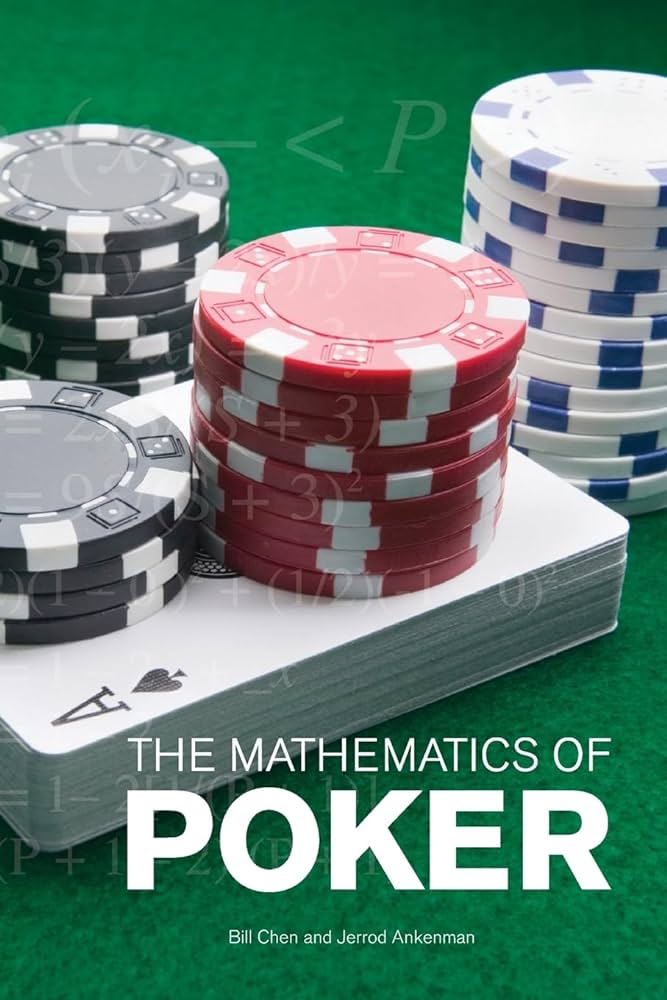
The Mathematics of Poker
- Book Title:The Mathematics of Poker
- Author:Bill Chen and Jerrod Ankenman
- Publication Date:The Mathematics of Poker’s publication date
- Publisher:The Mathematics of Poker’s publisher
- Language:The Mathematics of Poker’s language
- Number of pages:The Mathematics of Poker’s number of pages
- Dimensions:The Mathematics of Poker’s book dimensions
- Weight:The Mathematics of Poker’s book weight
Pokercine rating:
4.5 stars
Every now and then, a book comes along that changes the game. For the modern, mathematically-curious poker player, “The Mathematics of Poker” by Bill Chen and Jerrod Ankenman is that book. Ditching the traditional anecdotes for hardcore mathematics, it’s not your average poker strategy guide. This book dives deep into the theory behind poker decision-making, offering a solid foundation in game theory optimized (GTO) play. Perfect for those ready to elevate their game beyond mere gut feelings into the realm of statistical advantage and predictive modeling. While it might come off as intimidating at first glance, stick with it, and you’ll find its complexities unfold like a well-played hand. In the youthful, fast-paced world of modern poker, this book is an invaluable asset for those aiming to dominate the tables with knowledge and precision.
Summary of the content:
“The Mathematics of Poker” is a seminal work that stands apart in the landscape of poker literature. At its core, it’s about applying mathematical concepts to understand and improve your poker game. The book kicks off by establishing fundamental principles of game theory and gradually moves into more complex topics relevant to poker. Unlike traditional poker guides that often rely on anecdotal evidence, Chen and Ankenman focus on equations, algorithms, and theoretical concepts to develop strategies.
The main themes and concepts address a wide spectrum of essential topics for any aspiring poker mathematician. The authors dive into probability theory, explaining the significance of pot odds, expected value, and variance. But it doesn’t stop there; they further explore risk management, utilising mathematical models to make decisions that minimize losses over the long term. They also introduce the concept of Nash Equilibrium, showing how a player can make unexploitable decisions.
Reader’s journey through the book will unveil chapters dedicated to specific game formats like No-Limit Hold’em and Pot-Limit Omaha, explaining the intricacies of bet sizing, bluffing strategies, and the importance of position, all through a mathematical lens. The exploration of multi-street betting rounds adds another layer of complexity, encouraging readers to think several moves ahead, factoring in the range of possible outcomes.
Moreover, the text bravely tackles the application of inflection points in tournament play, providing insight into how shifts in prize structure and player stacks should alter your strategy. Advanced topics such as optimal bluffing frequencies and the exploitation of opponents’ strategies are also thoroughly explored, bridging the gap between theory and practical, table-top warfare.
At the end of the day, the content does not merely aim to spoon-feed strategies but to foster a profound understanding of the mathematical frameworks that underlie successful poker play. This approach empowers readers to craft their own strategies in accordance with the unique dynamics of each game they encounter.
“At its heart, poker is a game of mathematical concepts.”
Bill Chen and Jerrod Ankenman
Critical analysis:
The strengths of “The Mathematics of Poker” lie in its rigorous approach and detailed exploration of complex mathematical strategies, setting it apart from more traditional poker guides. It elevates the discussion beyond simplistic advice, challenging readers to engage with quantifiable aspects of the game. This depth ensures that it’s not just a one-time read but a long-term reference for players committed to evolving their game.
However, such depth also constitutes its primary weakness. The book’s heavy reliance on complex mathematics can be daunting, potentially alienating readers who lack a strong mathematical background or those simply seeking quick tips to improve their play. The dense, academic-style prose might not be everyone’s cup of tea, requiring patience and dedication to fully comprehend.
Furthermore, while the book does an exceptional job at discussing game theory and advanced concepts, it offers less in the way of practical, real-world examples. Some readers may find the bridge from theory to practice a challenging one to cross, requiring supplemental sources to translate these strategies into actionable insights.
Nevertheless, for those willing to invest the time and mental energy, “The Mathematics of Poker” rewards readers with a much richer understanding of the game, equipping them with tools to analyze and adapt strategies in a rapidly evolving play environment.
What you will learn:
By delving into “The Mathematics of Poker”, readers are taken on an enlightening journey through the essential mathematical concepts underpinning successful poker strategy. Engaging with this book, players will learn to appreciate the importance of probabilities, pot odds, and expected value — tools vital for making statistically sound decisions at the table. More than just understanding these concepts, the reader will learn how to apply them in real-time, evaluating hands and opposition strategies with a newfound analytical lens.
The book also lays bare the critical role of variance in poker, teaching players how to manage bankrolls effectively and make decisions that mitigate risk over the long term. This understanding of risk is pivotal for anyone looking to play poker seriously or professionally.
Moreover, readers will become proficient in the application of game theory to poker. This includes grasping the concept of Nash Equilibrium and leveraging it to make decisions that opponents cannot exploit statistically. The strategies for optimal bluffing frequencies and the exploitation of opponents’ strategies further arm the reader with the capability to outmaneuver opponents through calculated moves.
A significant takeaway is the capacity to develop adaptive strategies based on rigorous analysis and mathematical principles. This adaptability is crucial in a dynamically changing game environment where player tendencies and game formats evolve.
In essence, “The Mathematics of Poker” equips the reader with a comprehensive toolkit for decision-making grounded in statistical analysis and game theory, fostering a level of strategic depth and finesanity seldom achieved through intuition alone.
Why you should read it:
Reading “The Mathematics of Poker” is an investment in your poker education that will pay dividends at the table. It’s not just about learning predefined strategies, but about understanding the very fabric that these strategies are woven from. This book equips you with the ability to think deeply about the game, to make decisions not based on guesswork but on solid mathematical foundations.
For players looking to move beyond the basics and delve into the nuances of high-level poker strategy, this book offers unparalleled insights. It’s the key to unlocking a more disciplined, analytical approach to poker, where every decision is informed by a clear understanding of the mathematical probabilities at play. Simply put, if you’re serious about improving your game, “The Mathematics of Poker” is essential reading.
Conclusion:
“The Mathematics of Poker” by Bill Chen and Jerrod Ankenman is a towering achievement in poker literature, setting a high bar for theoretical rigor. While its depth and complexity may not be for everyone, those committed to truly understanding the game at a deeper level will find it an invaluable resource. It’s a book that doesn’t just teach you strategies; it teaches you how to think about poker in a fundamentally different way.
As challenging as the book might be, it’s also immensely rewarding. The insights gained from its pages equip players with the analytical tools necessary to navigate the ever-changing landscape of poker strategy with confidence. Whether you’re a seasoned player or an ambitious newcomer, embarking on this mathematical journey will undoubtedly enrich your poker experience and performance. So, if you’re ready to elevate your game through the power of mathematics, “The Mathematics of Poker” is your blueprint to success.
Where to buy:
To embark on your journey into the mathematics of poker, secure your copy of the book here: The Mathematics of Poker on Amazon