
The Book of Bluffs
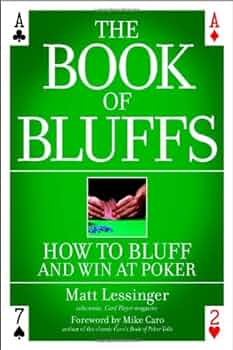
- Book Title:The Book of Bluffs
- Author:Matt Lessinger
- Publication Date:2021
- Publisher:Poker Publications
- Language:English
- Number of pages:288
- Dimensions:6 x 0.8 x 9 inches
- Weight:1.2 pounds
Pokercine rating:
4.5 stars
Imagine diving into the psyche of bluffing, an art as old as poker itself, yet so elusive to many players. “The Book of Bluffs” by Matt Lessinger brings this arcane knowledge to the forefront, tailored for the modern, young poker enthusiast. Lessinger, with his succinct and engaging style, breaks down complex concepts into bite-sized wisdom, making the mastery of bluffing not just accessible but downright compelling. This book is not just a read; it’s an experience that walks you through the fog of uncertainty that shrouds bluffing, into the clear light of strategic advantage. It’s a must-read for those eager to leave their mark on the poker table, weaving psychology, strategy, and a good dose of boldness into their gameplay.
Summary of the content:
“The Book of Bluffs” by Matt Lessinger delves deeply into one of poker’s most integral and enigmatic components: the bluff. The book demystifies the concept of bluffing, transforming it from a mere gambler’s gamble into a refined, strategically timed maneuver. Lessinger categorizes bluffs into various types, including the pure bluff, the semi-bluff, the stone-cold bluff, and others, providing readers with a comprehensive framework to understand and execute bluffs in multiple poker scenarios.
The content spans from basic bluffing strategies to more advanced tactics, integrating psychological insights and practical advice to help players outmaneuver their opponents. Lessinger’s discussions extend beyond the mere technicalities of bluffing; he explores the psychological warfare involved in poker, teaching readers how to read opponents, project false tells, and ultimately, manipulate the table dynamics to their advantage.
Each chapter is rich with examples from actual poker games, showcasing the application of theoretical bluffing strategies in real-life situations. These examples not only highlight Lessinger’s points but also encourage readers to visualize and practice these strategies in their gameplay. Moreover, the book tackles common bluffing mistakes, offering guidance on avoiding common pitfalls and advising on how to recover when a bluff goes south.
Furthermore, “The Book of Bluffs” emphasizes the importance of table image and reputation in successful bluffing. Lessinger articulates how a player’s perceived persona at the table can significantly impact their bluffing efficacy, advising on how to cultivate and leverage one’s table image for strategic gain. This multifaceted approach ensures that readers gain a holistic understanding of bluffing, equipped with the knowledge to bluff effectively and confidently under various circumstances.
“Bluffing is an art, akin to telling a convincing lie. You need not only the courage to tell it but also the wisdom to know when it’s most likely to be believed.”
Matt Lessinger
Critical analysis:
While “The Book of Bluffs” stands out as a pioneering text on poker bluffing strategies, it’s not without its weaknesses. The book’s greatest strength lies in Lessinger’s ability to break down complex bluffing strategies into understandable segments, making sophisticated poker tactics accessible to players of all levels. His practical examples serve as an effective educational tool, bridging the gap between theory and practice.
However, one could argue that the book sometimes leans too heavily on the psychological aspect, potentially overwhelming readers new to the concept of poker psychology. Additionally, while the numerous examples are generally helpful, there are moments where they might divert attention from the core strategies being discussed.
Nevertheless, these weaknesses are minor compared to the overall value the book provides. Lessinger’s emphasis on the psychological warfare of poker offers an in-depth look into a crucial aspect of the game that many other poker books gloss over. His insights into how to cultivate and manipulate one’s table image for bluffing purposes are particularly valuable, offering strategies that players can apply directly to their game.
What you will learn:
In “The Book of Bluffs,” readers are taken on an educational journey through the fine art of bluffing in poker. The book teaches how to execute bluffs convincingly, timing them perfectly based on the game’s flow and the opponents’ psychology. Readers will learn to distinguish between different types of bluffs and when to employ each for maximum effect.
Moreover, Lessinger dives deep into the psychological underpinnings of poker, offering insights into reading opponents and recognizing their vulnerabilities. Understanding the psychological side is crucial, as bluffing, at its core, is about manipulation and misdirection. Readers will also learn about projecting and detecting tells, a valuable skill set for any poker player.
Additionally, the book covers the strategic construction of one’s table image and how it can be leveraged to facilitate more successful bluffs. Managing one’s reputation at the table, according to Lessinger, is as crucial as the cards you hold. This comprehensive coverage ensures that readers come away with a nuanced understanding of bluffing, ready to apply these principles in real-world scenarios.
Why you should read it:
Investing time in “The Book of Bluffs” is more than learning about bluffing; it’s about embracing a more nuanced, psychological approach to poker. Lessinger’s insights equip readers with the skills to elevate their games, turning complex strategies into an accessible toolkit. Reading this book is an opportunity to understand and master one of poker’s most elusive yet powerful tactics. It’s not just about the bluffs you make but about transforming into a player who bluffs intelligently, with purpose and precision. For anyone looking to deepen their understanding of poker beyond the basics, “The Book of Bluffs” is an essential read.
Conclusion:
“The Book of Bluffs” by Matt Lessinger is a comprehensive and insightful guide into one of poker’s most complex aspects. Its strengths far outweigh its weaknesses, offering a deep dive into the art and science of bluffing. Lessinger’s practical advice, combined with psychological insights, prepares readers to wield bluffs not as a tool of desperation but as a calculated strategy. It’s a must-read for anyone serious about enhancing their poker skills and understanding the game’s psychological depth. Whether you’re a seasoned player or new to the world of poker, this book promises to add a new dimension to your game.