

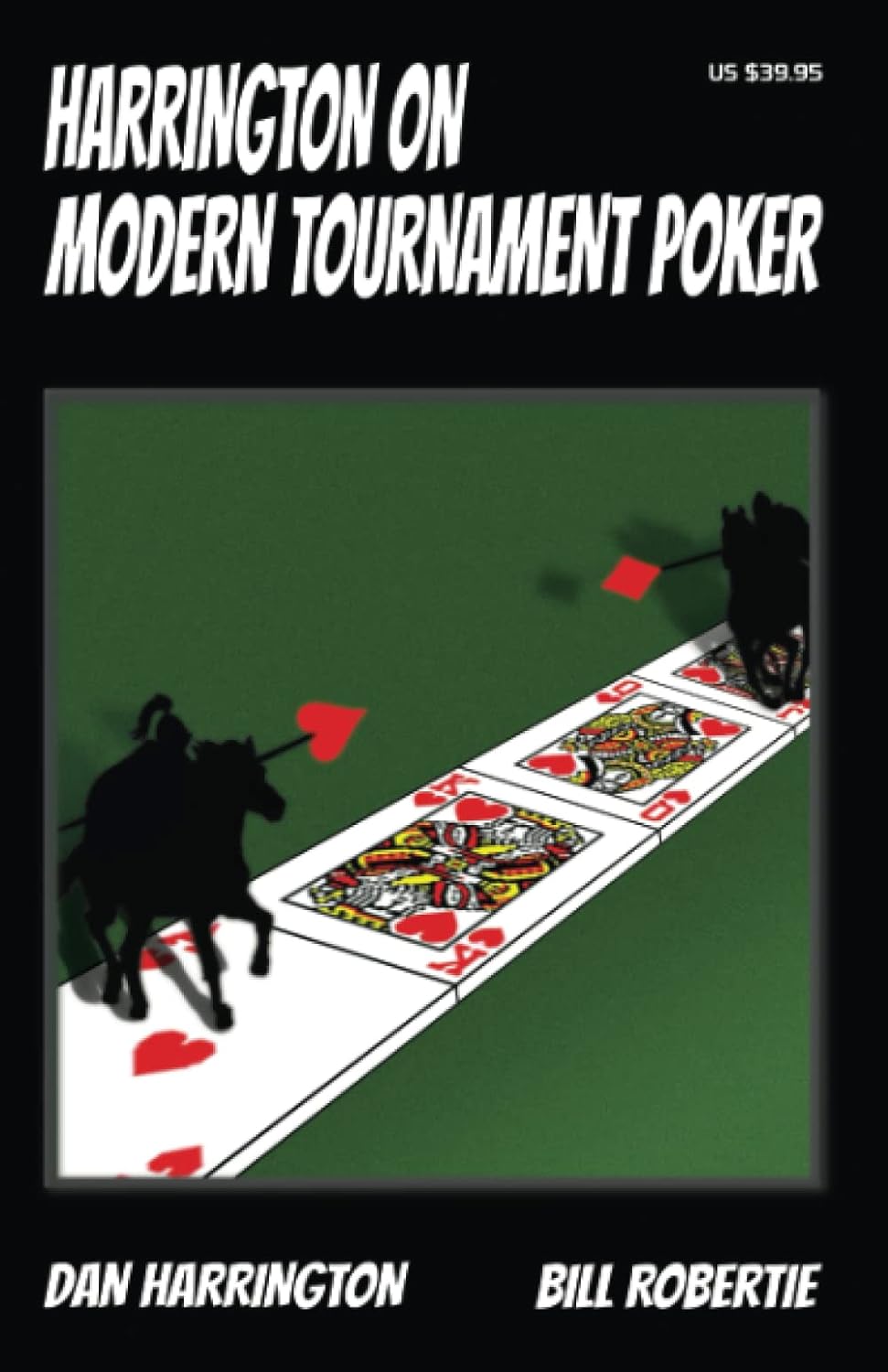
Harrington on Modern Tournament Poker
- Book Title:Harrington on Modern Tournament Poker
- Author:Dan Harrington and Bill Robertie
- Publication Date:December 15, 2014
- Publisher:Two Plus Two Publishing
- Language:English
- Number of pages:505 pages
- Dimensions:8.9 x 6 x 1.2 inches
- Weight:1.6 pounds
Pokercine rating:
4.5 stars
In the ever-evolving world of tournament poker, “Harrington on Modern Tournament Poker” has emerged as a beacon for the next generation of poker champions. Authored by Dan Harrington, a World Series of Poker Champion, and co-authored by Bill Robertie, a master of game strategy, this book dives deep into modern strategies, challenging old doctrines and introducing a dynamic style of play. Aimed at the young and savvy players of today, it’s not just another poker manual—it’s a revolution in print. With its fresh perspective, it speaks directly to those who are brave enough to embrace the complexities of the game in the digital age. Dive in, and you’ll find a treasure trove of tactics that demand attention, analysis, and application. Whether you’re looking to refine your aggressive play or fine-tune your defensive strategies, this book holds the keys to unlocking your potential at the poker table.
Summary of the content:
“Harrington on Modern Tournament Poker” stands as a monumental guide in the landscape of poker literature, offering readers an extensive exploration into strategies that have evolved alongside the game itself. This comprehensive text dives into the core of modern tournament play, providing insightful analysis and methodologies that consider the vast changes in strategy and play style that have emerged with online platforms and contemporary poker theory.
At the heart of the book is a profound understanding of the importance of stack size, a factor often overlooked by novices but crucial in the decisions of the experienced player. Harrington and Robertie guide readers through understanding how different stack sizes should influence their betting, playing, and bluffing strategies at various stages of a tournament. Moreover, the book introduces the concept of “M”, a revolutionary way of measuring one’s stack size relative to the blinds and antes, which is indispensable for making critical decisions during tournament play.
Another crucial element thoroughly covered is the importance of position, from which the authors unfold strategies for late-stage play, when the pressure is on, and the blinds are high. They delve into the intricacies of playing from the small blind, big blind, and everything in between, offering strategies that are both aggressive and defensive, depending on the player’s position and current table dynamics.
The book doesn’t shy away from the complexities of hand analysis either. Through detailed examples, the authors demonstrate how to dissect your opponents’ possible hands based on betting patterns and known cards, enabling readers to make more informed decisions on every street.
Hand in hand with technical skill, “Harrington on Modern Tournament Poker” emphasizes the psychological aspects of poker, including tips on handling pressure, the importance of table image, and the art of the bluff. It portrays poker not just as a game of cards but as a battle of wits, where understanding human behavior can tip the scales in your favor.
Finally, the text touches upon the pivotal subject of tournament life, offering guidance on navigating through early, middle, and late stages of a tournament, detailing the shift in strategies as the game progresses from loose early play to the tight, aggressive approaches demanded in the endgame.
The extensive content of “Harrington on Modern Tournament Poker” cements its status as a comprehensive guide for players aiming to navigate the turbulent waters of tournament poker with grace and strategy.
Critical analysis:
“Harrington on Modern Tournament Poker” distinguishes itself by combining the theoretical intricacies of poker strategy with practical, real-world application. The book’s strengths are manifold, starting with the authors’ ability to dissect complex concepts into digestible, actionable advice. This makes the guide an invaluable resource not just for intermediate and advanced players, but for ambitious beginners eager to fast-track their learning curve.
However, no review is complete without addressing areas for improvement. While the book is a treasure trove of strategic gems, its sheer density can sometimes overwhelm. The abundance of charts, examples, and scenarios require a level of commitment and study that might deter casual players. Moreover, given the fast-paced evolution of online poker, some sections of the book, especially those dealing with the nuances of online play, might feel slightly outdated to the digital-savvy player.
Despite these minor caveats, the overarching quality and timeless strategies presented make these issues seem trivial in the grand scope of poker education. It’s a testament to the authors’ expertise and understanding of the game that the book remains an essential addition to any serious player’s library.
“In no-limit, your stack size relative to the blinds and antes is critical information that should guide your play.”
Dan Harrington
What you will learn:
Embarking on the journey through “Harrington on Modern Tournament Poker”, readers are equipped with a toolkit designed to elevate their game to new heights. The most impactful themes elucidated within this tome include a deep understanding of the M concept—enabling players to make calculated moves based on their chip stack in relation to blinds and antes. This crucial concept changes the way one approaches tournament play, moving from a simple game of cards to a strategic battle of resource management.
Readers will also gain insights into the significance of position in poker. It’s one thing to understand the basics; it’s another to know how to exploit your position at the table to dominate your opponents. By employing the strategies Harrington and Robertie lay out, players learn to read the table dynamics, anticipate moves, and assert control, significantly increasing their chances of making it to the final table.
Perhaps the most vital skill imparted is the art of hand analysis and decision-making. The book excels in breaking down the thought process behind evaluating hands, offering a blueprint on how to dissect an opponent’s likely holdings and make moves that keep you one step ahead. This analytical mindset, once developed, is applicable in countless scenarios—transforming good players into formidable opponents.
Moreover, embracing the psychological aspects of poker, the guide delves into managing pressure, crafting a fearsome table image, and mastering the bluff. These lessons are as much about personal development as they are about poker, teaching players to maintain their cool in high-pressure situations, and to project confidence that can unnerve opponents.
In sum, “Harrington on Modern Tournament Poker” is a masterclass in the multifaceted game of poker, imparting wisdom that will distinctly alter the way players approach the table.
Why you should read it:
In a realm where information is power, “Harrington on Modern Tournament Poker” serves as the ultimate compendium of poker wisdom. The dynamic landscape of tournament poker is fraught with trials that test both skill and resolve. For players committed to excelling in this challenging environment, the book is an indispensable resource. It offers not just strategies but a philosophy towards tournament poker that advocates for adaptability, precision, and psychological astuteness. Investing time in this guide is akin to investing in your poker future, providing readers with the insights needed to navigate the chaotic world of tournament play with confidence. If you’re serious about poker and aspire to etch your name among the greats of the game, this book is your roadmap to success.
Conclusion:
“Harrington on Modern Tournament Poker” is more than just a book; it’s a pivotal educational cornerstone for anyone aiming to thrive in the competitive arena of tournament poker. Through insightful analysis, comprehensive content, and actionable strategies, Dan Harrington and Bill Robertie have curated a guide that addresses the nuances of modern poker play. While the density of information might seem daunting, the knowledge it imparts has the power to transform dedicated players into champions. Whether you’re new to the world of poker or seeking to refine your strategy, this book promises to be a rewarding investment in your poker education. Arm yourself with the wisdom contained within these pages, and face the poker world with newfound confidence and skill.
Where to buy:
You can purchase your copy of “Harrington on Modern Tournament Poker” at Amazon.