
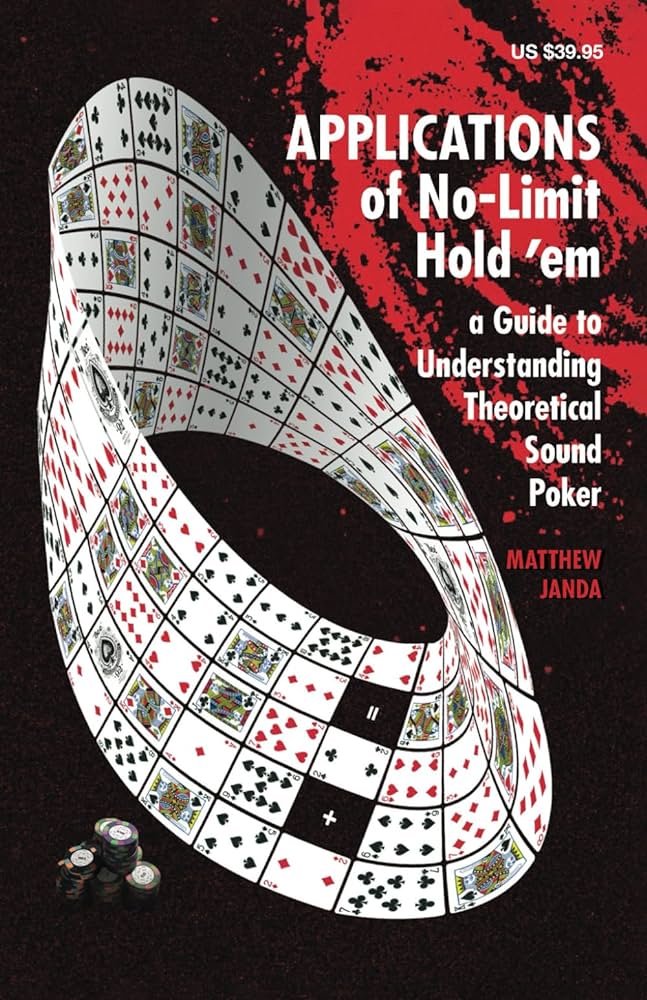
Applications of No-Limit Hold ’em – A Guide to Understanding Theoretically Sound Poker
- Book Title:Applications of No-Limit Hold ’em – A Guide to Understanding Theoretically Sound Poker
- Author:Matthew Janda
- Publication Date:20/04/2013
- Publisher:Two Plus Two
- Language:English
- Number of pages:510 pages
- Dimensions:5.5×1.15×8.5 inches
- Weight:1.5 pounds
Pokercine rating:
4.5 stars
“Applications of No Limit Hold’em” is a game-changer for young poker aficionados. It’s not just another dusty manual; it’s a dynamic roadmap to mastering the complexities of modern poker. With a fresh, no-nonsense approach, it dissects advanced strategies, equipping players with the tools to dominate the tables. Its insights into hand ranges, bet sizing, and game theory are indispensable for those seeking an edge. In a world where every move counts, this book is the ultimate playbook for ambitious players looking to up their game.
Summary of the content:
“Applications of No-Limit Hold ’em” is a groundbreaking work in the field of poker literature, offering a deep dive into the strategies of No-Limit Hold ’em poker. Authored by Matthew Janda, this book is not your average poker guide; it’s a comprehensive exploration of theoretically sound poker strategies, designed for serious players who aim to elevate their game. Janda approaches poker from a mathematical and theoretical standpoint, yet he manages to present the content in an accessible manner that bridges the gap between theory and practical application.
The book covers a wide array of topics crucial for mastering No-Limit Hold ’em. It begins with a discussion on the importance of ranges, breaking down how to construct them and how they shift in various stages of the game. Janda emphasizes the significance of understanding both your own range and your opponent’s, providing readers with the tools to analyze and adapt their strategies accordingly.
Another core theme is the concept of balance. Janda meticulously explains why balancing your play is essential in avoiding predictability, thereby keeping opponents guessing and exploiting their tendencies. He delves into the mathematics of poker, including equity, expected value, and the application of these concepts in making optimal decisions.
Beyond the numbers, the book also addresses the psychological aspects of poker, such as managing tilt, understanding the mental game, and the importance of table image. Janda’s insights into the strategic adjustments required for different types of games and opponents are particularly valuable, offering readers a versatile toolkit for navigating the complexities of No-Limit Hold ’em.
Advanced topics such as multi-street planning, game theory optimal (GTO) strategies, and exploiting leaks in opponents’ games are also thoroughly explored. Janda provides numerous hand examples and theoretical scenarios to illustrate these concepts, making the book a practical resource for applying what’s learned.
In summary, “Applications of No-Limit Hold ’em” is a comprehensive, in-depth guide that covers the theoretical underpinnings of No-Limit Hold ’em poker, while also providing actionable strategies for real-game situations. It’s a must-read for anyone serious about understanding and improving their poker game.
Critical analysis:
Matthew Janda’s “Applications of No-Limit Hold ’em” stands out in the crowded field of poker literature due to its rigorous approach to the game’s theory and its practical applications. One of the book’s strengths is its ability to demystify complex concepts, making them accessible to players with a basic understanding of poker math. Janda’s clear explanations and use of examples help readers grasp sophisticated strategies that can be daunting at first glance.
However, the book’s depth and complexity can also be seen as a weakness. Novice players or those with a casual interest in poker may find the material challenging and the mathematical discussions overwhelming. The book assumes a certain level of pre-existing knowledge, which could limit its appeal to a broader audience.
Another strength is the book’s comprehensive coverage of both theoretical and practical aspects of No-Limit Hold ’em. Janda’s emphasis on balance and adaptability is particularly valuable, offering insights that players can apply in a wide range of game situations. The inclusion of hand examples and theoretical scenarios is a significant plus, aiding in the understanding and application of concepts discussed.
Despite its merits, some readers might find the book’s structure and organization a bit cumbersome. The wealth of information and the detailed analysis of topics can sometimes lead to a dense reading experience, which might require multiple readings to fully absorb.
In conclusion, while “Applications of No-Limit Hold ’em” is an invaluable resource for players looking to deepen their understanding of poker theory, its appeal is likely best suited to those who are serious about the game and willing to invest the time and effort to study its content thoroughly.
“Understanding the fundamental theory behind poker is not just an academic exercise; it’s a critical component of being able to adapt and thrive in the ever-evolving landscape of the game.”
Matthew Janda
What you will learn:
Delving into “Applications of No-Limit Hold ’em” is akin to taking a masterclass in advanced poker strategy. Readers will embark on a journey that begins with the foundational elements of poker theory and progresses to the application of these principles in real-world scenarios. One of the most crucial lessons is the construction and application of ranges. Janda teaches how to think in terms of ranges rather than specific hands, a shift in perspective that is vital for making more informed decisions at the table.
Another key takeaway is the importance of balance in your play. The book elucidates why being unpredictable and balancing your betting patterns can keep opponents off-balance, making it harder for them to exploit your strategy. This concept is crucial for playing against skilled opponents who are adept at reading plays and patterns.
Readers will also gain insights into the mathematical underpinnings of poker, including how to calculate equity and expected value in various situations. These tools are essential for evaluating the profitability of different plays, helping players to make more mathematically sound decisions.
Moreover, Janda addresses the psychological aspects of poker, offering strategies for managing emotions and maintaining focus. Understanding the mental game is just as important as mastering strategy, as it enables players to perform their best under pressure.
Finally, the book covers advanced topics such as game theory optimal (GTO) play and exploiting opponents’ weaknesses. These lessons are invaluable for players looking to compete at higher levels, where the margins for error are slim and the need for a sophisticated strategy is paramount.
In essence, “Applications of No-Limit Hold ’em” offers a comprehensive education in modern poker strategy, equipping readers with the knowledge and tools to elevate their game.
Why you should read it:
If you’re serious about improving your poker game, “Applications of No-Limit Hold ’em” is an indispensable resource. This book goes beyond basic strategy to explore the theoretical foundations of the game, offering insights that can transform your approach to poker. Whether you’re looking to refine your understanding of ranges, balance your play, or delve into the mathematics of poker, Janda’s guide provides the knowledge you need to succeed. By applying the concepts and strategies outlined in this book, you’ll be better equipped to make informed decisions, adapt to various opponents, and ultimately, increase your profitability at the tables. In a game where the learning curve is steep and the competition fierce, “Applications of No-Limit Hold ’em” offers a competitive edge that can make all the difference.
Conclusion:
“Applications of No-Limit Hold ’em” by Matthew Janda is a tour de force in poker literature, offering a deep and nuanced understanding of the game’s theoretical underpinnings. While the book’s complexity may pose a challenge to some, its comprehensive coverage of advanced poker strategies makes it an invaluable resource for those committed to improving their game. Janda’s insights into range construction, balance, and the mathematical aspects of poker are particularly noteworthy, providing readers with the tools to make more informed decisions and adapt their strategies to a wide range of game situations. Whether you’re an aspiring professional or a seasoned player looking to refine your approach, this book is a must-read. Its lessons on adaptability, mathematical reasoning, and psychological resilience are applicable not just at the poker table but in the broader game of life.
Purchase recommendation:
For those interested in purchasing “Applications of No-Limit Hold ’em,” the book is available at several online retailers. You can find it on Amazon, where it’s available in both paperback and Kindle formats.
