

Texas Hold’em is the rockstar of poker variants, commanding the spotlight in every major tournament and kitchen-table game alike. The objective? Simple: make the best five-card hand using any combination of your two private cards and the five community cards. Or, if you’re feeling cheeky, bluff your opponents into folding better hands.
Here’s a quick rundown of the essentials:
- Blinds and Antes: Texas Hold’em uses blinds (small and big) to keep the action moving. The small blind is typically half the size of the big blind. In tournaments, you might also encounter antes, small mandatory bets from every player to build the pot.
- Betting Structure: True to its name, No Limit Texas Hold’em means there are no restrictions on the amount you can bet. Go all-in with a single chip if you’re feeling daring. This no-holds-barred approach impacts strategy heavily, rewarding bold plays and big bluffs.
- Game Type: Texas Hold’em falls under the “Hold’em” category. The game revolves around creating the highest-ranking hand possible. It’s a high game, meaning the highest hand wins the pot. Forget about those lowball games; here, it’s all about the high.
- Variation and Based On: Texas Hold’em is a variation of community card poker, where the best hand is made from a combination of community cards and personal hole cards. It’s the most popular form of poker globally, influencing many other variants.
Remember, in Texas Hold’em, your stack can go from zero to hero (or vice versa) with one well-timed bet. So, keep your poker face sharp and let’s dive into the nitty-gritty of how to play Texas Hold’em and master the game.
Learn How to Play Texas Hold’em
Texas Hold’em can be played as No Limit, Pot Limit, or Limit, but for this guide, we’ll focus on the No Limit version, which is the most popular. Regardless of the betting structure, the game follows the standard poker hand rankings.
1. Setting Up the Game
Texas Hold’em starts with the dealer distributing two cards face down to each player, known as hole cards. A rotating dealer button indicates the dealer position, moving one spot to the left after each hand. Two players to the left of the dealer post the blinds. The small blind is typically half the big blind, initiating the pot and encouraging action. For our example, we’ll use $1/$2 blinds.
2. The Pre-Flop Round
After the blinds are posted, each player looks at their hole cards and decides their action: fold, call, or raise. The player to the left of the big blind starts the betting. For example, if the big blind is $2, a player must call with $2 or raise, usually at least twice the big blind ($4).
Example:
- Player A (small blind): $1
- Player B (big blind): $2
- Player C: Raises to $6
- Player D: Calls $6
- Player E: Folds
- Player F: Calls $6
- Player A: Calls $5
- Player B: Calls $4
Hole Cards:
- Player A: 7♠️ 8♠️
- Player B: K♦️ Q♦️
- Player C: A♣️ K♣️
- Player D: 9♥️ 9♦️
- Player F: J♥️ 10♥️
3. The Flop
The dealer burns one card (removes it from play) and then deals three community cards face up. This is the flop. Another round of betting begins with the player to the left of the dealer.
Example:
- Flop: 8♥️ J♦️ 3♠️
- Player A: Checks
- Player B: Checks
- Player C: Bets $15
- Player D: Calls $15
- Player F: Calls $15
- Player A: Folds
- Player B: Folds
Active Players and Hands:
- Player C: A♣️ K♣️
- Player D: 9♥️ 9♦️
- Player F: J♥️ 10♥️
4. The Turn
The dealer burns another card and deals the fourth community card, known as the turn. Another round of betting ensues, starting with the player to the left of the dealer. The stakes often double in limit games, but in no limit, it’s a free-for-all.
Example:
- Turn: 2♥️
- Player C: Bets $30
- Player D: Calls $30
- Player F: Raises to $90
- Player C: Folds
- Player D: Calls $60
Active Players and Hands:
- Player D: 9♥️ 9♦️
- Player F: J♥️ 10♥️
5. The River
The dealer burns one final card and deals the fifth community card, called the river. The last round of betting occurs, starting with the player to the left of the dealer.
Example:
- River: K♣️
- Player D: Checks
- Player F: Bets $200
- Player D: Calls $200
Active Players and Hands:
- Player D: 9♥️ 9♦️
- Player F: J♥️ 10♥️
6. The Showdown
If two or more players remain after the final betting round, a showdown occurs. Players reveal their hole cards, and the best five-card hand wins the pot.
Example:
- Player D: 9♥️ 9♦️ (Pair of Nines)
- Player F: J♥️ 10♥️ (Pair of Jacks)
Player F wins with a pair of Jacks.
Here is a great video from PokerVIP that will show you visually how to play Texas Hold’em:
Hand Rankings
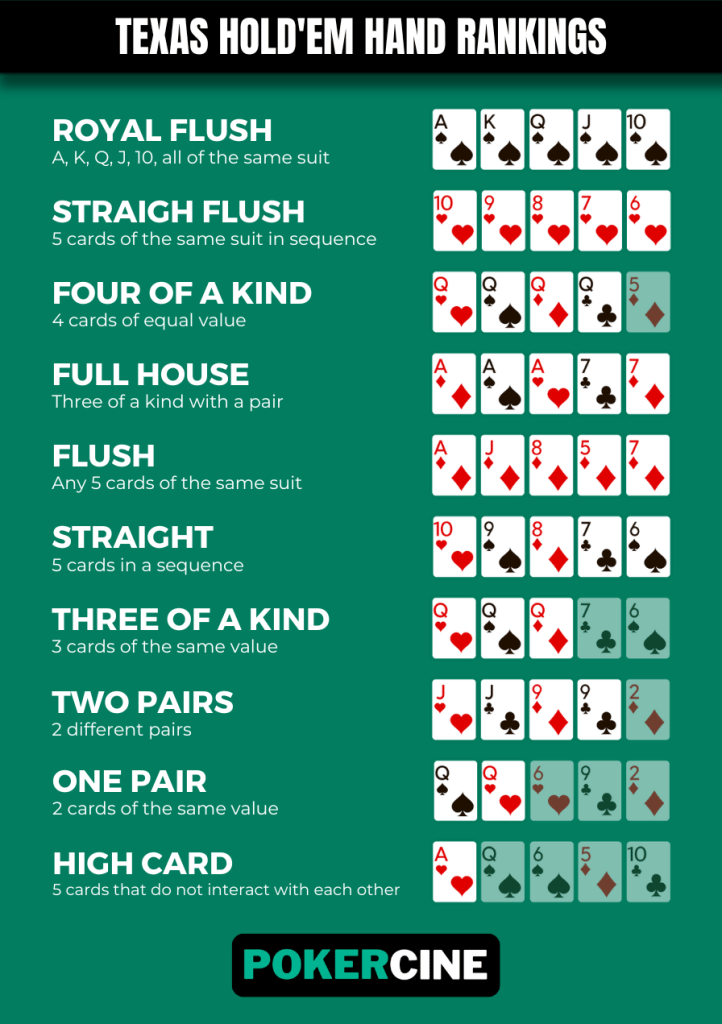
Texas Hold’em uses the standard poker hand rankings, which determine the winner by the strength of the five-card combination. Here’s a detailed breakdown of how each hand is formed, listed from the best to the worst.
Hand Rankings from Best to Worst
- Royal Flush: A, K, Q, J, 10, all of the same suit.
- Straight Flush: Five consecutive cards of the same suit.
- Four of a Kind: Four cards of the same rank.
- Full House: Three cards of one rank and two cards of another rank.
- Flush: Five cards of the same suit, not in sequence.
- Straight: Five consecutive cards of different suits.
- Three of a Kind: Three cards of the same rank.
- Two Pair: Two cards of one rank and two cards of another rank.
- One Pair: Two cards of the same rank.
- High Card: When no other hand is made, the highest card plays.
See the ranking in a more visual way:
Tips and Tricks for Texas Hold’em
1. Play Tight, Play Right
As a beginner, it’s important to play fewer hands but play them aggressively. This is known as “tight” play. By focusing on strong starting hands, you can make more confident bets and avoid tricky situations.
2. Position is Power
Your position at the table greatly affects your strategy. Being in a later position gives you an advantage as you can see how others act before making your decision. Use this to play more hands and bluff effectively.
Tip: Play tighter in early positions and looser in late positions.
3. Be Aggressive
Passive play (just calling) can be a trap for beginners. Playing aggressively (betting and raising) gives you control of the hand and can push opponents out of the pot.
Tip: If you have a strong hand, bet and raise instead of just calling. This builds the pot and protects your hand.
4. Pay Attention to the Table
Always watch your opponents and take notes on their behavior. Notice who plays aggressively, who bluffs often, and who is tight or loose. This will help you make better decisions.
Tip: Observe how often opponents fold, call, or raise. Use this information to read their hands better.
5. Manage Your Bankroll
Set a budget for how much you’re willing to lose in a session and stick to it. This prevents you from making reckless decisions and chasing losses.
Tip: Only play with money you can afford to lose. If you hit your limit, take a break.
Common Mistakes in Texas Hold’em and How to Avoid Them
1. Playing Too Many Hands
Beginners often think they need to play every hand. This leads to losing chips on weak hands. Focus on playing stronger hands, especially in early positions.
How to Avoid:
- Stick to premium hands like high pairs and high suited connectors in early positions.
- Expand your range slightly in late positions.
2. Overvaluing Hands
Not all hands are created equal. A pair of Kings is great pre-flop but can be easily beaten post-flop. Assess the community cards and opponents’ actions carefully.
How to Avoid:
- Reevaluate your hand strength after the flop.
- Be ready to fold strong starting hands if the board gets scary.
3. Ignoring Pot Odds
Pot odds help determine whether a call is worth it based on the potential payout. Ignoring them can lead to poor financial decisions.
How to Avoid:
- Calculate pot odds before calling a bet.
- Only call if the potential payout justifies the risk.
4. Failing to Bluff Appropriately
Bluffing is an art. Overdoing it can make you predictable and cost you chips. Underdoing it can make you too easy to read.
How to Avoid:
- Bluff in situations where it makes sense (e.g., representing a strong hand).
- Don’t bluff against multiple opponents or when your table image is poor.
5. Chasing Losses
After a few bad hands, it’s tempting to try to win back your chips quickly. This often leads to rash decisions and further losses.
How to Avoid:
- Stick to your game plan and avoid making decisions based on frustration.
- Take a break if needed to reset your mindset.
6. Not Protecting Your Blinds
Your blinds are investments in the pot. Defending them appropriately prevents opponents from stealing them too often.
How to Avoid:
- Be more willing to defend with decent hands.
- Re-raise occasionally to deter aggressive steal attempts.
Watch this video from Alec Torelli to learn some solid basic strategy:
Odds in Texas Hold’em
Understanding the odds in Texas Hold’em can significantly enhance your decision-making and overall strategy. Here are some key ones you should learn:
Preflop Odds
- Pocket Aces (AA): The probability of being dealt pocket Aces is 0.45%, or odds of 220:1.
- Ace-King (AK): The probability of being dealt Ace-King is 1.2%, or odds of 82:1. For suited Ace-King (AKs), the odds are 331:1.
- Pocket Pairs: The chance of being dealt any pocket pair is 5.88%, or odds of 16:1.
- Suited Connectors: The probability of being dealt suited connectors (e.g., 7♠️ 8♠️) is 3.92%, or odds of 24:1.
Flop Odds
- Flopping a Pair: The odds of flopping at least a pair (if you hold two unpaired cards) are about 32.4%, or 2.2:1
- Flopping a Set: If you hold a pocket pair, the odds of flopping a set (three of a kind) are approximately 11.8%, or 7.5:1.
- Flopping a Flush: The probability of flopping a flush with two suited cards is about 0.8%, or 118:1.
- Flopping a Straight: The odds of flopping a straight with two connectors (e.g., 5♠️ 6♠️) are around 1.3%, or 76:1.
- Flopping a Set (three of a kind): The odds of flopping a set when you hold a pocket pair are approximately 11.8%, or 7.5 to 1. This means that for every 8.5 times you see a flop with a pocket pair, you’ll hit a set about once.
Other Odds
- Hitting a Flush Draw: If you have a flush draw after the flop, the odds of completing your flush by the river are about 35%, or 1.86:1.
- Hitting an Open-Ended Straight Draw: The probability of completing an open-ended straight draw by the river is about 31.5%, or 2.17:1.
- Hitting a Gutshot Straight Draw: The odds of completing a gutshot straight draw by the river are about 16.5%, or 5.1:1
Specific Matchup Odds
- Pocket Aces vs. Pocket Kings: In a heads-up scenario, pocket Aces will win against pocket Kings approximately 82% of the time, or odds of 4.5:1.
- Pocket Pair vs. Two Overcards: Commonly known as a “coin flip,” where each hand has roughly a 50% chance of winning. For example, pocket Queens vs. Ace-King suited is about 57:43 in favor of the Queens.
Notable Bracelet Winners
The player with the most WSOP bracelets in Texas Hold’em is Phil Hellmuth, who has won an impressive 14 bracelets in Texas Hold’em (no limit, limit and pot limit). His success in Texas Hold’em has contributed significantly to his record 17 WSOP bracelets overall.
Here are some of the most notable players who have won WSOP bracelets in Texas Hold’em events:
| Player | Bracelets | Year |
|---|---|---|
| Phil Hellmuth | 14 | 1989, 1992, 1993 (3), 1997, 2001, 2003 (2), 2006, 2007, 2012, 2018, 2023 |
| Johnny Chan | 6 | 1985, 1987, 1988, 2002, 2003, 2005 |
| Erik Seidel | 6 | 1992, 1994, 2001, 2005, 2021, 2023 |
| Daniel Negreanu | 5 | 1998, 2004, 2008, 2013 (2) |
| Stu Ungar | 3 | 1980, 1981, 1997 |
Want to see some incredible WSOP hands? If you have 5 hours to spare, PokerGo made this incredible video with the 100 best hands of the WSOP.
Fun Facts and Records
Here are some interesting and lesser-known facts and records about Texas Hold’em:
- First Online Poker Game: The first real-money online poker game was dealt on January 1, 1998, on Planet Poker, the first online card room to offer real-money games.
- The Biggest Pot in Televised Poker: The largest pot ever won in a televised poker game was $3.1 million. This record was set by Tom Dwan on Hustler Casino Live’s “Million Dollar Game” in 2023. Dwan won this massive pot by calling an all-in bluff on the river with pocket Queens against Wesley Fei’s Ace-King high.
- The Largest Tournament Field: The 2019 WSOP Big 50 event holds the record for the largest live poker tournament field, attracting 28,371 entries. The event had a $500 buy-in and offered a prize pool of over $13 million. Femi Fashakin won the event, taking home $1,147,499.
- Largest Prize Pool: The largest prize pool in poker history was the 2023 WSOP Main Event, which amassed $93,399,900. Daniel Weinman won this event and took home the first prize of $12.1 million.
- Biggest Online Poker Tournament: The largest online poker tournament by field size was held by PokerStars in June 2013, with 225,000 players participating in a $1 buy-in event. The total prize pool was $225,000.
- Antonio Esfandiari’s Big One for One Drop Win: In 2012, Antonio Esfandiari won the Big One for One Drop event at the WSOP, which had a $1 million buy-in. He took home a staggering $18,346,673, the largest single payout in poker tournament history at that time.
These are just a few of the many remarkable records in the world of Texas Hold’em.
Famous Quotes about Texas Hold’em
“The name of the game is No Limit Texas Hold’em, the game that takes a minute to learn but a lifetime to master.”
Mike Sexton“No-limit hold’em: Hours of boredom followed by moments of sheer terror.”
Tom McEvoy“Hold’em is to stud what chess is to checkers.”
Johnny Moss“The key to No-Limit is to put a man to a decision for all his chips.”
Doyle Brunson“Limit poker is a science, but no-limit is an art. In limit, you are shooting at a target. In no-limit, the target comes alive and shoots back at you.”
Crandall Addington
Net Worth of 5 Famous Players in Texas Hold’em
- Phil Ivey – $125 million: Phil Ivey is considered one of the greatest all-around poker players, with ten WSOP bracelets and significant earnings from live tournaments and high-stakes cash games. His aggressive style and exceptional hand-reading abilities make him a formidable opponent.
- Daniel Negreanu – $70 million: Known as “Kid Poker,” Daniel Negreanu has six WSOP bracelets and is one of the most recognizable faces in poker. His success spans live tournaments, high-stakes cash games, and lucrative sponsorship deals with major online poker sites.
- Doyle Brunson – $75 million: Often referred to as the “Godfather of Poker,” Doyle Brunson has won ten WSOP bracelets, including back-to-back Main Events in 1976 and 1977. His book “Super/System” is considered a poker bible, and he has made substantial earnings from high-stakes games.
- Phil Hellmuth – $23 million: Phil Hellmuth, known as the “Poker Brat,” holds a record 17 WSOP bracelets. He has earned significant winnings from both live tournaments and cash games. His colorful personality and frequent television appearances have made him a well-known figure in the poker world.
- Antonio Esfandiari – $27 million: Antonio Esfandiari, also known as “The Magician,” is famous for his victory in the Big One for One Drop event at the WSOP in 2012, where he won $18,346,673. He has three WSOP bracelets and substantial earnings from live tournaments and cash games.
Texas Hold’em in the Movies
Texas Hold’em has been a popular subject in numerous films, showcasing the drama, strategy, and excitement of the game. Here are some notable movies that feature Texas Hold’em:
- Rounders (1998): “Rounders” is often credited with sparking the poker boom of the early 2000s. Starring Matt Damon and Edward Norton, the film follows the story of a reformed gambler who returns to playing high-stakes Texas Hold’em to help his friend pay off loan sharks. The movie is known for its realistic depiction of poker strategy and the underground poker scene.
- Casino Royale (2006): In this James Bond film, Daniel Craig’s 007 faces off against the villain Le Chiffre in a high-stakes Texas Hold’em game. The poker scenes are central to the plot, adding tension and showcasing Bond’s skill and composure. The film contributed to popularizing Texas Hold’em and introduced many viewers to the intricacies of the game.
- Molly’s Game (2017): Based on the true story of Molly Bloom, a former Olympic skier who ran one of the world’s most exclusive high-stakes poker games, “Molly’s Game” features numerous Texas Hold’em scenes. The film stars Jessica Chastain as Molly and highlights the glamour and risks associated with running underground poker games frequented by celebrities and business moguls.
- High Roller: The Stu Ungar Story (2003): This biographical film chronicles the life of Stu Ungar, one of the greatest poker players of all time. Although it covers various forms of poker, Texas Hold’em is prominently featured, showcasing Ungar’s exceptional skill and turbulent life.
- The Grand (2007): A mockumentary-style comedy, “The Grand” features an ensemble cast including Woody Harrelson, David Cross, and Cheryl Hines. The film revolves around a fictional high-stakes poker tournament and parodies the world of professional poker, with Texas Hold’em being the primary game played.
Watch this video where none other than Fedor Holz rates poker scenes in movies:
FAQ – Frequently Asked Questions for Texas Hold’em
What is Texas Hold’em?
Texas Hold’em is a popular variant of poker where each player is dealt two private cards and five community cards are dealt face up on the “board.” Players aim to make the best five-card hand using any combination of their two private cards and the five community cards.
Why is it called Texas Hold’em?
The game is called Texas Hold’em because it originated in Robstown, Texas, in the early 1900s before gaining widespread popularity.
When was Texas Hold’em invented?
Texas Hold’em was invented in the early 1900s in Robstown, Texas.
Who is the best Texas Hold’em player?
We’re not crazy enough to try and answer that! With legends like Phil Ivey, Daniel Negreanu, Phil Hellmuth, Doyle Brunson, Stu Ungar, Tom “durrrr” Dwan, and Fedor Holz—just to name a few—battling for the title, it’s like picking your favorite child. Each has their own unique style and countless accolades. So, we’ll leave the debate to the poker gods and enjoy watching these masters work their magic.
What are the best starting hands in Texas Hold’em?
The best starting hands in Texas Hold’em are: Pocket Aces (A♠️ A♣️), Pocket Kings (K♠️ K♦️), Pocket Queens (Q♠️ Q♥️) and Ace-King suited (A♠️ K♠️).
How to learn Texas Hold’em?
You can learn Texas Hold’em by reading books, watching tutorial videos, joining online poker forums, and practicing on free poker apps or websites.
Texas Hold’em for dummies or How to play Texas Hold’em?
To play Texas Hold’em, each player is dealt two private cards. Five community cards are dealt face up in three stages. Players make the best five-card hand from any combination of their two private cards and the five community cards. Betting occurs before and after each stage.
How to win at Texas Hold’em?
To win at Texas Hold’em, focus on starting hand selection, position, and betting strategies. Study your opponents’ behaviors and use bluffing strategically.
How to deal the cards in Texas Hold’em?
The dealer deals two cards face down to each player. Five community cards are dealt face up in three stages: the flop (three cards), the turn (one card), and the river (one card).
How to study for Texas Hold’em?
Study for Texas Hold’em by reading strategy books, watching professional poker streams, using poker training software, and reviewing your hand histories. Participate in forums like Two Plus Two and join study groups.
What are the best books or resources about Texas Hold’em?
- GTO Wizard: Learn Game Theory Optimal (GTO) strategies with simulations and analysis.
- Upswing Poker: Offers courses, articles, and training videos by top professionals.
- “Modern Poker Theory” by Michael Acevedo: In-depth look at GTO strategies.
- “Applications of No-Limit Hold’em” by Matthew Janda: Covers advanced strategies using mathematical and game theory principles.
- “The Mental Game of Poker” by Jared Tendler: Focuses on the psychological aspects of poker.
What are some strategies for Texas Hold’em?
Strategies for Texas Hold’em include playing tight-aggressive, understanding pot odds and implied odds, using position effectively, and employing bluffing and semi-bluffing techniques.
What are common mistakes to avoid in Texas Hold’em?
Common mistakes include playing too many hands, overvaluing weak hands, ignoring position, failing to adjust to opponents, and not managing your bankroll properly.
Where can I play Texas Hold’em?
You can play Texas Hold’em in casinos, poker rooms, and home games.
What are the best sites to play Texas Hold’em online?
The best sites to play Texas Hold’em online are PokerStars, GG Poker, 888poker, and Party Poker.
Where to play Texas Hold’em for free?
You can play Texas Hold’em for free on apps like PokerStars, Zynga Poker, and 888poker.
Texas Hold’em near me?
You can find Texas Hold’em games in local casinos, poker rooms, and through poker clubs or meetups in your area.
Top bracelet winners in Texas Hold’em?
Phil Hellmuth holds the record with 14 WSOP bracelets in Texas Hold’em events.
How many bracelets has Daniel Negreanu won in Texas Hold’em?
Daniel Negreanu has won 5 WSOP bracelets in Texas Hold’em events.
How many bracelets has Phil Ivey won in Texas Hold’em?
Phil Ivey has never won a WSOP bracelets in Texas Hold’em events.
How many bracelets has Phil Hellmuth won in Texas Hold’em?
Phil Hellmuth has won 14 WSOP bracelets in Texas Hold’em events.
What is the biggest pot ever played in Texas Hold’em?
The biggest pot ever played in a televised Texas Hold’em game was $3.1 million, won by Tom Dwan on Hustler Casino Live’s “Million Dollar Game” in 2023.
What are the biggest Texas Hold’em tournaments?
The biggest Texas Hold’em tournaments include the WSOP Main Event, the World Poker Tour (WPT) Championship, and the European Poker Tour (EPT) Main Event.
What is the net worth of notable Texas Hold’em players?
Phil Ivey – $125 million
Daniel Negreanu – $70 million
Doyle Brunson – $75 million
Phil Hellmuth – $23 million
Antonio Esfandiari – $27 million
At Pokercine, we believe that every hand is an opportunity to learn and grow. So, grab your chips, take your seat at the table, and dive into the world of Texas Hold’em. The cards are in your hands—play them wisely and enjoy the journey!