
Seven Card Stud is one of the classic variants in the world of poker, standing out for its strategic depth and historical significance. Unlike the community card games like Texas Hold’em and Omaha, Seven Card Stud is a game where each player receives their own unique set of cards, leading to a more individualistic and methodical style of play.
For many players, the allure of Seven Card Stud lies in its complexity and the constant need for observation and memory. Each player must carefully track the upcards of their opponents while managing their own hand development. This dynamic creates an intense and engaging gameplay experience that rewards strategic thinking and patience.
Origins
The origins of Seven Card Stud can be traced back to the 19th century in the United States, where it gained immense popularity among soldiers during the Civil War. Over time, it spread through saloons and gambling halls, eventually becoming a staple in both home games and casinos. Its rich history has cemented its status as a timeless favorite among poker enthusiasts.
Comparing Seven Card Stud to No Limit Hold’em
Given that No Limit Hold’em is the most popular form of poker, understanding the key differences between it and Seven Card Stud can make it easier for players to transition between these variants. Both games require skill, strategy, and an understanding of poker fundamentals, but they differ significantly in structure and gameplay.
- Community Cards: In No Limit Hold’em, players share five community cards dealt to the center of the table, which everyone can use in combination with their two hole cards. In Seven Card Stud, there are no community cards; each player receives their own seven cards.
- Betting Rounds: No Limit Hold’em has four betting rounds: pre-flop, flop, turn, and river. Seven Card Stud has five betting rounds: Third Street, Fourth Street, Fifth Street, Sixth Street, and Seventh Street. This additional round can significantly impact strategy and the size of the pot.
- Card Visibility: In No Limit Hold’em, only the player’s hole cards are hidden, while the community cards are visible to all. In Seven Card Stud, each player has a combination of face-up and face-down cards, requiring keen observation and memory to track opponents’ hands.
- Blinds vs. Antes: No Limit Hold’em uses a system of blinds (small blind and big blind) to initiate betting. Seven Card Stud uses an ante system, where each player contributes a small amount to the pot before the cards are dealt, followed by a bring-in bet from the player with the lowest upcard on Third Street.
- Hand Strength: The dynamics of hand strength differ between the two games. In No Limit Hold’em, strong starting hands (like high pairs and suited connectors) are crucial. In Seven Card Stud, the value of starting hands can change as additional cards are revealed, making it important to assess hand potential over multiple streets.
- Betting Limits: No Limit Hold’em allows players to bet any amount of their chips at any time, leading to high-stakes, aggressive play. Seven Card Stud is usually played with fixed limits, meaning bets and raises are in set increments, which requires a more calculated and disciplined approach.
- Positional Play: Position is crucial in No Limit Hold’em, with the player acting last having a significant advantage. In Seven Card Stud, positional advantage shifts with each round based on the strength of upcards, making it a more fluid and dynamic aspect of the game.
Understanding these differences can help players adapt their strategies and appreciate the unique challenges and skills required in Seven Card Stud compared to No Limit Hold’em.
How to Play Seven Card Stud
Learning to play Seven Card Stud can seem daunting at first, but with a clear step-by-step guide, you’ll be able to grasp the rules and start playing confidently. In this section, we’ll break down the gameplay from the initial deal to the final showdown, ensuring you understand each phase of the game.
Antes and the Initial Deal
In Seven Card Stud, the game begins with each player placing an ante, a small forced bet to seed the pot. The ante amount varies depending on the stakes but is typically around 10% of the small bet.
- Antes: Each player places an ante into the pot before any cards are dealt.
- Dealing Third Street: Each player is dealt three cards, two face down (hole cards) and one face up (door card).
Example: In a game with $1/$2 limits, the ante might be $0.20. Each player antes, and then the dealer gives everyone three cards: Jane receives 7♠ (hole), K♥ (hole), and 2♦ (door). John receives Q♣ (hole), 8♠ (hole), and 3♠ (door).
Third Street
The player with the lowest face-up card (door card) must make a bring-in bet, typically around half the size of the small bet, or choose to complete the bet to the full small bet amount.
- Bring-in: The player with the lowest door card starts the betting with a bring-in bet.
- Betting: Players can fold, call the bring-in, or raise to the full small bet amount.
Example: Jane has the lowest door card (2♦) and must bring in $0.50. John and the other players can call, raise to $1, or fold.

Fourth Street
Each player still in the hand receives a fourth card face up. The player with the highest hand showing starts the betting.
- Dealing Fourth Street: Each player gets a fourth card face up.
- Betting: The player with the highest upcards starts the betting.
Example: Jane receives 5♣, giving her 7♠ (hole), K♥ (hole), 2♦, and 5♣. John receives Q♦, giving him 9♣ (hole), 8♠ (hole), 3♠, and Q♦. John has the highest hand showing (a pair of Queens), so he starts the betting.
Fifth Street
Each player receives a fifth card face up. The betting now doubles, meaning players must bet and raise in larger increments (the big bet).
- Dealing Fifth Street: Each player gets a fifth card face up.
- Betting: The player with the highest hand showing starts the betting with the larger bet.
Example: Jane receives J♥, and John receives 7♦. Now Jane’s hand is 7♠ (hole), K♥ (hole), 2♦, 5♣, and J♥. John’s hand is 9♣ (hole), 8♠ (hole), 3♠, Q♦, and 7♦. John still has the highest hand showing, so he starts the betting with a $2 bet.
Sixth Street
Each player receives a sixth card face up. The player with the highest hand showing continues to start the betting.
- Dealing Sixth Street: Each player gets a sixth card face up.
- Betting: The player with the highest hand showing starts the betting.
Example: Jane receives 4♠, and John receives 10♠. Jane’s hand is now 7♠ (hole), K♥ (hole), 2♦, 5♣, J♥, and 4♠. John’s hand is 9♣ (hole), 8♠ (hole), 3♠, Q♦, 7♦, and 10♠. John still has the highest hand showing, so he starts the betting with a $2 bet.
Seventh Street (River)
Each player receives a seventh and final card, dealt face down. A final round of betting ensues, starting with the player who has the highest hand showing.
- Dealing Seventh Street: Each player gets a final card face down.
- Betting: The player with the highest hand showing starts the final round of betting.
Example: Jane receives a final card face down, and John receives his final card face down. Jane’s final hand is 7♠ (hole), K♥ (hole), 2♦, 5♣, J♥, 4♠, and a face-down card. John’s final hand is Q♣ (hole), 8♠ (hole), 3♠, Q♦, 7♦, 10♠, and a face-down card. John starts the final betting round with a $2 bet.
Showdown
After the final round of betting, any remaining players reveal their hole cards to determine the winner. The player with the best five-card hand wins the pot.
- Revealing Hands: Players reveal their hole cards.
- Determining the Winner: The best five-card hand wins the pot.
Example: Jane reveals her hole cards to show 7♠, K♥, 2♦, 5♣, J♥, 4♠, and A♠. Her best hand is a high card with Ace, King, Jack, 7, and 5. John reveals his hole cards to show Q♣, 8♠, 3♠, Q♦, 7♦, 10♠, and A♣. His best hand is a pair of Queens. John wins the pot with his higher handA
Here is a great video from Daniel Negreanu teaching how to play Seven Card Stud:
Hand Rankings in Seven Card Stud
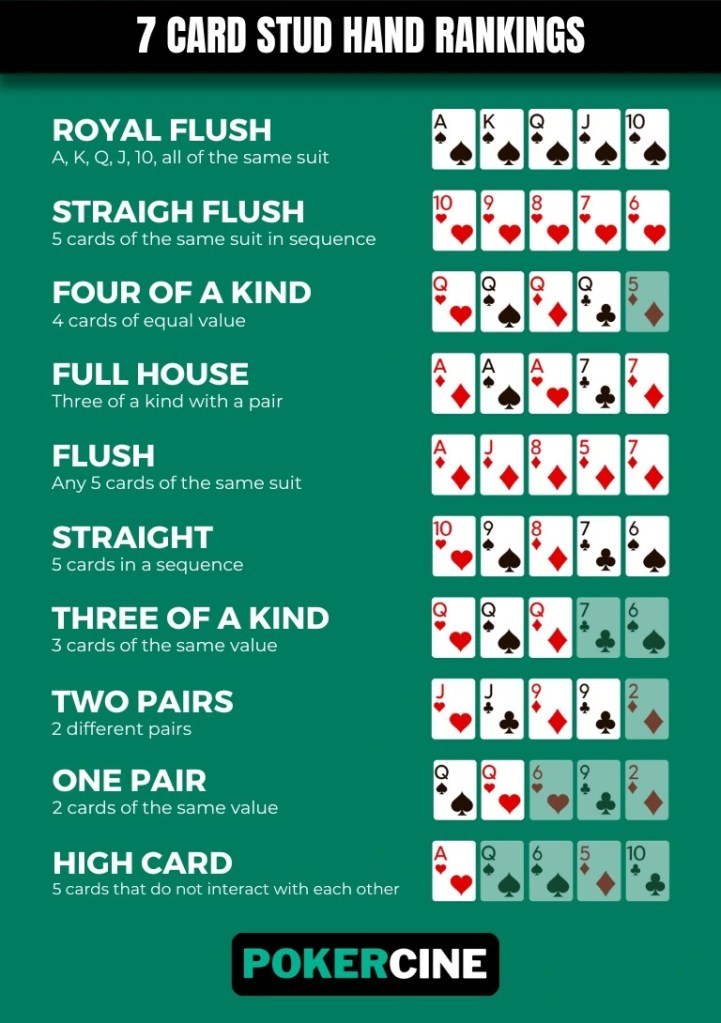
Seven Card Stud uses the standard poker hand rankings, which determine the winner by the strength of the five-card combination. Here’s a detailed breakdown of how each hand is formed, listed from the best to the worst.
Hand Rankings from Best to Worst
- Royal Flush: A, K, Q, J, 10, all of the same suit.
- Straight Flush: Five consecutive cards of the same suit.
- Four of a Kind: Four cards of the same rank.
- Full House: Three cards of one rank and two cards of another rank.
- Flush: Five cards of the same suit, not in sequence.
- Straight: Five consecutive cards of different suits.
- Three of a Kind: Three cards of the same rank.
- Two Pair: Two cards of one rank and two cards of another rank.
- One Pair: Two cards of the same rank.
- High Card: When no other hand is made, the highest card plays.
See the ranking in a more visual way:
Tips and Tricks for Seven Card Stud
Seven Card Stud is a game that rewards strategic thinking, keen observation, and patience. Here are some advanced strategies and psychological aspects to help elevate your game:
Basic Strategies
- Starting Hand Selection: Choose your starting hands wisely. Good starting hands in Seven Card Stud typically include high pairs, three cards to a straight or flush, and high-value cards. Avoid hands that rely too much on improvement unless the pot odds are favorable.
- Observe Opponents’ Upcards: Pay close attention to your opponents’ upcards. This helps you deduce the strength of their hands and adjust your strategy accordingly. For example, if an opponent’s visible cards include many of the suits or ranks you need, it decreases the likelihood of you completing your hand.
- Bet Aggressively with Strong Hands: When you have a strong hand, bet aggressively to build the pot and put pressure on your opponents. This strategy can force players with weaker hands to fold, increasing your chances of winning the pot uncontested.
- Bluff Sparingly: Bluffing is less effective in Seven Card Stud than in community card games because there is more information available to your opponents through upcards. Use bluffs sparingly and only when the situation is optimal, such as when your upcards suggest a strong hand.
- Track Folded Cards: Remember which cards have been folded, as this information can significantly impact your decision-making. Knowing that certain cards are out of play helps you calculate your odds more accurately and can inform your betting strategy.
- Adjust to Changing Game Dynamics: Be flexible and adjust your strategy based on the flow of the game. If you notice that the table is playing tight, you can take more risks with semi-bluffs. Conversely, if the table is loose, focus on playing premium hands and extracting maximum value.
- Psychological Warfare: Use psychology to your advantage. Pay attention to opponents’ betting patterns and body language. These can provide valuable clues about the strength of their hands. Conversely, be aware of your own tells and work to minimize them.
Common Mistakes in Seven Card Stud and How to Avoid Them
- Overplaying Weak Hands: Many players make the mistake of overcommitting to weak starting hands, hoping for a miracle draw. To avoid this, be disciplined with your starting hand selection and fold when necessary.
- Ignoring Upcards: Failing to pay attention to opponents’ upcards can lead to costly mistakes. Always consider the visible cards when making decisions, and adjust your strategy based on the information available.
- Chasing Draws with Poor Odds: Chasing unlikely draws can quickly deplete your chip stack. Before committing chips to a draw, calculate the pot odds and ensure they justify the risk.
- Inconsistent Betting Patterns: Inconsistent or erratic betting can make you predictable and easy to exploit. Develop a consistent betting strategy that keeps your opponents guessing and prevents them from reading your hand strength easily.
- Failing to Adjust to Table Dynamics: Sticking rigidly to one strategy without considering the changing dynamics of the table can be detrimental. Stay observant and be willing to adapt your play style based on the behavior of your opponents.
- Neglecting Positional Advantage: While position is less critical in Seven Card Stud compared to Hold’em, it still matters. Being the last to act on each street allows you to gather more information before making decisions. Recognize when you have positional advantage and use it to your benefit.
Advanced Strategies and Tactics for Seven Card Stud
This section will explore advanced concepts such as starting hand selection, bluffing techniques, the importance of position, and adjusting your play style based on the tendencies of other players.
Starting Hand Selection
Choosing the right starting hands is critical in Seven Card Stud. Here are some key considerations:
- High Pairs: Hands that include high pairs (such as Aces, Kings, or Queens) are strong starting hands. These hands give you a good chance to build a powerful five-card hand.
- Three to a Straight or Flush: Hands that have three cards to a straight or flush are worth playing, especially if the cards are close in rank. For example, 5♦ 6♦ 7♦ can develop into a strong hand.
- High Value Cards: Starting with high-value cards (like face cards or Aces) increases your potential for high-ranking hands and can intimidate opponents
Bluffing Techniques
Bluffing in Seven Card Stud is more about timing and less frequent than in Hold’em due to the visibility of upcards. Here are some effective bluffing techniques:
- Representing a Strong Hand: If your upcards suggest a strong hand, you can bluff by betting aggressively, making opponents think you have a solid hand.
- Semi-Bluffing: Betting with a drawing hand that has potential to improve can pressure opponents while giving you a chance to win the pot even if you don’t hit your draw.
Adjusting Your Play Style
Adapting your play style based on the tendencies of your opponents is crucial. Here’s how to do it effectively:
- Identifying Player Tendencies: Pay attention to whether opponents are tight (playing few hands) or loose (playing many hands). Adjust your aggression accordingly.
- Exploiting Weaknesses: If an opponent consistently folds to aggressive bets, you can exploit this by increasing your bluff frequency.
- Countering Aggression: Against aggressive players, tighten your starting hand requirements and be prepared to call down with stronger hands.
By incorporating these tips and avoiding common mistakes, you can enhance your Seven Card Stud gameplay and increase your chances of success.
Insights from Professional Players
Professional players have shared valuable insights on Seven Card Stud strategies. For instance, Phil Ivey emphasizes the importance of keen observation and memory in tracking folded cards. Doyle Brunson advocates for a disciplined approach to starting hand selection and cautious play on early streets.
Want more advanced strategies? Watch this video by Evan Jarvis from Gripsed Poker Training.
Notable Bracelet Winners for Seven Card Stud
Seven Card Stud has a storied history at the World Series of Poker (WSOP), attracting some of the most skilled poker players over the years. Here is a detailed look at some notable bracelet winners in this variant:
| Player | Bracelets | Year |
|---|---|---|
| Johnny Moss | 4 | 1975, 1976, 1979, 1981 |
| Phil Ivey | 2 | 2002, 2009 |
| Chip Reese | 2 | 1978, 1982 |
| Ted Forrest | 2 | 1993, 2004 |
| Mel Judah | 2 | 1989, 1997 |
Fun Facts, Myths, and Records about Seven Card Stud
Seven Card Stud, with its rich history and unique gameplay, has accumulated numerous fun facts, myths, and records over the years. Here are some interesting points specific to this variant:
- Oldest Poker Tournament: Seven Card Stud was one of the original games featured in the first World Series of Poker (WSOP) in 1970, highlighting its long-standing popularity among poker enthusiasts.
- Nickname: Seven Card Stud is also known as “Down the River” or “Seven-Toed Pete,” showcasing its colorful history and the various names it has been given by players over the years.
- Johnny Moss’s Record: Johnny Moss holds four WSOP bracelets in Seven Card Stud, making him one of the most successful players in this variant. He won these bracelets in the years 1975, 1976, 1979, and 1981.
- Historic Match: One of the most legendary poker matches involved Johnny Moss and Nick “the Greek” Dandolos in a marathon session of Seven Card Stud. This match, arranged by Benny Binion, is a cornerstone of poker folklore, illustrating the game’s deep roots in poker history.
- Complexity and Skill: Known as a “memory game,” Seven Card Stud requires players to remember folded cards and upcards, making it a game that heavily rewards skill and strategic thinking over sheer luck.
- Unique Variations: There are several interesting variations of Seven Card Stud, such as Razz (where the lowest hand wins), Seven Card Stud Hi-Lo (split pot between the highest and lowest hands), and inventive home game variations like Baseball and Acey-Deucey.
Famous Quotes about Seven Card Stud
“In Seven Card Stud, it’s all about reading your opponents and knowing when to fold. It’s a game of discipline.”
Phil Ivey“Seven Card Stud is a game of patience and observation. You have to watch every card and every player, and remember what’s gone.”
Johnny Moss“Seven Card Stud is the ultimate poker challenge because it requires you to constantly adjust your strategy based on the cards you see and the behavior of your opponents.”
David Bach
Odds in Seven Card Stud
Being Dealt a Particular Hand:
- Three of a Kind: The odds of being dealt three of a kind from the start are approximately 424:1.
- Three Suited Cards: The odds of being dealt three suited cards are around 18:1.
- Any Pair: The odds of being dealt any pair with your first three cards are about 5:1.
Completing Hands:
- Straight: If the first three cards are in sequence, the odds of completing a straight are 6:1.
- Flush: If the first three cards are suited, the odds of completing a flush are 5:1.
- Full House: If your hand holds three of a kind by sixth street, the odds of completing a full house are 4:1.
- Two Pair: If you start with a pair in the first three cards, the odds of improving to at least two pair are 1.4:1
Statistics about Seven Card Stud
Here are some relevant statistics related to Seven Card Stud, providing insights into the game’s dynamics and its place in the poker world:
- Pairs: In Seven Card Stud, pairs win approximately 30% of the time.
- Professional Preferences: Over 10% of professional poker players prefer Seven Card Stud over Texas Hold’em.
- Major Poker Tournaments: Seven Card Stud events make up about 5% of the schedules in major poker tournaments.
Net Worth of Top 5 Most Famous Players in Seven Card Stud
Here are the net worths of the top 5 most famous players known for their expertise in Seven Card Stud:
- Phil Ivey: Net Worth: $125 million Phil Ivey is regarded as one of the best all-around poker players, with two WSOP bracelets in Seven Card Stud Hi-Lo and substantial earnings from live tournaments and cash games.
- Doyle Brunson: Net Worth: $75 million Known as the “Godfather of Poker,” Doyle Brunson has had a long and successful career, with numerous WSOP titles and significant contributions to poker strategy.
- Daniel Negreanu: Net Worth: $50 million Daniel Negreanu, a prominent poker player with multiple WSOP bracelets, is known for his skill in various poker variants, including Seven Card Stud.
- Ted Forrest: Net Worth: $6 million Ted Forrest, a skilled poker player with multiple WSOP bracelets in Seven Card Stud, is renowned for his strategic play and success in high-stakes games.
- John Cernuto: Net Worth: $5 million John Cernuto, also known as “Miami John,” is a seasoned poker player with a WSOP bracelet in Seven Card Stud and a reputation for consistent performance in tournaments.
FAQ – Frequently Asked Questions about Seven Card Stud
What is Seven Card Stud?
Seven Card Stud is a classic poker variant where each player is dealt seven cards, but only the best five-card hand wins. Unlike Texas Hold’em, there are no community cards.
Why is it called Seven Card Stud?
It’s called Seven Card Stud because each player receives seven cards throughout the hand, and “Stud” refers to the style of poker where players receive a mix of face-up and face-down cards.
When was Seven Card Stud invented?
Seven Card Stud became popular during the 19th century in the United States, particularly gaining traction during the Civil War.
What is the difference between Seven Card Stud and Texas Hold’em?
In Seven Card Stud, players receive their own set of seven cards with no community cards, while in Texas Hold’em, players share five community cards in combination with their two hole cards.
How to learn Seven Card Stud?
To learn Seven Card Stud, start by understanding the rules and hand rankings, and then practice by playing low-stakes games or using online resources and tutorials.
How to play Seven Card Stud?
Each player antes, is dealt two face-down cards and one face-up card, followed by four more cards (three face-up, one face-down) with betting rounds after each deal. The best five-card hand wins the pot.
How to win at Seven Card Stud?
To win at Seven Card Stud, focus on starting hand selection, pay attention to opponents’ upcards, and use strategic betting to maximize your wins and minimize losses.
How to deal the cards in Seven Card Stud?
Deal two cards face down and one face up to each player. Then deal three more face-up cards and one final face-down card to each player, with betting rounds between each deal.
What are the best starting hands in Seven Card Stud?
The best starting hands include 3 of a kind, high pairs (Aces, Kings, Queens), three cards to a straight or flush, and high-value cards.
How to study for Seven Card Stud?
To study for Seven Card Stud, use resources like strategy books, online courses, and practice tools. Some recommended books include “The Theory of Poker” by David Sklansky and “Super System” by Doyle Brunson. Additionally, joining online forums and studying hand histories can be very beneficial.
What are the best books or resources about Seven Card Stud?
Some recommended books are “The Theory of Poker” by David Sklansky and “Super System” by Doyle Brunson, which include sections on Seven Card Stud. Online resources like PokerStars Learn and training sites also offer valuable content.
What are some strategies for Seven Card Stud?
Key strategies include observing opponents’ upcards, selectively bluffing, managing your bankroll, understanding pot odds, and adjusting your play based on the behavior of other players.
What are common mistakes to avoid in Seven Card Stud?
Avoid overplaying weak hands, not paying attention to opponents’ upcards, failing to adjust your strategy based on the flow of the game, and chasing unlikely draws.
Where can I play Seven Card Stud?
Seven Card Stud can be played in many casinos, poker rooms, and online poker sites like PokerStars, GG Poker, 888poker, and Party Poker.
What are the best sites to play Seven Card Stud online?
Some of the best sites to play Seven Card Stud online include PokerStars, GG Poker, 888poker, and Party Poker.
Where to play Seven Card Stud for free?
Free games are available on online poker sites like PokerStars, GG Poker, 888poker, and on mobile poker apps.
Seven Card Stud near me?
Check local casinos, poker rooms, and social clubs for Seven Card Stud games. Online searches or poker room directories can help.
Top bracelet winners in Seven Card Stud?
Top winners include Johnny Moss with 4 WSOP bracelets, Phil Ivey with 2, and Chip Reese with 2.
Who is the best Seven Card Stud player?
Many consider Phil Ivey and Doyle Brunson among the best due to their success and strategic acumen in Seven Card Stud.
How many bracelets has Daniel Negreanu won in Seven Card Stud?
Daniel Negreanu has not won a WSOP bracelet in Seven Card Stud specifically but has excelled in other poker variants.
How many bracelets has Phil Ivey won in Seven Card Stud?
Phil Ivey has won 2 WSOP bracelets in Seven Card Stud Hi-Lo events.
How many bracelets has Phil Hellmuth won in Seven Card Stud?
Phil Hellmuth has not won a WSOP bracelet in Seven Card Stud.
What is the biggest pot ever played in Seven Card Stud?
Details on the biggest pot in Seven Card Stud are scarce, but high-stakes games have reached substantial amounts.
What are the biggest Seven Card Stud tournaments?
The biggest tournaments include the WSOP Seven Card Stud events and the Seven Card Stud Hi-Lo events.
What is the net worth of notable Seven Card Stud players?
Phil Ivey: $125 million, Doyle Brunson: $75 million, Daniel Negreanu: $50 million, Ted Forrest: $6 million, John Cernuto: $5 million.