
Pot Limit Omaha (PLO) has become a standout in the poker community due to its unique gameplay and strategic depth. Originating in the United States during the 1980s, PLO quickly rose to prominence in both high-stakes poker rooms and online platforms. Its appeal lies in the combination of skill and strategy, offering a dynamic experience that challenges even seasoned players.
Today, PLO is widely played in major poker hubs like Las Vegas and enjoys a significant following in Europe as well. Its popularity continues to grow, attracting players who seek a sophisticated and engaging poker variant.
The Basics of Pot Limit Omaha
Pot Limit Omaha (PLO) is a popular poker variant that builds on the foundation of Texas Hold’em but with notable differences. The primary objective in PLO is to make the best five-card hand using exactly two of the four hole cards dealt to each player and three of the five community cards.
Basic Rules:
- Starting Hands: Each player is dealt four hole cards.
- Blinds: The game uses small and big blinds to initiate betting.
- Betting Structure: As the name suggests, PLO is played with a pot-limit betting structure, meaning players can bet any amount up to the size of the pot.
Gameplay:
- Hand Composition: Players must use exactly two of their hole cards and three community cards to form their best hand.
- High Hand Wins: PLO is generally a high-hand game, meaning the best high hand at showdown wins the pot.
- Pot Limit: The maximum bet is determined by the size of the pot, adding a strategic layer to the betting.
Impact on Strategy:
- Increased Hand Combinations: With four hole cards, players have a greater number of potential hands, making pre-flop strategy and post-flop decisions more complex.
- Emphasis on Strong Hands: Winning hands in PLO are often stronger than those in Hold’em, requiring players to aim for straights, flushes, or better.
Comparing Pot Limit Omaha to No Limit Hold’em
Pot Limit Omaha (PLO) and No Limit Hold’em (NLHE) are two of the most popular poker variants, each offering unique challenges and strategic opportunities. Understanding the differences between these games is crucial for any player looking to excel in PLO.
- Betting Structure: In PLO, the maximum bet is the size of the pot, which can limit the amount of money in play at any given time. In NLHE, players can bet any amount up to their entire stack at any point, leading to potentially larger pots and more dramatic all-in moments.
- Starting Hands: PLO players receive four hole cards instead of two. This significantly increases the number of potential hand combinations, making pre-flop hand selection and post-flop strategy more complex compared to NLHE.
- Hand Strength: In PLO, the winning hand is often much stronger than in NLHE. With more cards in play, players frequently make straights, flushes, and full houses. This means that top pair or two pair, which can be strong in NLHE, are usually not sufficient in PLO.
- Drawing Hands: PLO emphasizes drawing hands more than NLHE. With four hole cards, players often have numerous draws to straights and flushes, making it a game of chasing and completing strong hands.
- Bluffing: While bluffing is a key element in both games, it is typically more challenging in PLO due to the higher frequency of strong hands and draws. Players need to be more selective and strategic with their bluffs compared to NLHE.
- Variance: PLO has higher variance than NLHE because of the increased number of potential hand combinations and stronger hands. This can lead to more significant swings in a player’s bankroll, requiring careful bankroll management.
By understanding these differences, players can better adjust their strategies when transitioning from No Limit Hold’em to Pot Limit Omaha, making the learning curve smoother and enhancing their overall poker skills.
How to Play Pot Limit Omaha
Dealing the Cards
Pot Limit Omaha (PLO) begins with the dealer shuffling a standard 52-card deck. Players are dealt four hole cards each, face down. The game uses a small blind and big blind system, similar to Texas Hold’em, to initiate betting. The player to the left of the dealer posts the small blind, and the next player to the left posts the big blind.
Example: In a game with $1/$2 blinds, Player A posts $1 (small blind), and Player B posts $2 (big blind).
The Pre-Flop Round
Once the blinds are posted, each player receives four hole cards. The first betting round starts with the player to the left of the big blind. Players can choose to call the big blind, raise, or fold.
Example Scenario:
- Player C is first to act and calls $2.
- Player D raises to $9 (the pot size is $9).
- Player E folds.
- Player A (small blind) calls the raise.
- Player B (big blind) calls the raise.
- Player C calls the raise.
Pot Size: $36
The Flop
The dealer burns one card (removes it from play) and deals three community cards face up in the center of the table. These cards are known as the flop.
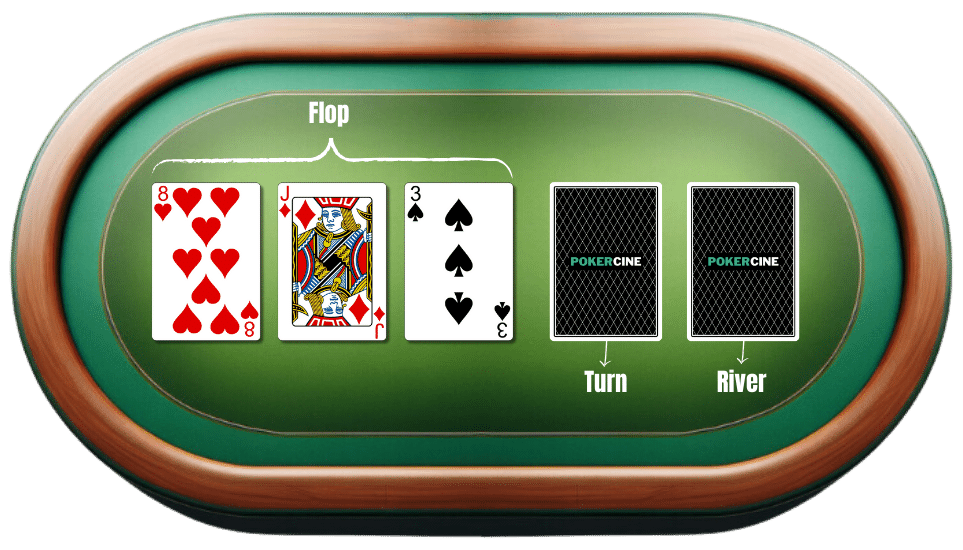
Example Flop: 8♥️ J♦️ 3♠️
A second betting round begins with the player to the left of the dealer. Players can check, bet, call, raise, or fold.
Example Scenario:
- Player A checks.
- Player B bets $20.
- Player C calls $20.
- Player D raises the pot: $116 (the pot size before the raise is $36 + $20 + $20 + $20 = $96; adding $20 from the call makes it $116).
- Player A folds.
- Player B calls $96.
- Player C folds.
Pot Size: $288
The Turn
After the flop betting round is complete, the dealer burns another card and deals one additional community card, known as the turn.
Example Turn: 2♥️
A third betting round starts, again with the player to the left of the dealer.
Example Scenario:
- Player B bets $100.
- Player D calls $100.
Pot Size: $488
The River
Following the turn betting round, the dealer burns one more card and deals the final community card, known as the river.

Example River: Q♠️
The final betting round begins.
Example Scenario:
- Player B bets $200.
- Player D raises the pot: $1,088 (the pot size before the raise is $488 + $200 + $200 = $888; adding $200 from the call makes it $1,088).
- Player B calls $888.
Pot Size: $2,664
Showdown
After the final betting round, if more than one player remains, a showdown occurs. Players reveal their hole cards, and the best five-card hand, using exactly two hole cards and three community cards, wins the pot.
Example Showdown:
- Player B’s hand: A♣️ K♠️ T♥️ 9♣️
- Player D’s hand: Q♦️ J♠️ 8♦️ 8♠️
Community Cards: 8♥️ J♦️ 3♠️ 2♥️ Q♠️
Player B: Straight (8♥️ 9♣️ T♥️ J♦️ Q♠️)
Player D: Set of Eights (8♦️ 8♠️ 8♥️ Q♠️ J♦️)
Player B wins with a Straight.
Important Considerations
- Using Two Hole Cards: Remember, players must use exactly two of their four hole cards and three of the community cards.
- Pot Limit Betting: The maximum bet at any point is the size of the pot, which requires players to calculate pot sizes quickly and accurately.
- Strategic Play: Because players have more hole cards, they must think strategically about potential hands and drawing possibilities.
Here is a great video from Daniel Negreanu teaching how to play Seven Card Stud:
Hand Rankings in Pot Limit Omaha (PLO)
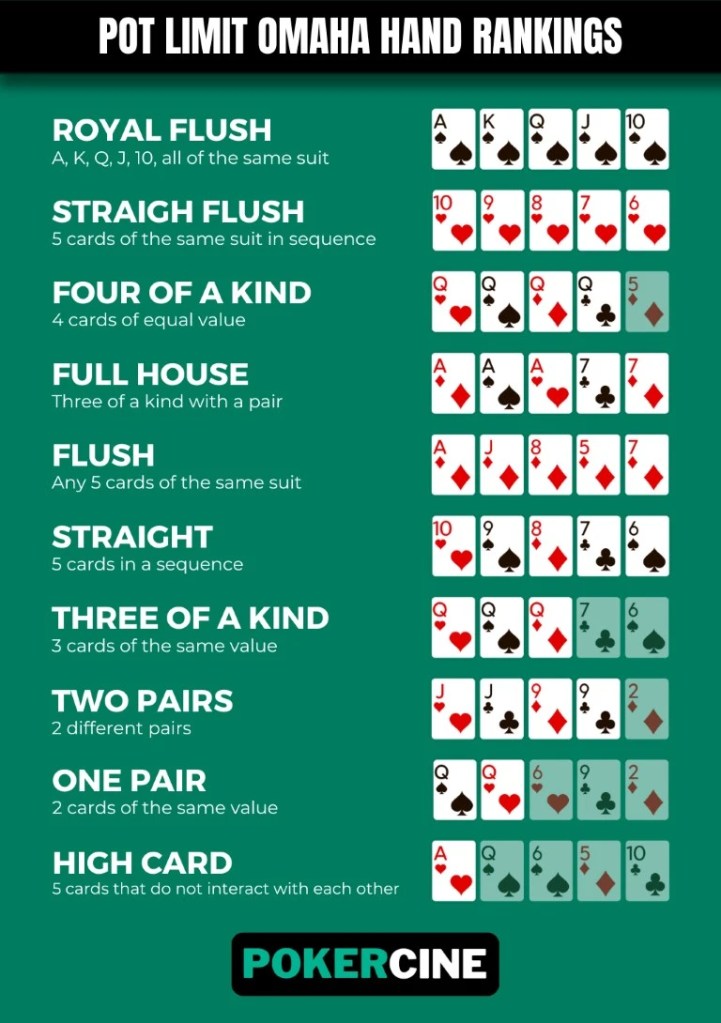
PLO uses the standard poker hand rankings, which determine the winner by the strength of the five-card combination. Here’s a detailed breakdown of how each hand is formed, listed from the best to the worst.
Hand Rankings from Best to Worst
- Royal Flush: A, K, Q, J, 10, all of the same suit.
- Straight Flush: Five consecutive cards of the same suit.
- Four of a Kind: Four cards of the same rank.
- Full House: Three cards of one rank and two cards of another rank.
- Flush: Five cards of the same suit, not in sequence.
- Straight: Five consecutive cards of different suits.
- Three of a Kind: Three cards of the same rank.
- Two Pair: Two cards of one rank and two cards of another rank.
- One Pair: Two cards of the same rank.
- High Card: When no other hand is made, the highest card plays.
See the ranking in a more visual way:
Tips and Tricks for Pot Limit Omaha
Here are some basic tips to help you elevate your game and outmaneuver your opponents:
1. Play Tight Pre-Flop: Unlike Texas Hold’em, starting hands in PLO are more complex due to the four hole cards. Stick to premium hands that have the potential to make the nuts. Avoid getting entangled with marginal hands that can lead to difficult decisions post-flop.
2. Focus on Nut Draws: In PLO, the best possible hand (the nuts) often wins the pot. Aim for hands that can draw to the nuts, such as nut flushes and nut straights. This reduces the risk of losing to a higher hand and increases your chances of scooping big pots.
3. Position is Crucial: Position in PLO is even more critical than in Hold’em. Being in a late position allows you to see how your opponents act before you make your decision. This information is invaluable when determining whether to bet, call, or fold.
4. Pot Control: Given the pot-limit betting structure, it’s essential to manage the pot size. Avoid overcommitting with medium-strength hands. Instead, try to keep the pot smaller when you have drawing hands and bet aggressively when you have the nuts.
5. Hand Reading Skills: Develop your hand reading skills. Pay attention to betting patterns, board texture, and your opponents’ tendencies. This will help you make more informed decisions and avoid costly mistakes.
6. Bluff with Caution: Bluffing is less effective in PLO due to the higher likelihood of someone having a strong hand or draw. Use bluffs sparingly and primarily when you have a strong read on your opponent and the board texture favors your story.
7. Bankroll Management: The variance in PLO is significantly higher than in Hold’em. Ensure you have a solid bankroll management strategy to withstand the swings. A general rule is to have at least 40 buy-ins for the stakes you are playing.
Common Mistakes in Pot Limit Omaha and How to Avoid Them
1. Overvaluing Weak Hands: Many players make the mistake of overvaluing hands that look strong but are vulnerable. For example, two pair or a set might not hold up against a straight or flush. Avoid putting too much money into the pot with these hands unless you’re confident they’re the best.
2. Playing Too Many Hands: Due to the four hole cards, it’s tempting to play a wide range of hands. However, playing too many hands leads to difficult post-flop decisions. Stick to playing premium hands and fold the rest.
3. Ignoring Position: Neglecting the importance of position is a critical mistake. Always be mindful of your position relative to the dealer and use it to your advantage, especially when you’re holding marginal hands.
4. Failing to Adjust to Opponents: Each opponent plays differently, and failing to adjust your strategy accordingly is a common error. Pay attention to your opponents’ playing styles and adjust your tactics to exploit their weaknesses.
5. Poor Bet Sizing: Bet sizing in PLO is crucial. Betting too much or too little can give away information about your hand. Use your bets to control the pot size and extract maximum value from your strong hands.
Check this video from Scott Clements with great tips for mastering PLO:
Advanced Strategies and Tactics for Pot Limit Omaha
Mastering Pot Limit Omaha (PLO) requires understanding nuanced strategies that can give you a significant edge over your opponents. Here, we delve into advanced aspects of the game to refine your skills further.
Starting Hand Selection
Hand Strength and Playability: Unlike Hold’em, where high pairs and big cards dominate, PLO emphasizes connectedness and suitedness. Look for hands that can create the nuts, such as double-suited connectors (e.g., A♠️ K♠️ Q♥️ J♥️) or high pocket pairs with straight potential (e.g., K♠️ K♦️ Q♠️ J♦️). Avoid hands with danglers (cards that don’t connect well with the others), as they reduce your post-flop flexibility.
Bluffing Techniques
Selective Bluffing: Bluffing in PLO is an art that requires precision. Given the likelihood of opponents having strong draws, use bluffs sparingly. Ideal bluffing spots include dry flops where your perceived range is strong, and you have blockers to potential nut hands. For instance, if you hold A♠️ K♠️ 9♦️ 8♦️ on a 2♠️ 3♣️ 7♠️ board, you can represent a strong hand while holding blockers to the nut flush draw.
Importance of Position
Leveraging Positional Advantage: Position in PLO is crucial due to the increased complexity of hand combinations. In late position, you gain critical information on your opponents’ actions, allowing you to control the pot size more effectively and make better decisions. Play more hands in late position and tighten up significantly in early positions.
Adjusting Play Style Based on Opponents
Reading Opponents: Adjust your play style according to your opponents’ tendencies. If you face loose-aggressive players, tighten up your starting hand requirements and capitalize on their over-aggression by playing strong hands passively pre-flop and aggressively post-flop. Conversely, against tight players, widen your range to steal pots and apply pressure.
Adapting to Table Dynamics: In multi-way pots, focus on making the nuts as drawing to second-best hands can be costly. In heads-up or short-handed situations, you can widen your range and use more aggressive plays.
Insights from Professional Players and Well-Known Games
Phil Galfond’s Approach: Renowned PLO expert Phil Galfond emphasizes the importance of being unpredictable and balanced. He advocates for mixing up your play to keep opponents guessing, which involves occasionally playing weaker hands aggressively and strong hands deceptively.
Famous PLO Games: In the 2014 WSOP, George Danzer showcased the power of tight-aggressive play, leading to his victory. Observing top players like Danzer can provide insights into effectively managing aggression and patience in PLO.
Here is a video from UpswingPoker with more in-depth strategies about PLO:
Notable Bracelet Winners for Pot Limit Omaha
The most notable players with the WSOP bracelets in Pot Limit Omaha are Jason Mercier, Daniel Alaei and Johnny Chan with 2 bracelets each in this variant. It’s important to notice that we are only considering Pot Limit Omaha and not other variantions of Omaha.
| Player | Bracelets in PLO | Year |
|---|---|---|
| Jason Mercier | 2 | 2009, 2011 |
| Daniel Alaei | 2 | 2010, 2013 |
| Johnny Chan | 2 | 2000, 2003 |
| Phil Galfond | 1 | 2008 |
| Scott Clements | 1 | 2007 |
Fun Facts, Myths, and Records about Pot Limit Omaha
Here are some interesting facts and mythsabout Pot Limit Omaha (PLO):
- Royal Flush Myth: There’s a common myth that PLO players frequently hit royal flushes due to the extra hole cards. While it’s true that the odds are slightly better than in Hold’em, hitting a royal flush in PLO is still an extremely rare event.
- Biggest PLO Pot: The largest recorded online PLO pot occurred in 2009 on Full Tilt Poker, where Patrik Antonius won $1,356,946 against Viktor “Isildur1” Blom. This historic pot remains a testament to the high-stakes and high-action nature of PLO.
Famous Quotes about Pot Limit Omaha
“Omaha is a game that was invented by a Sadist and is played by Masochists.”
Shane Smith“In Pot Limit Omaha, the nuts change often, and the best hand on the flop is rarely the best hand on the river.”
Phil Galfond
Odds in Pot Limit Omaha
Here are some specific and interesting odds related to Pot Limit Omaha (PLO) that highlight the unique aspects of this poker variant:
- Starting Hand Combinations: In PLO, each player is dealt four hole cards, leading to a total of 270,725 possible starting hand combinations. This is significantly higher than the 1,326 starting hand combinations in Texas Hold’em, reflecting the increased complexity and variability of the game.
- Odds of Being Dealt Aces: The probability of being dealt a pair of aces (AAxx) in PLO is approximately 2.5%. This is due to the larger number of hole cards compared to Hold’em, where the odds of being dealt pocket aces is about 0.45%.
- Flopping a Set: The odds of flopping a set (three of a kind) in PLO when holding a pocket pair is about 11.8%. This is slightly higher than in Hold’em due to the four hole cards, which increases the chances of hitting a set.
- Completing a Straight: If you have a wrap draw (a hand with multiple straight possibilities), the odds of completing a straight by the river can be as high as 68%. This high probability makes wrap draws particularly powerful in PLO.
- Equities Running Close: Pre-flop equities in PLO tend to be much closer than in Hold’em. For instance, a hand like A♠️A♥️7♦️6♦️ will only beat K♥️K♠️Q♥️J♠️ 59.84% of the time. This closeness in hand strength often results in larger pots and more post-flop play.
Net Worth of Top 5 Most Famous Players in Pot Limit Omaha
- Phil Ivey – $125 million: Phil Ivey is regarded as one of the best all-around poker players, with substantial earnings from live tournaments and cash games. He has won multiple WSOP bracelets, including a $5,000 Pot Limit Omaha event in 2005 for $635,603.
- Tom Dwan – $10 million: Tom “Durrrr” Dwan gained fame during the online poker boom and is known for his fearless and aggressive playing style. He has earned millions from both online and live poker, particularly in high-stakes cash games, and is renowned for his participation in legendary PLO games.
- Patrik Antonius – $25 million: Patrik Antonius is a Finnish professional poker player who excels in both live and online formats. Known for his calm demeanor and strategic acumen, Antonius has won several high-stakes PLO games, including one of the largest online pots ever recorded, worth $1,356,946.
- Viktor “Isildur1” Blom – $5 million: Viktor Blom, better known as “Isildur1,” is famous for his high-stakes online poker battles, particularly in PLO. His fearless playing style and willingness to take on any opponent have earned him a reputation as one of the most formidable PLO players. Despite some significant losses, Blom’s winnings from high-stakes games contribute substantially to his net worth.
- Phil Galfond – $10 million: Phil Galfond is known for his deep understanding of PLO and his success in high-stakes cash games. He has won multiple WSOP bracelets, including in PLO events, and runs his own poker training site, Run It Once, which has helped many players improve their PLO game.
FAQ – Frequently Asked Questions for Pot Limit Omaha
What is Pot Limit Omaha?
Pot Limit Omaha (PLO) is a popular poker variant where each player is dealt four hole cards, and must use exactly two of them in combination with three of the five community cards to make the best five-card hand.
Why is it called Pot Limit Omaha?
It is called Pot Limit Omaha because the betting is limited to the size of the pot at any given time, and the game follows a structure similar to Omaha poker, where players use two of their four hole cards with three community cards.
When was Pot Limit Omaha invented?
Pot Limit Omaha evolved from the game of Omaha, which gained popularity in the 1980s in the United States. The exact date of its invention is unclear, but it became widely recognized and distinct in the 1980s.
What is the difference between Pot Limit Omaha and Texas Hold’em?
In Texas Hold’em, players are dealt two hole cards and can use any combination of the five community cards. In PLO, players receive four hole cards and must use exactly two of them with three of the community cards to form their hand.
How to calculate the pot in Pot Limit Omaha?
To calculate a pot-size raise in Pot Limit Omaha, use this simple trick: 3 times the last bet plus the current pot.
For example, if the pot is $100 and the last bet was $50, the pot size bet would be (3 x $50) + $100 = $250.
What are the best starting hands in Pot Limit Omaha?
The best starting hands in PLO typically include double-suited aces, such as A♠️ A♥️ K♠️ K♥️ or A♠️ A♣️ J♠️ T♣️, as well as high cards that are connected and double-suited.
How to learn Pot Limit Omaha?
Start by understanding the basic rules and hand rankings, then practice through online platforms, study strategy articles and videos, and consider joining poker forums for tips from experienced players.
Pot Limit Omaha for dummies or How to play Pot Limit Omaha?
Pot Limit Omaha is played with each player receiving four hole cards. Players must use exactly two of their hole cards and three community cards to make the best five-card hand. The betting limits are restricted to the size of the pot.
How to win at Pot Limit Omaha?
Winning at PLO involves strategic hand selection, understanding pot odds, and adjusting to opponents’ playing styles. Focus on drawing to the nuts and managing your bankroll effectively.
How to deal the cards in Pot Limit Omaha?
The dealer deals four hole cards to each player, followed by a betting round. Then, three community cards (the flop) are dealt face-up, followed by a round of betting, one more community card (the turn), another round of betting, and finally, the last community card (the river) with a final betting round.
How to study for Pot Limit Omaha?
To study for PLO, read advanced strategy books, watch training videos from reputable poker training sites, analyze hand histories, and use poker software to simulate different scenarios.
What are the best books or resources about Pot Limit Omaha?
Some recommended books include “Advanced Pot-Limit Omaha Volume I & II” by Jeff Hwang, “Mastering Pot-Limit Omaha” by Herbert Okolowitz and Wladimir Taschner, and “Secrets of Professional Pot-Limit Omaha” by Rolf Slotboom.
What are some strategies for Pot Limit Omaha?
Key strategies include playing tight and aggressive, focusing on hands that can make the nuts, understanding pot odds and implied odds, and effectively using position to control the pot size.
What are common mistakes to avoid in Pot Limit Omaha?
Common mistakes include overvaluing weak hands, playing too many hands, ignoring position, failing to adjust to opponents, and poor bet sizing.
Where can I play Pot Limit Omaha?
Pot Limit Omaha can be played in most major casinos and online poker sites. Popular online platforms include PokerStars, GG Poker, 888poker, and Party Poker.
What are the best sites to play Pot Limit Omaha online?
The best sites to play PLO online include PokerStars, GG Poker, 888poker, and Party Poker.
Where to play Pot Limit Omaha for free?
You can play Pot Limit Omaha for free on online platforms like PokerStars, 888poker, and various poker training sites that offer free play options.
Pot Limit Omaha near me?
Check local casinos or poker rooms for Pot Limit Omaha games. Many major casinos and poker clubs offer PLO tables.
Top bracelet winners in Pot Limit Omaha?
Jason Mercier and Daniel Alei are among the top bracelet winners in this variant.
Who is the best Pot Limit Omaha player?
Daniel Alei is often regarded as one of the best Pot Limit Omaha players due to his consistent high-stakes success and multiple WSOP wins in this variant.
How many bracelets has Daniel Negreanu won in Pot Limit Omaha?
As of now, Daniel Negreanu has not won a WSOP bracelet specifically in Pot Limit Omaha.
How many bracelets has Phil Ivey won in Pot Limit Omaha?
Phil Ivey has won one WSOP bracelet in Pot Limit Omaha, which he secured in 2005.
How many bracelets has Phil Hellmuth won in Pot Limit Omaha?
Phil Hellmuth has not won a WSOP bracelet specifically in Pot Limit Omaha.
What is the biggest pot ever played in Pot Limit Omaha?
The largest recorded online PLO pot occurred in 2009 on Full Tilt Poker, where Patrik Antonius won $1,356,946 against Viktor “Isildur1” Blom.
What are the biggest Pot Limit Omaha tournaments?
The biggest PLO tournaments include the WSOP $10,000 Pot Limit Omaha Championship, the PLO events at the PokerStars SCOOP and WCOOP series, and the PLO tournaments at the Triton Poker Series.
What is the net worth of notable Pot Limit Omaha players?
Phil Ivey – $125 million, Tom Dwan – $10 million, Patrik Antonius – $25 million, Viktor “Isildur1” Blom – $5 million, Phil Galfond – $10 million
As we wrap up our Pot Limit Omaha (PLO) guide, we’ve uncovered the essence of this thrilling poker variant. From mastering starting hands to navigating post-flop scenarios, we’ve delved into key strategies for success. Now, armed with this knowledge, it’s time to hit the tables and put theory into practice.