
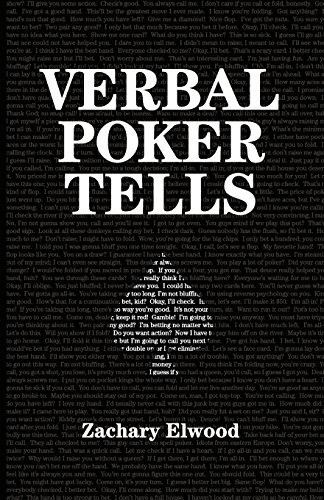
Verbal Poker Tells
- Book Title:Verbal Poker Tells
- Author:Zachary Elwood
- Publication Date:2022-04-15
- Language:English
- Number of pages:232
- Weight:12.8 ounces
Pokercine rating:
4.8 stars
Cracking open “Verbal Poker Tells” by Zachary Elwood is akin to unlocking a treasure trove of poker wisdom, especially for the modern, ambitious player eager to gain an edge in the increasingly competitive realm of poker. Elwood masterfully decodes the art of verbal cues at the poker table, shifting the paradigms of traditional poker tells literature. His approach is analytically rigorous yet surprisingly accessible, making complex psychological insights available to both novices and seasoned players. Whether you’re playing in dimly lit backrooms or bright, bustling casinos, this book offers a fresh perspective on the age-old game, making it a must-read for any poker enthusiast looking to up their game in today’s digital age.
Summary of the content:
Zachary Elwood’s “Verbal Poker Tells” dives deep into the uncharted waters of spoken tells in poker, a territory that, until now, had received scant attention compared to the study of physical tells. The book meticulously catalogues various types of verbal interactions and classifies them into categories that reflect different patterns of deception and honesty. Elwood presents hundreds of real poker hand examples, expertly dissected to unveil how spoken words can betray a player’s hand strength or strategic intentions.
At its core, the book is segmented into easily digestible chapters that focus on specific aspects of verbal communication at the poker table. These chapters address how factors such as speech content, timing, tone, and even word choice can provide invaluable insights into an opponent’s mindset. Elwood encourages players to adopt a holistic view, combining verbal and non-verbal cues to form a more comprehensive understanding of opponents’ behaviors.
Elwood also challenges many prevailing myths about poker tells, providing a nuanced perspective on how to interpret talkative players, silent types, and everyone in between. Beyond mere identification of tells, the book provides practical strategies for leveraging this information to make more informed decisions. Importantly, “Verbal Poker Tells” offers guidance on how to avoid giving away your own tells, a critical skill in maintaining a competitive edge.
Additionally, the book is peppered with anecdotes from Elwood’s personal poker experiences, adding both educational value and entertainment. These stories serve not only to illustrate points but also to remind readers that poker is a game rich in human interaction, where psychological acuity can be as important as technical skill.
Elwood’s analytical yet engaging writing style makes sophisticated concepts accessible, ensuring readers come away with a robust framework for interpreting and utilizing verbal tells. The inclusion of exercises and quizzes at the end of chapters reinforces learning, making the book not just a source of information but a tool for improving one’s game.
“To master poker, one must read beyond the cards.”
Zachary Elwood
Critical analysis:
“Verbal Poker Tells” excels in an area of poker literature that had been relatively overlooked: the intricate world of verbal tells. Zachary Elwood’s comprehensive examination of how verbal cues can betray a player’s intentions sets a new standard for poker strategy books. The strength of this work lies in its methodical approach, offering a meticulously researched guide that’s both practical and insightful.
However, despite its many strengths, the book is not without weaknesses. For some readers, especially those looking for a quick-fix solution to their poker game, the detailed analyses and abundance of examples may feel overwhelming. The depth Elwood goes into could be daunting for casual players who might prefer a lighter read.
Yet, these criticisms are minor when considering the book’s overall contribution to the field of poker strategy. Elwood doesn’t promise easy wins; instead, he offers the tools to develop a keen understanding of an aspect of poker that can significantly impact game outcomes. The book demands active engagement from its readers, challenging them to not only absorb information but also to think critically about the verbal interactions at their tables.
Another minor critique could be the book’s emphasis on live poker scenarios, which might seem less applicable to online players. However, the principles Elwood discusses have underlying universal relevance and can enhance a player’s observational skills in any poker environment.
What you will learn:
By the end of “Verbal Poker Tells,” readers will have gained an arsenal of knowledge on how to detect and interpret the subtleties of verbal communication in poker. Elwood educates players on recognizing patterns in opponents’ speech that signal strength or weakness, understanding the psychological implications behind specific word choices, and deciphering the strategic use of silence.
Readers will learn the importance of context in interpreting verbal tells, as the same statement can have vastly different meanings depending on the situation. Elwood emphasizes the dynamic nature of poker, encouraging players to remain adaptable and to continually reassess their read on opponents’ verbal cues as the game progresses.
Furthermore, the book arms players with strategies to protect their own verbal tells, offering advice on how to cultivate a consistent table talk strategy that minimizes informational leaks. This skill is invaluable, as controlling one’s own verbal cues can significantly deter opponents from gaining insights into your play.
The lessons extend beyond specific tells, fostering a deeper understanding of the psychological underpinnings of poker. Elwood’s insights help players develop a more nuanced approach to the game, where the ability to read and manipulate psychological nuances can lead to a significant competitive advantage.
Why you should read it:
Investing time in “Verbal Poker Tells” is a strategic move for any poker player serious about elevating their game. Beyond the wealth of specific tells and examples Elwood provides, the book offers a primer on the psychological warfare that is integral to poker. This book is not just about learning to detect lies or truths; it’s about developing a keener sense of observation and understanding human behavior in a competitive context.
By reading this book, players will expand their strategic toolkit, gaining insights that are applicable in a wide range of poker situations. The knowledge acquired from Elwood’s analysis can be the edge you need to outsmart your opponents, making “Verbal Poker Tells” a wise investment for anyone looking to become a more formidable player.
Conclusion:
“Verbal Poker Tells” by Zachary Elwood is an essential addition to any poker player’s library, offering deep insights into the nuanced world of verbal cues in poker. With its comprehensive analysis, practical strategies, and engaging writing, it stands out as a significant contribution to poker literature. While it demands active engagement and may be dense for casual readers, its potential to improve one’s game is undeniable. For those willing to dive deep into the aspects of poker beyond the physical cards, Elwood’s work offers invaluable lessons and techniques. Highly recommended for anyone looking to gain a competitive advantage at the poker table.