

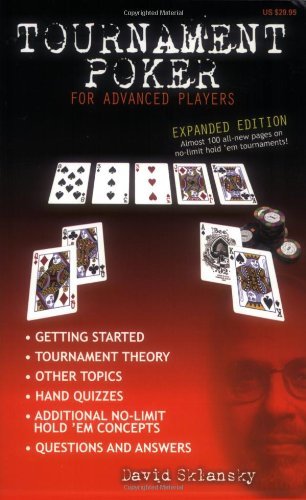
Tournament Poker for Advanced Players
- Book Title:Tournament Poker for Advanced Players
- Author:David Sklansky
- Publication Date:2002-01-01
- Publisher:Two Plus Two Publishing
- Language:English
- Number of pages:317
- Dimensions:6 x 0.7 x 9 inches
- Weight:13.6 ounces
Pokercine rating:
4.5 stars
From the vibrant tables of amateur leagues to the intense showdowns of the professional circuit, “Tournament Poker for Advanced Players” by David Sklansky is nothing short of a master class for those ready to elevate their game. Sklansky, with his profound insights and strategic depth, has tailored this book for the player poised on the brink of greatness, guiding them through the multifaceted world of tournament poker. The readability, coupled with actionable strategies, makes this tome a must-read for modern players. Its unique perspective on navigating tournament play, with nuanced discussions on variance, player psychology, and critical decision-making, makes it resonate with young enthusiasts and seasoned players alike.
Summary of the content:
David Sklansky’s “Tournament Poker for Advanced Players” is a deep dive into the complex world of poker tournaments, exploring essential strategies and concepts critical for succeeding beyond the basics. The book transcends traditional advice, catapulting intermediate players into the advanced realm, focusing primarily on Texas Hold’em tournaments, yet the strategies discussed can often be applied across various poker formats.
At its core, the book dissects the fundamental shift in strategy required to excel in tournament play versus cash games. Sklansky emphasizes the importance of adjusting to the tournament’s evolving dynamics, including changing blinds, tournament phases, and the psychological aspects of playing against a wide array of opponents.
One of the central themes is the Gap Concept, which discusses the significant difference in hand strength needed to call a raise versus making a raise oneself. This concept alone can dramatically alter how players approach tournament play.
Sklansky also introduces the idea of playing hands for two reasons: for its current value and for its future value, highlighting the importance of strategic foresight in tournament success.
The book doesn’t shy away from the finer points of poker, such as the significance of table image, the intricacies of blind stealing, and the subtle art of the semi-bluff. Furthermore, Sklansky dedicates entire sections to the critical stages of tournament play, including early play, the middle stages, and the high-pressure environment of the final table.
Positional play, stack size management, and head-up play are thoroughly explored, providing readers with a comprehensive understanding of how to adjust their game plan based on the dynamic conditions of tournament play.
To round out the strategic discussion, Sklansky presents advanced topics such as risk management, the impact of deal-making, and the psychological warfare that often defines championship-level poker. Through detailed examples and theoretical scenarios, he conveys complex ideas in an accessible manner, making them applicable for aspiring poker champions.
“The key to no-limit hold’em is to put a man to a decision for all his chips.”
David Sklansky
Critical analysis:
The strength of “Tournament Poker for Advanced Players” lies in Sklansky’s ability to distill complex concepts into readable, actionable strategies. His analytical approach demystifies the often intimidating atmosphere of tournament play, equipping readers with the knowledge to make informed decisions. However, the book’s main weakness is its dense nature, which can be overwhelming for those new to advanced poker theory. While it’s targeted at advanced players, beginners might find the leap in complexity daunting, making some sections less accessible.
Moreover, the book’s concentration on Texas Hold’em, while understandable given its popularity, means players looking for insights into other variants might need to look elsewhere. Yet, the strategic principles Sklansky discusses have broad applicability, offering value to those willing to adapt the concepts to different contexts.
Despite these minor caveats, the book’s strengths overwhelmingly outshine its weaknesses. Sklansky’s analytical rigor, combined with practical examples, provides a rare insight into the mindset required to excel in tournament poker. Its exploration of psychological strategies and the emphasis on adaptability underscore the book’s value in a player’s library.
What you will learn:
Readers of “Tournament Poker for Advanced Players” will embark on a comprehensive journey through the world of competitive poker, gaining insights into not just strategic play, but also the psychological and adaptive aspects of the game. Sklansky’s expert analysis shines a light on the importance of position, the pivotal role of stack size, and the delicate balance of risk versus reward in tournament play.
The Gap Concept, one of the book’s foundational themes, will transform how players view hand selection, pushing them to consider not just the strength of their hand but the context in which it is played. This nuanced approach to tournament poker compels players to go beyond basic strategies, challenging them to think several moves ahead.
Additionally, Sklansky’s discussion on the endgame tactics unveils the critical adjustments necessary as players navigate from the initial stages of a tournament to the high-pressure environment of the final table. Understanding the shift in dynamics, from managing a deep stack in the early phases to aggressive, decisive play in the latter stages, is crucial for any tournament player’s success.
The book also demystifies the art of the semi-bluff and the strategic utility of blind stealing, providing readers with a toolkit for incrementally building their chip stack without always relying on the best hand.
Why you should read it:
In the high stakes world of tournament poker, understanding the subtle nuances that differentiate a successful player from the rest is crucial. “Tournament Poker for Advanced Players” offers that and more, acting as a critical resource for players serious about making significant strides in their tournament performance. Engaging with this book means not just learning strategies, but mastering the art of adaptation, making insightful plays based on profound understanding, and excelling under pressure. For anyone committed to excellence in the poker arena, Sklansky’s work is an indispensable guide.
Conclusion:
“Tournament Poker for Advanced Players” stands as a seminal work in the poker literature, offering depth, strategic insight, and a pathway to mastery for advanced players. While the book demands a certain level of pre-existing poker knowledge, its benefits to the dedicated player are immense. Sklansky’s analytical approach, combined with practical examples, offers readers a comprehensive blueprint for tournament success. Ultimately, for those looking to refine their tactical game and deepen their understanding of high-level poker strategy, this book is an invaluable asset.