
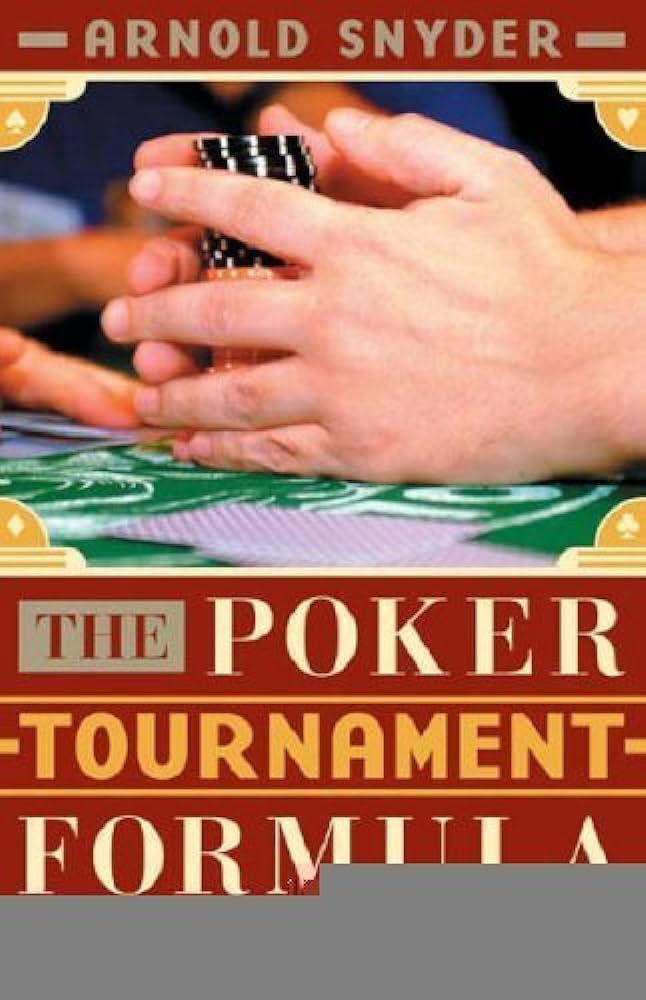
The Poker Tournament Formula
- Book Title:The Poker Tournament Formula
- Author:Arnold Snyder
- Publication Date:December 1, 2006
- Publisher:Huntington Press
- Language:English
- Number of pages:274 pages
- Dimensions:5.5 x 0.6 x 8.5 inches
- Weight:12 ounces
Pokercine rating:
4.5 stars
If you’ve ever dreamed of buying into a poker tournament and not just playing but dominating, “The Poker Tournament Formula” by Arnold Snyder is your go-to manual. Packing a potent mix of strategies and insights, this book is not your average, dry poker guide. It’s injected with Snyder’s seasoned perspectives, making complex concepts accessible to the next generation of poker enthusiasts. He has a way of breaking down intimidating poker strategies into bite-sized, digestible pieces. It’s perfect for young players aiming to make a significant impact in the fast-paced world of poker tournaments. This book is a clear standout in a crowded field, offering something genuinely fresh and valuable.
Summary of the content:
The book plunges deep into the frenetic world of no-limit hold’em poker tournaments, differing fundamentally from the slow, calculated pace of traditional cash games. Arnold Snyder, with his decades of poker expertise, lays out a comprehensive roadmap for navigating these choppy waters. “The Poker Tournament Formula” is divided into detailed sections, each tackling a different aspect of tournament play, from pre-tournament preparation to the final head-to-head showdown.
One of Snyder’s key themes is the importance of speed-adjusted strategies. He reasons that standard poker strategies falter in the fast tournament setting, where blinds increase quickly and you have less information about your opponents. Snyder’s approach pivots on adapting to the pace of play, emphasizing aggression and the art of stealing blinds to build your stack.
The book also dives into the psychological warfare inherent in poker tournaments. Snyder dissects the mindset necessary to thrive, stressing resilience, the ability to read opponents, and the savvy to alter your playing style mid-game. Through real-world examples and hand scenarios, readers gain insight into the multifaceted strategy of poker tournaments, including how to manage variance and the significance of position.
Another poignant theme is bankroll management, a critical component for anyone aspiring to play poker long-term. Snyder’s guidance on selecting tournaments, calculating buy-ins, and navigating through the various stages of a tournament is invaluable for novices and seasoned players alike.
To top it off, Snyder punctuates his technical advice with anecdotes and histories, weaving the rich tapestry of poker’s evolution and the legends who’ve shaped it. This not only enriches the reader’s understanding but also connects them with the broader poker community and its heritage.
“In poker, patience may be a virtue, but in tournaments, aggression is your lifeblood.”
Arnold Snyder
Critical analysis:
“The Poker Tournament Formula” is an ambitious book that seeks to recalibrate how players approach tournaments. Snyder excels in presenting an alternative framework designed for the rapid-fire nature of modern poker tournaments. The book’s strengths are evident in its actionable strategies and the way it empowers players to adapt their game proactively rather than reactively. Snyder’s advice on adjusting to the tournament’s pace, the criticality of stack size management, and the nuances of player psychology are all grounded in solid experience.
However, a potential weakness of the book could be its deviation from traditional poker wisdom, which might not sit well with purists of the game. The aggressive strategies advocated by Snyder, while effective in the environments he describes, may not be universally applicable across all tournament formats. Additionally, the book assumes a certain level of pre-existing poker knowledge, potentially making it less accessible to absolute beginners.
Despite these minor critiques, Snyder’s bold approach injects fresh blood into the conversation around poker strategy, making “The Poker Tournament Formula” a compelling read for those looking to elevate their tournament game.
What you will learn:
In “The Poker Tournament Formula,” readers will unearth a treasure trove of strategies tailored for the high-speed dynamics of tournament play. Snyder’s focus on the crucial aspects of poker tournaments—like the importance of aggression, the art of chip stack management, and the psychological warfare played at the table—equip players with the tools they need to succeed.
Understanding the pace of play and how it influences strategy is a cornerstone of Snyder’s philosophy. He articulates how traditional slow-paced strategies are less effective in tournaments, where blinds increase rapidly, and the pressure mounts. This book provides a solid foundation in adapting to these conditions, emphasizing the strategic shifts needed to thrive.
Moreover, Snyder delves into the psychological aspects of poker, teaching how to read opponents and adjust one’s playstyle on the fly. This insight is crucial for navigating the later stages of tournaments, where the mental game often determines the winners.
Bankroll management is another critical lesson from the book. Snyder gives practical advice on choosing the right tournaments, managing buy-ins, and navigating wins and losses, which is invaluable for anyone looking to make poker more than just a casual endeavor.
Ultimately, readers will learn that success in poker tournaments demands more than just understanding the cards—it requires a comprehensive strategy that adapts to the unique pace and pressure of tournament play.
Why you should read it:
Poker is not just a game of luck but a complex strategic battle requiring skill, intuition, and adaptability. “The Poker Tournament Formula” by Arnold Snyder is an essential read for anyone looking to transition from casual play to serious tournament competition. It offers a fresh perspective on strategy that’s specifically tailored for the high-speed, high-pressure environment of poker tournaments. This book doesn’t just improve your game; it transforms your approach, making you not just a player, but a contender. For those committed to elevating their poker prowess, ignoring Snyder’s insights could mean missing out on valuable strategies that could be the difference between busting out early and making it to the final table.
Conclusion:
“The Poker Tournament Formula” is more than just a poker strategy book; it’s a comprehensive manual for navigating the treacherous waters of competitive poker tournaments. Arnold Snyder’s unique approach, combining aggressive play with psychological warfare and strategic adaptability, sets it apart from traditional poker guides. Whether you’re a novice looking to make your mark in the world of poker tournaments or a seasoned player seeking to refine your strategy, this book offers valuable insights. Its blend of anecdotes, strategies, and practical advice makes it an engaging read. In a game where the right knowledge can turn the tides, “The Poker Tournament Formula” is a key addition to any poker player’s library.