

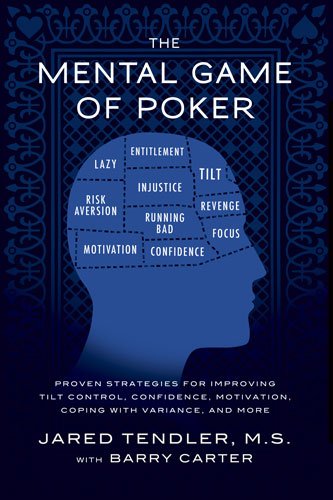
The Mental Game of Poker
- Book Title:The Mental Game of Poker
- Author:Jared Tendler and Barry Carter
- Publication Date:The Mental Game of Poker’s publication date
- Publisher:The Mental Game of Poker’s publisher
- Language:The Mental Game of Poker’s language
- Number of pages:The Mental Game of Poker’s number of pages
- Dimensions:The Mental Game of Poker’s book dimensions
- Weight:The Mental Game of Poker’s book weight
Pokercine rating:
4.5 stars
Imagine sitting at the poker table, chips stacked, cards in hand, but something’s not right. Your heart races, mind spirals, and suddenly, your A-game slips away. Enter “The Mental Game of Poker” by Jared Tendler with Barry Carter, a beacon for those adrift in the psychological tumult of poker. This isn’t just another book about poker strategy; it’s a lifeline to mastering the unspoken, often overlooked, mental battlegrounds of the game. Dive deep into the minds of Tendler and Carter as they arm you with the strategies to weather the storms of tilt, fear, motivation, and confidence. A must-read for the next-gen players seeking to not only understand the cards but the mental prowess required to wield them effectively.
Summary of the content:
Jared Tendler’s “The Mental Game of Poker”, co-authored by Barry Carter, transcends the typical boundaries of poker literature by diving into the cognitive aspects influencing a player’s performance. Over the span of its insightful chapters, this groundbreaking book dissects several core mental hurdles that gamers face: tilt, fear, motivation, confidence, and dealing with variance. Unlike traditional poker guides focusing on the technical intricacies of pot odds or hand ranges, Tendler and Carter offer a refreshing lens, examining the psychological battles fought before, during, and after each session at the felt.
At the heart of this work is the recognition of ’tilt’—not just as sporadic outbursts of frustration but as a complex psychological process that can undermine a player’s decision-making and, subsequently, their overall success. Tendler doesn’t just identify the problem; he provides a toolkit for managing emotional swings and states, ensuring that readers can maintain their A-game consistently.
The segment on fear dissecting the anxieties associated with risking money, making mistakes, or playing against formidable opponents, enlightens readers about recognizing these fears and methods to overcome them. Here, the book transitions from identifying psychological vulnerabilities to actively engaging strategies to mitigate their impact.
A crucial theme of motivation explores what drives players to endure the grind, how to sustain or rediscover lost enthusiasm, and the significance of setting realistic, achievable goals. Insightful discourse on confidence, alongside practical advice on cultivating a genuine sense self-assurance, further sets this book apart, making it an essential guide for those looking to thrive under pressure and bounce back from setbacks.
Moreover, Tendler tackles the topic of variance, a phenomenon often misinterpreted by many players, leading to incorrect conclusions about their skill level and strategic choices. Through the lens of “The Mental Game of Poker”, variance is not a foe to be feared but a constant to be managed through logical, disciplined play and psychological resilience.
The book rounds off with innovative concepts like ‘The Adult Learning Model’, ‘The Inchworm Concept’, and detailed, interactive exercises. These not only fortify the theoretical foundations laid but also encourage direct application, facilitating tangible improvements in the reader’s mental game.
“Mastering your mental game is the ultimate edge in poker.”
Jared Tendler
Critical analysis:
“The Mental Game of Poker” strides into an arena often left uncharted by poker guides, offering a profound exploration of the psychological dimensions crucial to a player’s success. Tendler’s expertise as a mental game coach shines through each page, presenting an astute analysis of common cognitive pitfalls and delivering actionable solutions with clarity and precision. His collaboration with Barry Carter ensures that these complex psychological discussions remain grounded, accessible, and immensely practical for poker players across all levels.
The book’s strength lies in its holistic approach to tackling the mental challenges of poker. Instead of superficial fixes or motivational platitudes, readers are treated to a deep dive into the mechanics of the mind. The exhaustive exploration of tilt—one of the most debilitating mental blocks in poker—is particularly noteworthy. The strategies proposed are not merely theoretical but are backed by tangible exercises and examples that readers can implement in their gameplay.
However, one could argue that the deep psychological focus might somewhat overshadow the technical aspects of poker. Complete novices might find the book a steep climb without a basic understanding of poker fundamentals. Moreover, the detailed emphasis on psychological concepts requires readers to engage with an open mind and a willingness to introspect, which may not align with the expectations of those seeking quick-fix strategies.
Despite these considerations, “The Mental Game of Poker” remains an indelible contribution to poker literature, challenging the conventional norms and directing the spotlight onto the mental battlegrounds where true poker prowess is forged.
What you will learn:
“The Mental Game of Poker” is a treasure trove of insights for players eager to elevate their game beyond the physical cards and chips. The first lesson is in understanding and combating tilt, where readers learn not just to identify their triggers but to develop robust mental routines to prevent tilt from hijacking their decision-making process. It teaches the art of emotional regulation, ensuring players remain rational and focused under pressure.
The concepts of fear and confidence are dissected to unveil their profound impact on a player’s ability to take calculated risks and play aggressively when the situation demands. Tendler’s guidance empowers readers to face their fears, be it the fear of losing money or the dread of making mistakes, and transform these fears into strengths.
Through engaging discussions and exercises on motivation, the book equips players with strategies to sustain their passion for the game, set realistic goals, and consistently work towards achieving them. The teachings on dealing with variance offer a refreshing perspective, encouraging players to embrace it as an integral part of the game, thereby fostering resilience and a more analytical approach to decision-making.
The book is not just about overcoming mental blocks; it’s about building a mental framework that supports continuous learning and improvement. Whether it’s developing a deeper understanding of one’s own psychological profile or mastering the ability to learn from every hand—regardless of the outcome—readers finish the book equipped with the mental fortitude to navigate the intense, often chaotic world of poker.
Why you should read it:
The mental aspect of poker is frequently underestimated, yet it’s the territory where the game is truly won or lost. “The Mental Game of Poker” is your guide to conquering this domain. It equips you with the psychological tools and strategies to maintain your equilibrium in the face of adversity, maximize your learning from every session, and turn psychological vulnerabilities into strengths. Whether you’re struggling with tilt, grappling with fear, or seeking to cultivate a winner’s mindset, this book delivers. It’s an investment in your poker career that extends far beyond the felt, offering life lessons in resilience, discipline, and the pursuit of excellence.
Conclusion:
In conclusion, “The Mental Game of Poker” by Jared Tendler and Barry Carter is a must-read for anyone serious about improving their poker play. It goes beyond the conventional strategy to address the mental and emotional components that influence every decision at the table. With its in-depth analysis, practical exercises, and actionable advice, the book offers a comprehensive guide to mastering the mental challenges of poker. Whether a novice looking to start on solid footing or a professional seeking to maintain their edge, this book is an invaluable resource for developing the mental toughness required to succeed in the competitive world of poker.